In today’s real estate market, relying on referrals and cold calls isn’t enough. To truly succeed, you need to be found by people who are actively looking to buy or sell. Real estate SEO is the solution that helps your business stand out and proves you’re a trusted expert.
This guide provides a beginner-friendly yet powerful framework for mastering real estate search engine optimization.
Whether you’re a seasoned broker or just starting out, understanding these fundamentals can transform your online presence and, most importantly, grow your business.
In This Article
What Is Real Estate SEO?
Real estate SEO is about making your website and online content rank higher on search engines like Google. When someone searches for terms like “homes for sale in [your city]” or “best real estate agent near me,” you want your website to show up high on the list. The higher you are, the more people visit your site and the more chances you have to get new clients.
It’s not just about adding keywords to your content. (Keyword stuffing is a big SEO no-no!) It’s about creating a smooth and useful experience for both users and search engines. This includes:
- Writing valuable content
- Making technical fixes
- Promoting your website
In short, real estate SEO is about making search engines see you as a trusted expert in real estate. In return, search engines rank your website higher, clients find you more easily, and you generate more business.
Why Is SEO Crucial for Real Estate Agents?
SEO for real estate agents is a non-negotiable. It’s a tough market out there, and optimizing your website is the only way to win more buyers and sellers. Here’s why real estate SEO is a must-do:
- More Visibility and Leads: Most home buyers and sellers start their journey online. If your website isn’t showing up, you’re missing out on a huge group of potential clients. Good SEO makes sure your listings are seen by people who are actively looking for them.
- Builds Trust and Credibility: Websites that rank high on Google are often seen as more trustworthy and reliable. When you consistently appear at the top, it tells people you are a knowledgeable professional.
- Cost-Effective Marketing: Compared to traditional ads, SEO offers a better return on your money. It takes time and effort, but the free traffic you get from SEO leads to a steady flow of clients without ongoing ad costs.
- 24/7 Marketing: Your website works for you around the clock. Even when you’re not working, your optimized content is attracting and informing potential clients.
- Targeted Audience Reach: SEO lets you target specific areas. By using local keywords (like “homes for sale in [your city]”), you can attract clients who are specifically interested in properties in your service area, which leads to better leads.
Simply put, investing in SEO is investing in the long-term growth of your business. It provides a strong online base that brings in new clients with zero ad spend.
Beginner-Friendly SEO Plan for Real Estate Agents
Now that we understand the “why,” let’s talk about the “how.” Here are the core parts to focus on for a good real estate SEO strategy:
1. Keyword Research: The Foundation of Visibility
Every effective SEO strategy starts with keyword research. And while it might be tempting to go after the popular, high-volume keywords, that’s typically not the best approach. (This is particularly true if you have a new website or low domain authority.)
Instead, your focus should be understanding what your specific clients are searching for. Then, using those phrases in your content.
Your goal is to find words that are important to your services, are searched for often enough, and aren’t too competitive.
Think about these types of keywords:
- Broad Keywords: These are general terms like “real estate.” While they’re searched a lot, they’re also very competitive and won’t attract the best leads.
- Long-Tail Keywords: These are more specific phrases, like “3 bedroom homes for sale in [City] with a big yard.” They’re searched less often but attract people who are serious about buying or selling, which leads to better conversions.
- Local Keywords: For real estate, local SEO is a must. People are searching for properties and agents in specific areas. Examples include “[City] real estate agent” or “homes for sale [Neighborhood].” Adding these to your content is vital for attracting local clients.
- Question-Based Keywords: Many users ask search engines questions. Think about phrases like “how to sell my house fast.” Creating content that answers these questions shows you’re an expert and attracts users early in their search.
Keyword Research Tools
Several tools can help you find real estate keywords, including Google Keyword Planner, Semrush, Ahrefs, and Moz Keyword Explorer. These tools give you keyword ideas, display how often they are searched, and show the competition.
My personal favorite keyword research tool is LowFruits.
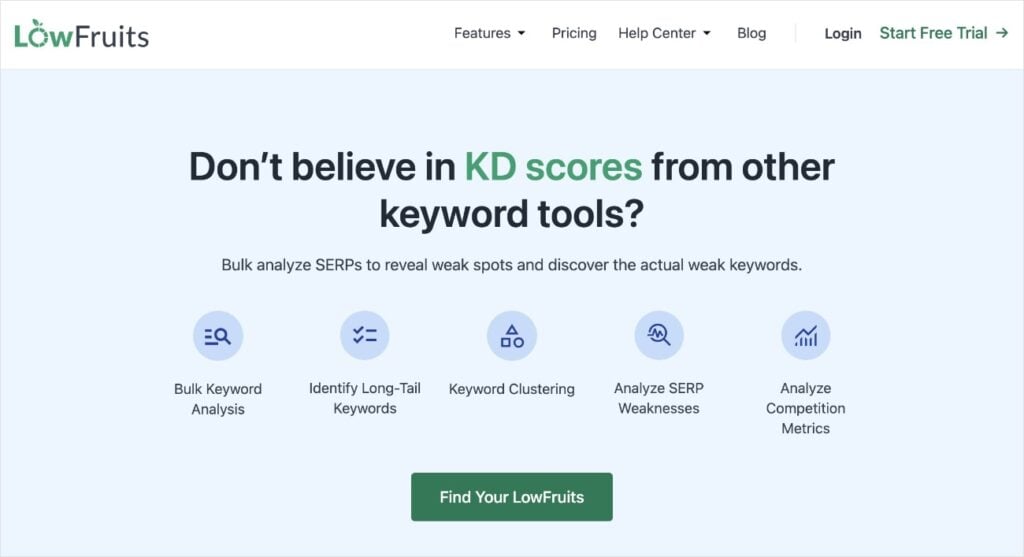
LowFruits streamlines keyword research so you can find easy ranking opportunities more quickly. It was designed specifically for small businesses, so they can compete with bigger domains.
For real estate agents, the LowFruits KWFinder reveals low-competition keywords that are ideal for targeting. In the example below, we see a report for the seed keyword “chicago real estate.” It includes over 2K easy keywords.
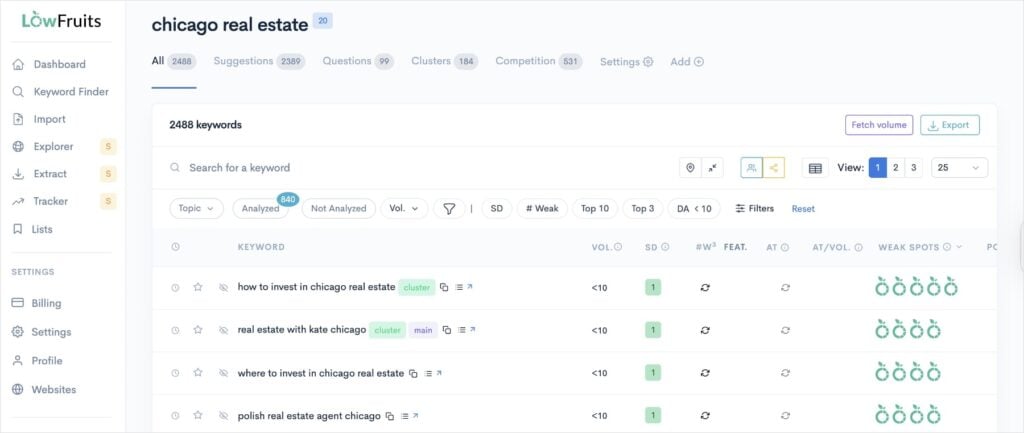
You also get the following keyword metrics:
- Search Volume: The average number of searches per month.
- SERP Difficulty:This metric represents the keyword difficulty. 1 is easy, 2 is medium, and 3 is hard.
- Weak Spots: Each icon represents a low-authority domain ranking in the top 10 search results.
By looking for and targeting keywords with decent volume, low difficulty, and multiple Weak Spots, you’ll increase your changes of ranking high in search engine results pages (SERPs).
To learn more, see this tutorial on how to do real estate keyword research.
Pro Tip: Look at what keywords your competitors are ranking for. This can give you great ideas and new opportunities for your own strategy. Here are two resources to make this process easy:
2. On-Page SEO: Optimizing Your Website’s Content
Once you have your keywords, the next step is to use them on your website.
On-page SEO includes all the changes you make directly on your website to help it rank better and give users a good experience. This includes:
Title Tags & Meta Descriptions
These are the first things clients see in search results. Your SEO titles should be catchy and include your keywords. Meta descriptions should be a short summary that encourages clicks.

For character counts, keep SEO titles under 60 characters and meta descriptions between 140-160 characters.
You can also use SERP preview tool to see how your metadata looks before publishing a page.
I’ve been doing SEO for 6+ years and still use SERP previews for every single piece of content. Getting your metadata right is super important for improving your organic click-through rate (CTR).
High-Quality Content
This is the most important part of any real estate search engine optimization strategy.
Your website should have useful and engaging content. This includes detailed property descriptions, guides for neighborhoods, blog posts about trends, and local market reports.
For example, this article by Engel & Volkers tells readers why they should invest in an exclusive new waterfront property in Dubai Islands. Not only is this development an exciting update in the Dubai real estate market, but it’s also a strategic use of copywriting to connect its international customer base with the real estate agency via a free consultation.
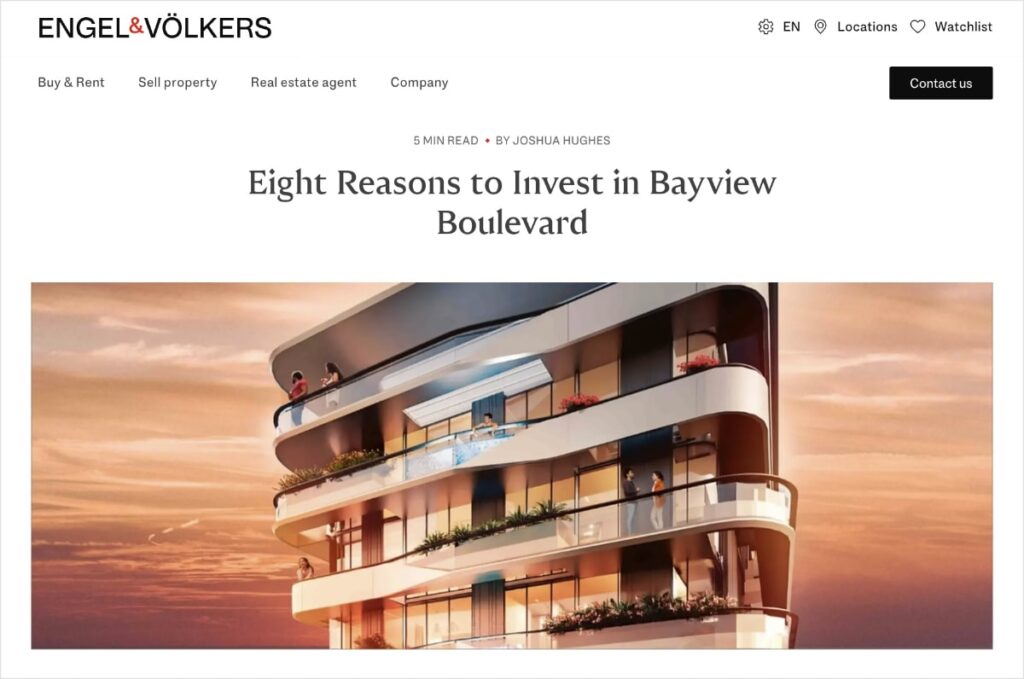
Ultimately, the more helpful your content, and relevant to your specific market, the better your user engagement metrics will be.
User engagement metrics, like bounce rate and time on page, tell search engines that users find your content valuable. This is critical for ranking high for the terms you want in Google.
Keyword Placement
Where you put your keywords matters. Your focus keyword (your most important keyword) should go in the following areas:
- SEO title
- Meta description
- URL slug
- Introduction
- Subheadings
- Body copy
- Conclusion
So, basically, everywhere. BUT, don’t go overboard.
As I mentioned in an earlier section, you do not want to keyword stuff. This is an old, black hat SEO tactic that doesn’t work anymore.
In fact, modern search engines will penalize you for it. So, keep it natural, but consistent. The goal is to make your content good for people first, search engines second.
Image SEO
Images are important for real estate websites. Unfortunately, many real estate agents don’t realize that they need to optimize them for search engines.
So, they look pretty on the site, but do nothing for your SEO.
I’m going to help you change this.
Image SEO is the practice of optimizing your images so search engines can understand—and rank— them in search results. And the good news is that it’s really simple to do.
There are 3 main elements you want to optimize for your images:
- Image filename: What you save and upload the image as (e.g., “nyc-real-estate-agent-bio-pic.jpg” is better than “img10248.jpg.”)
- Alt text: This is a text description of the image. Screen readers can use it to describe the image to visually impaired users. Search engines can read it, too.
- Captions: If your image needs it, you can add a caption. This provides additional context. It’s not required for all images, though.
Let’s look at an example.
Here’s a blog post from Foxtons titled, “how do I handle multiple offers on my home?”

Their primary keyword is “multiple offers.” Let’s see how they optimized this image:
- Filename: multiple-offers/1600.jpg
- Alt text: How do I handle multiple offers on my home?
- Caption: Not needed
This is a pretty good use of their focus keyword in their image optimizations. My one recommendation would be to change the alt text a bit.
As I mentioned above, screen readers use alt text to describe images to visually impaired users. That’s why it’s your job to make sure these users can get an accurate idea of what an image contains.
For the above featured image, I would have made the alt text: “Interior view of a home with dining room overlooking the garden, with a text overlay that reads ‘how do I handle multiple offers on my home?”
This version gives an actual description of the image while still incorporating the title and keyword.
Internal Linking
Internal links are hyperlinks from one page of your website to another page. The key is that all these links are on your website.
The idea is to connect related content, making it easier for users and search engines to discover new content.
For example, a blog post about selling your home could link to your seller’s guide page. This helps search engines find your content and keeps users engaged on your site for longer.
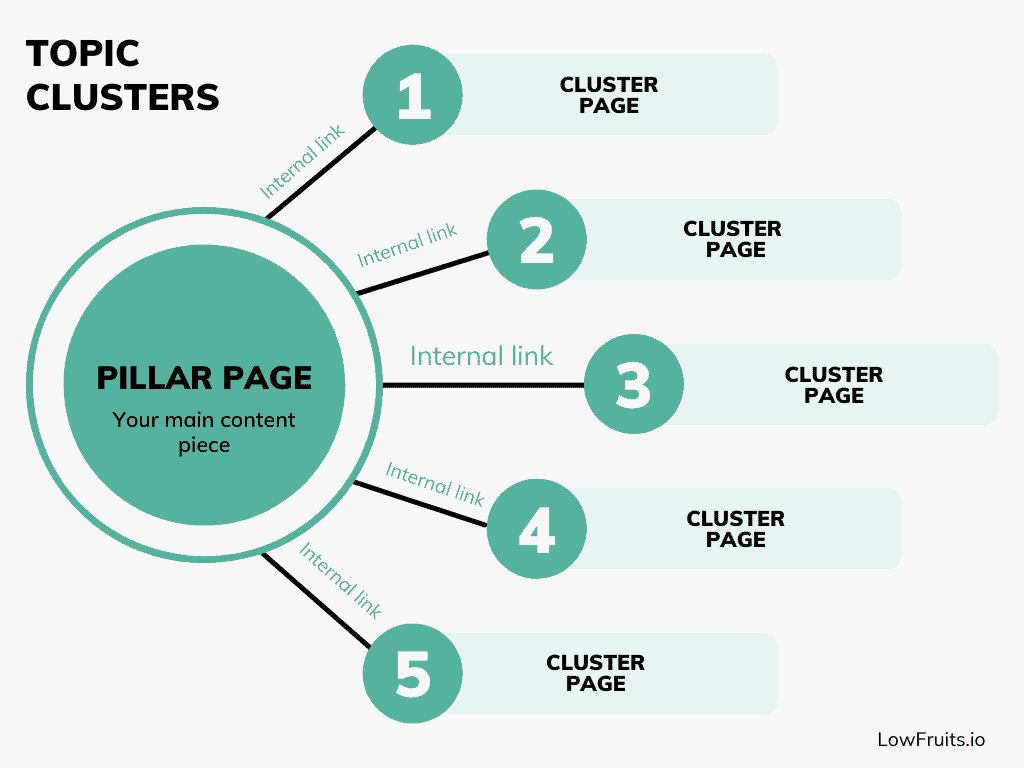
An SEO best practice is to include internal links between your pillar page and cluster pages.
Pillar content is your main content hub (for example, the seller’s guide). Cluster pages are smaller subtopics that go in greater detail. Both pages should link to one another.
This strategy supports topic clusters, which group related content together and build topical authority.
Check out this guide on how to create topic clusters to boost your SEO.
The other facet of internal linking is to use appropriate anchor text.
Anchor text is the hyperlink text you use to describe the content you’re linking to. It should be accurate, descriptive, and concise.
By using these internal linking best practices, you’ll be well on your way to becoming a trusted resource in the real estate space.
User Experience (UX)
Last, but certainly not least, is user experience (UX).
A website that’s easy to use is also easy for search engines to understand. That’s why it’s so important for users and bots to be able to navigate and crawl your website with ease.
Some tips include:
- Having a clear menu
- Using appropriate subheadings
- Linking to related content
- Including images for visual interest
As you may have noticed, we covered a lot of these items already when discussing on-page SEO. That’s because they’re pretty easy optimizations that you’ll find yourself doing naturally to improve your content.
A good UX will keep people on your site longer, which is critical for connecting with your clients and getting conversions.
3. Local SEO: Dominating Your Local Market
For real estate agents, local SEO is perhaps the most important part of your growth strategy.
Most real estate deals happen in a specific area, and clients are often searching for properties or agents nearby. Optimizing for local search makes sure you appear high on the list when someone in your area is looking for real estate help.
Here’s how to master local SEO:
Google My Business (GMB)
Your Google My Business profile is often the first thing clients see. This appears when users click your business listing from search results.
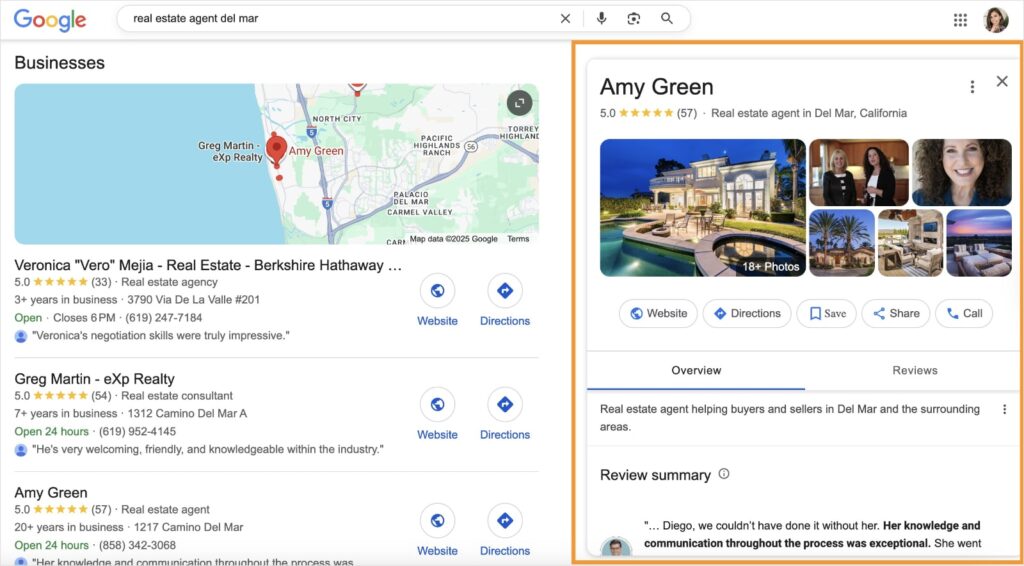
Make sure your profile is complete, accurate, and regularly updated with your name, address, phone number, and photos.
Ask clients for reviews and respond to all of them. This greatly helps your visibility.
Did you know? NAP stands for name, address, and phone number. NAP SEO is the practice of optimizing all your online profiles to have the same NAP details so search engines view your business as trustworthy.
Local Citations
Get your business listed across all available real estate networks.
Your NAP details should be the same across all online directories (like Yelp and Zillow). Wrong information can confuse search engines and hurt your rankings.
Other popular real estate platforms include:
- Redfin
- Trulia
- Realtor.com
- Homes.com
Location-Specific Pages
If you serve multiple neighborhoods, create a separate page for each one. These pages should have local content, like details about the neighborhood, local amenities, and market trends.
Local Keywords
As mentioned before, add location-specific keywords naturally into your content and property descriptions. You can do this by creating property listings with descriptive H1 tags, optimized metadata, and SEO-friendly URLs.
Also, don’t forget about image SEO! Image optimizations are another great opportunity to include keywords and rank for your targeted terms.
Optimzed images can also help you rank in Google Images, where there are over 1 billion searches every day.
Online Reviews
Reviews are a signifcant factor for local SEO. They’re also critical to the reputation of your business.
Positive reviews build trust with clients and tell Google that your business is reliable and in demand.
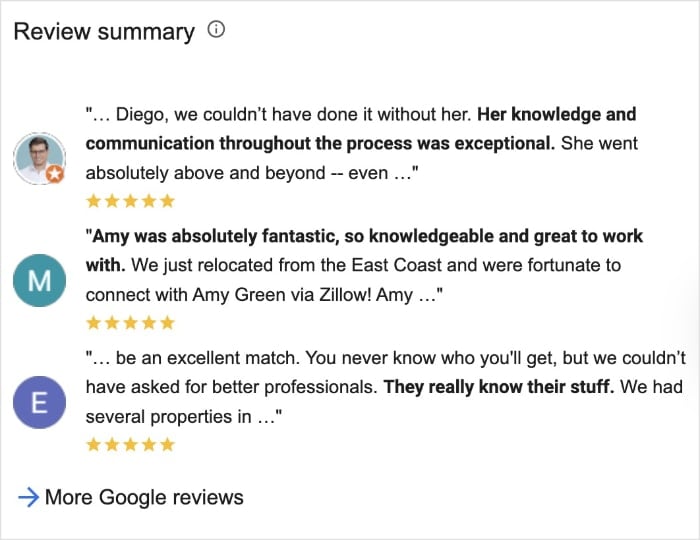
Make it easy for clients to leave reviews after you help them. You can do this by directing them to your website, Google Business Profile, or online review platforms like Yelp.
Ultimately, by focusing on these local SEO strategies, you can make sure your real estate business is the first one potential clients in your area find when they start their property search.
4. Content Marketing: Becoming a Thought Leader
Content marketing is what drives real estate search engine optimization.
It’s about creating useful, relevant content to attract and keep an audience. For real estate, this means becoming a trusted source of information for buyers, sellers, and investors.
Here’s how good content marketing helps your SEO efforts:
- Blog Posts: Regularly write high-quality blog posts that answer common questions or provide market insights. Each post is a chance to target new keywords and show your expertise.
- Neighborhood Guides: Create detailed guides for the neighborhoods you serve. These are very useful for clients and are great for local SEO.
- Video Content: Video is very popular, especially in real estate. Make video tours of properties, neighborhood spotlights, or Q&A sessions. Videos can be put on your website and shared on social media to get more traffic.
- Infographics and Visuals: Take complicated real estate data and turn it into simple infographics. Visual content is engaging and can attract links when others share your useful information.
- Case Studies and Testimonials: Share success stories from past clients. This builds trust and provides unique, keyword-rich content.
- Market Reports: Show that you are a market expert by publishing regular reports on local housing trends. This kind of content is very helpful and can get a lot of free traffic.
Remember, the goal of content marketing is not just to rank for keywords, but to provide real value to your audience. When you consistently offer helpful content, you become an authority, which naturally improves your rankings and attracts more qualified leads.
Content Optimization Tools
You don’t have to figure out how to do content optimizations on your own. There are different tools you can use to streamline the content creation process. Some good options include Hemingway App, Clearscope, and Surfer.
My favorite is SEOBoost. It has a word processing platform that provides SEO feedback as you write.
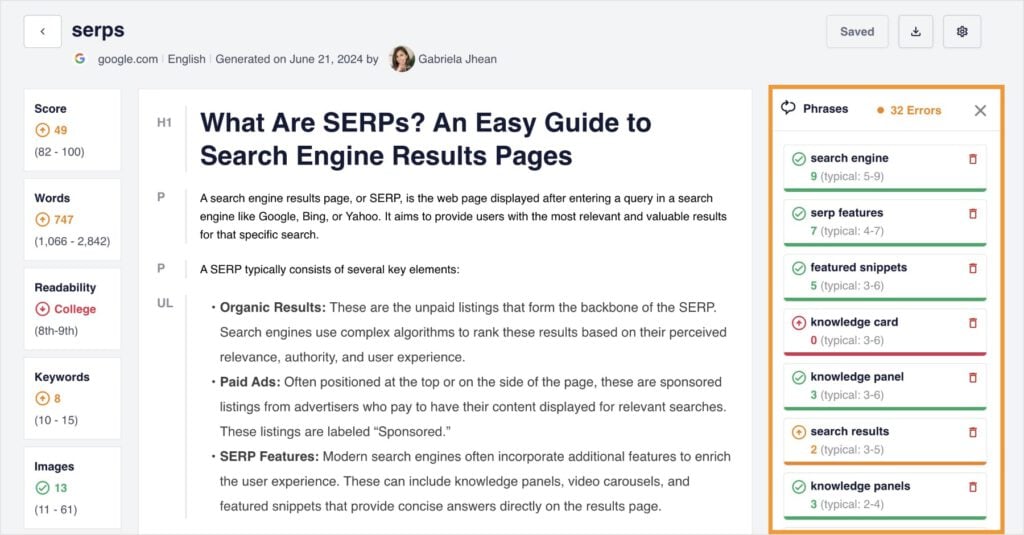
It also suggests related keywords that you can incorporate into your content to improve its visibility in search results.
Or, if you’re a WordPress user, you can use All in One SEO plugin. It integrates with SEOBoost to provide the same feedback directly in the WordPress editor.
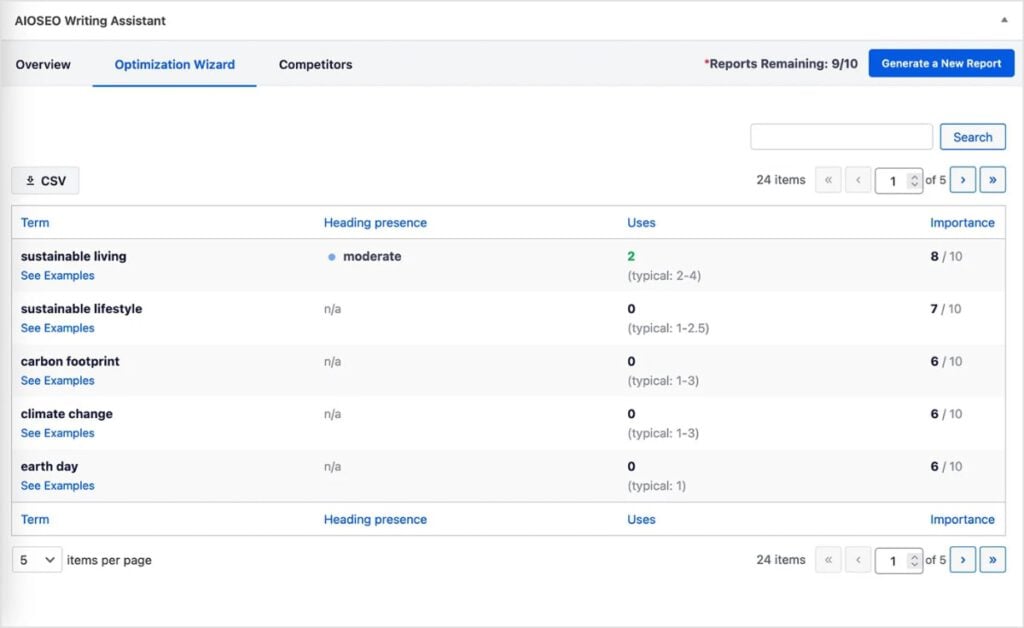
For even more software recommendations, check out my picks of the best SEO content optimization tools.
5. Technical SEO: Improving Site Performance
While content and keywords are vital, even the best content won’t rank if search engines can’t understand your website. This is where technical SEO comes in.
Technical SEO focuses on the parts of your website that you don’t see to make sure it meets the rules of modern search engines.
Key parts of technical SEO include:
- Site Speed and Mobile-Friendliness: In a mobile-first world, a fast website that works well on phones is a must. Google prefers sites that work smoothly on all devices. Tools like Google PageSpeed Insights can help you find and fix problems.
- Website Structure: A well-organized website helps both users and search engines find information easily. Use a logical order for your pages and make sure important pages are easy to get to.
- XML Sitemaps: An XML sitemap is a file that lists all the important pages on your site. This helps search engines find and look at your content better.
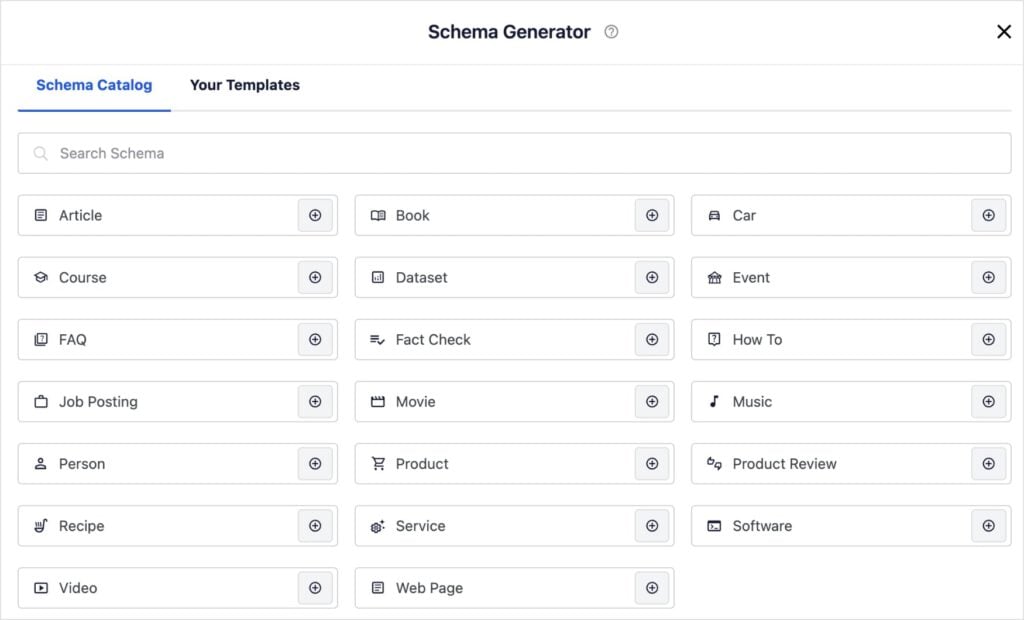
- Schema Markup (Structured Data): Schema markup is a type of code you add to your website to help search engines better understand your content. For real estate, this can include details like price, address, number of bedrooms, and property type. This can make your listings stand out in search results.
- SSL Certificate (HTTPS): Security is a top priority. Having an SSL certificate encrypts data, making your website more secure. Google prefers secure websites, so make sure your site has one.
Fixing these technical parts ensures that your website is not only good for users but also fully optimized for search engines, which is a strong base for SEO success.
Technical SEO Tools
There are a lot of different tools you can use to monitor your site’s technical performance.
- Google Search Console is great for getting insights into how users interact with your website.
- Screaming Frog analyzes up to 500 URLs for free and lists out all technical issues like missing metadata, duplicate titles, and too-large images.
- PageSpeed Insights tells you how fast your web page loads and gives you a Core Web Vitals report.
- All in One SEO can help you add XML sitemaps and structured data easily to your site. (See screenshot below for the schema catalog.)
6. Link Building: Building Authority and Trust
Link building is the process of getting other reputable websites to link to your website.
In the eyes of search engines, these links are like votes of confidence, showing that your website is trustworthy.
Here are some good ways to get links for real estate:
- Guest Blogging: Write useful articles for other real estate blogs or local news websites. In return, you can often get a link back to your own site.
- Local Partnerships: Work with local businesses (like mortgage brokers or home inspectors) and link to their websites in exchange for them linking back to yours.
- Sponsor Local Events: Sponsoring a local event or charity can often get you a link from their website. This is a great way to help your community and improve your SEO.
- Create Shareable Content: Make valuable content like infographics or market reports that people will naturally want to link to.
- Testimonials and Reviews: If you use tools or services for your business, offer to give a testimonial in exchange for a link back.
Remember, quality is more important than quantity when it comes to links. A few good links from trusted sites are better than many spam links.
Focus on building real relationships and creating content that others want to link to. This will improve your reach and build your reputation.
Staying Ahead: Trends in Real Estate SEO
Now that you’ve got the basics down, let’s see how you can future-proof your real estate SEO strategy.
Here are a few key trends to watch in the digital landscape:
- Voice Search: With more people using smart speakers, it’s important to optimize your content for voice search. Think about how people speak, not just how they type.
- AI and Machine Learning: AI is playing a bigger role in search. Using AI SEO tools to help you analyze data or create content can give you a big advantage.
- Video Content: Video is now a must-have for online marketing. From virtual property tours to Q&A sessions, videos are engaging and can boost your online footprint.
- Focus on User Experience (UX): Google has made it clear that a good user experience is very important. A fast, easy-to-use website will rank higher.
- Hyperlocal Content: As competition grows, the need for very specific local content becomes even more important. Focus on neighborhoods and even specific streets to attract local clients.
By staying on top of these trends, you can make sure your organic growth plan stays effective and continues to get results.
Conclusion: Your Path to Real Estate SEO Success
In the world of real estate, a strong online presence is no longer a luxury—it’s a must. By using the power of SEO for real estate agents, you’re not just making your website better; you’re:
- Building a steady stream of leads
- Establishing yourself as a trusted expert
- Growing your business
Remember, SEO is an ongoing process. It takes consistent effort and a real commitment to providing value. But the rewards—more visibility, better leads, and a thriving real estate career—are worth it.
FAQs About Real Estate SEO
What is SEO in real estate?
Real estate search engine optimization (SEO) is the process of optimizing your website to rank higher in search results for keywords used by home buyers and sellers. It focuses on attracting free, high-quality traffic from people actively looking for real estate services.
How to do SEO for a real estate website?
To do SEO for a real estate website, you should focus on 3 key areas: keyword research, on-page SEO, and local SEO. Start by finding relevant keywords that your audience uses. Then, create high-quality content optimized with those keywords. Finally, build your local authority through a Google Business Profile and local citations. There’s also technical SEO and link building that can improve your visibility even further.
Can I improve my real estate SEO?
You can improve your real estate SEO by consistently creating helpful and authoritative content for your website. Start by targeting low-competition, long-tail keywords. This will help you get found online, build trust, and drive more traffic and leads. Then, you can tackle bigger, higher-volume keywords once you’ve established domain authority.