Are you a real estate agent struggling to get found online? The truth is, without the right real estate keywords, your website might as well be invisible. You could have the most beautiful listings and the best local knowledge, but if potential buyers and sellers can’t find you, your business will struggle to take off.
This guide is designed to solve that problem.
I’ll give you a powerful head start with a list of top-performing real estate keywords and a simple process to find even more. You’ll not only have a robust keyword list but also the skills to continuously uncover new opportunities and dominate your local market.
Let’s dive in.
In This Article
What Is Real Estate SEO?
Real estate SEO is the process of optimizing your website to rank in search engine results pages (SERPs) for relevant real estate keywords. It’s more than just listing your properties online. It’s a strategic effort to get found by people in your local area who are actively searching for homes, market information, or a trusted agent.
Unlike some other businesses, a successful real estate SEO strategy is highly localized. It’s about building trust and authority in your specific neighborhood or city, ensuring that when someone searches for a house in your area, your website is the first place they find.
Why Are Real Estate SEO Keywords Important?
Real estate keywords are the bridge between your potential clients and your business. They’re the exact words and phrases people type into Google when they have a question or are ready to take action.
Without the right real estate SEO keywords, you’re missing out on a massive stream of free, high-quality traffic. The right keywords allow you to:
- Attract the Right Leads: Target users who are actively looking for homes or thinking about selling, not just browsing.
- Establish Authority: By creating content that answers your audience’s questions, you position yourself as the local expert.
- Beat the Competition: Many agents are only targeting generic, highly competitive terms. By using low-competition keywords, you can capture traffic from people they’re overlooking.
Now, let’s get into the best real estate keywords.
100 Best SEO Keywords for Real Estate
This list of real estate keywords is categorized to help you attract various types of leads. Use these to inspire your website content, blog posts, local SEO efforts, and even your social media strategy.
General Real Estate Keywords
These keywords often answer specific questions or address broader real estate topics.
- real estate
- real estate agent near me
- residential real estate
- commercial real estate
- real estate license
- real estate lawyer
- best realtor in [City, e.g., Dallas]
- real estate developer
- real estate agent salary
- realtor
- how much does a real estate agent make
- capital gains tax on real estate
- real estate courses
- real estate market
- real estate jobs
- real estate investment
- real estate companies near me
- real estate appraiser
- real estate broker
- real estate attorney
- real estate law
- top real estate companies
- how to invest in real estate
- real estate investment trusts
- real estate news
Keywords for Buyer Leads
These keywords target people actively looking to buy a home or researching the buying process.
- homes for sale [City]
- houses for sale [City]
- condos for sale [City]
- townhomes for sale [City]
- new homes for sale [City]
- luxury homes for sale [City]
- foreclosures for sale [City]
- open houses [City]
- just listed homes [City]
- cheap homes for sale [City]
- homes with land for sale [City]
- waterfront homes for sale [City]
- beach homes for sale [City]
- homes with ocean view [City]
- homes with a pool [City]
- homes with large yard [City]
- first time home buyer programs [City]
- how to buy a house in [City]
- best neighborhoods to live in [City]
- [City] real estate listings
- [City] housing market
- buy a home [City]
- real estate agent for buyers [City]
- pre-approved for mortgage [City]
- mortgage calculator
Keywords for Seller Leads
These keywords target homeowners considering selling their property or researching the selling process.
- sell my house [City]
- what is my home worth [City]
- home valuation [City]
- how to sell my house fast [City]
- best real estate agent to sell house [City]
- real estate agent for sellers [City]
- selling a home in [City]
- steps to selling a house [City]
- how to increase home value [City]
- prepare home for sale [City]
- listing agent [City]
- real estate market report [City]
- average home price [City]
- cash home buyers [City]
- selling without a realtor [City]
- for sale by owner tips [City]
- closing costs for sellers [City]
- selling a rental property [City]
- when is the best time to sell a house [City]
- probate real estate [City]
Long-Tail & Hyperlocal Keywords
These target specific neighborhoods, areas, or unique property types within your service area. These are often the most valuable keywords because they have high-purchase intent. Remember to replace [Neighborhood] and [Type] with your specific details.
- homes for sale in [Neighborhood, e.g., Leucadia]
- real estate [Neighborhood]
- [Neighborhood] homes with [Feature, e.g., 4 bedrooms]
- condos in [Neighborhood]
- commercial real estate [City]
- industrial property for sale [City]
- land for sale [City]
- investment properties [City]
- rental property management [City]
- fixer upper homes [City]
- farm houses for sale [City]
- historic homes for sale [City]
- waterfront property [City]
- luxury apartments [City]
- lofts for sale [City]
- studio apartments [City]
- duplexes for sale [City]
- triplex for sale [City]
- multi-family homes [City]
- vacant land for sale [City]
- new construction homes [City]
- green homes for sale [City]
- eco-friendly homes [City]
- smart homes for sale [City]
- senior living communities [City]
- retirement homes [City]
- active adult communities [City]
- horse properties [City]
- equestrian estates [City]
- golf course homes [City]
How to Go Beyond the List (And Beat Your Competition)
Having a list of real estate keywords is a great start. You can immediately begin using these terms in your blog posts, website copy, and local business listings.
However, the real estate market is constantly evolving, and your competition isn’t sitting still. The most valuable keywords for your specific niche—the ones that your competitors might be overlooking—often aren’t on any list you’ll find readily available online.
These are the unique, long-tail phrases that can bring highly motivated buyers and sellers directly to your website.
To truly dominate your local market and stay ahead, you need a repeatable process to find these hidden gem keywords. That’s where keyword research tools come in.
I’ll show you exactly how I use one of my favorites, LowFruits, to uncover these opportunities.
How to Find Real Estate Keywords With LowFruits
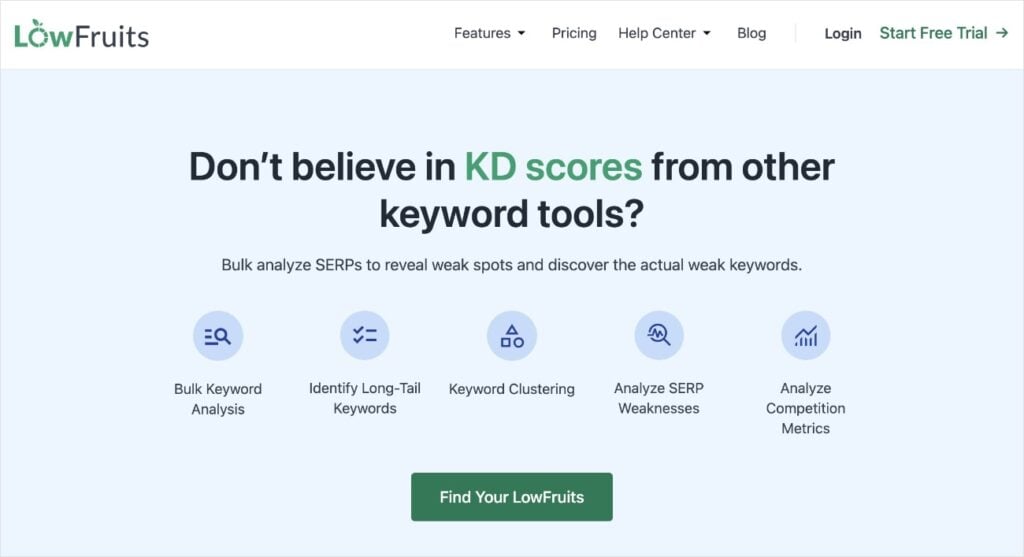
LowFruits is a keyword research and SERP analysis tool designed for small businesses. Unlike other generic SEO tools, it focuses on uncovering long-tail keywords that you can actually rank for.
This approach is ideal for local businesses and real estates agents who might not have high domain authority or massive SEO budgets.
Here’s the process I use when looking for real estate keywords for clients:
Step 1: Start With a Broad Seed Keyword (Your Core Market)
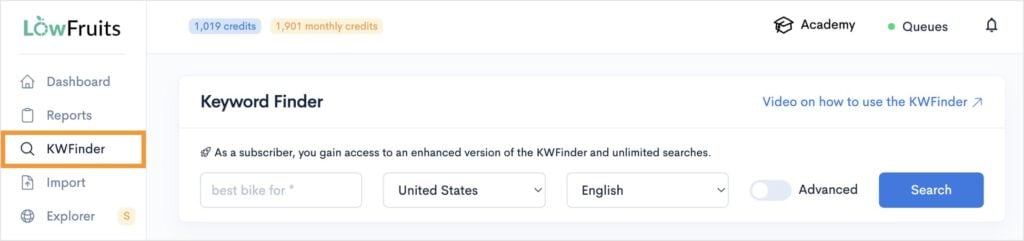
First, you’re going to navigate to the KWFinder tool located in the left menu. Then, you’re going to identify your primary service area. This could be your city, a popular neighborhood, or a county.
From here, enter your primary service area + a real estate term you’re interested in, like “real estate” or “homes for sale [City].” For our tutorial, I’ll enter “chicago real estate.”
You can adjust the country and language if needed.
Once you’ve clicked Search, LowFruits will ask you how you want to view your keyword report.
You can either:
- Access all keywords (and select which ones to analyze manually).
- Access all keywords + analyze all high-intent keywords (keywords with high conversion potential).
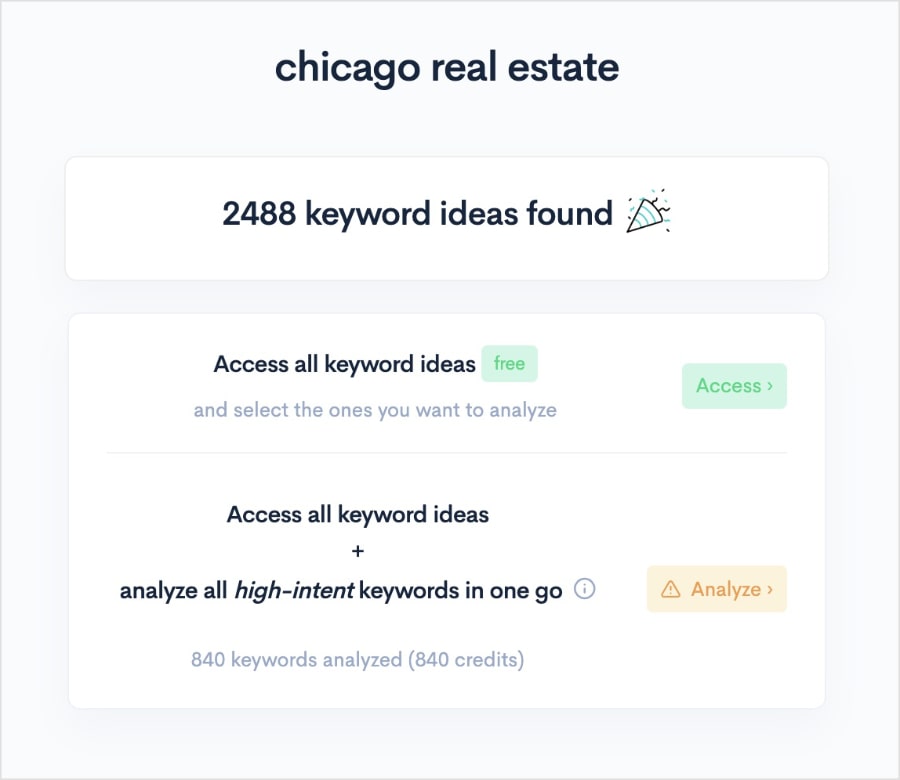
I like to pick the second option because it’s faster. However, if you’re low on LowFruits credits, you can always select the first option.
LowFruits uses a credit system to analyze keywords. 1 keyword analyzed = 1 credit.
Once your report is ready, your Keyword Finder dashboard will look like this:
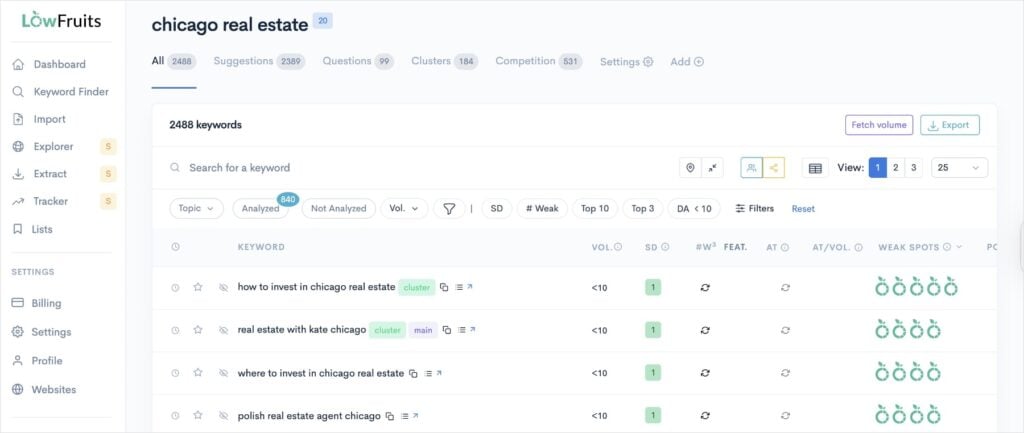
Here’s a quick overview of the most important keyword metrics:
- Keyword Search Volume: The average monthly search volume based on your geographical settings.
- SERP Difficulty Score: The LowFruits metric for keyword difficulty. 1 is easy, 2 is medium, and 3 is hard.
- Weak Spots: Each icon represents a low-authority domain ranking in the top 10 search results.
Now, let’s see how you can use this report to pick the best real estate keywords for search engine optimization.
Step 2: Filter for Low-Competition Keywords
For this step, we’re going to start applying filters. They’re really easy to use in LowFruits.
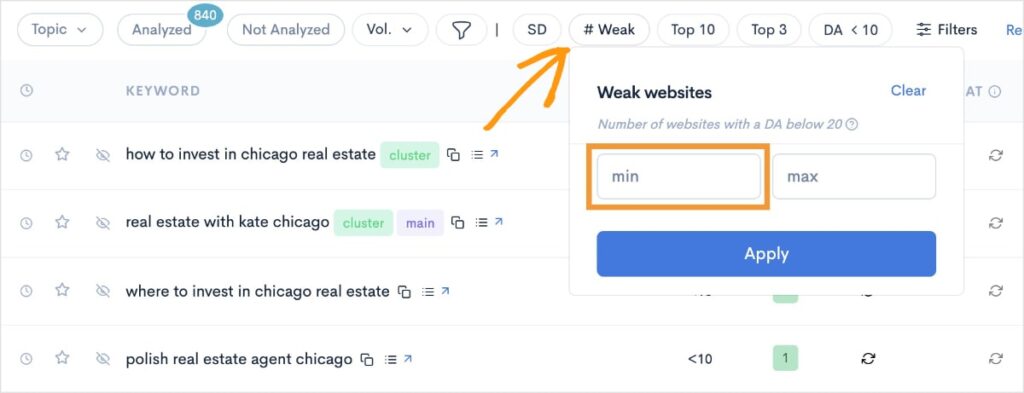
First up is the number of weak websites (Weak Spots). Open this filter, and set the minimum to 2.
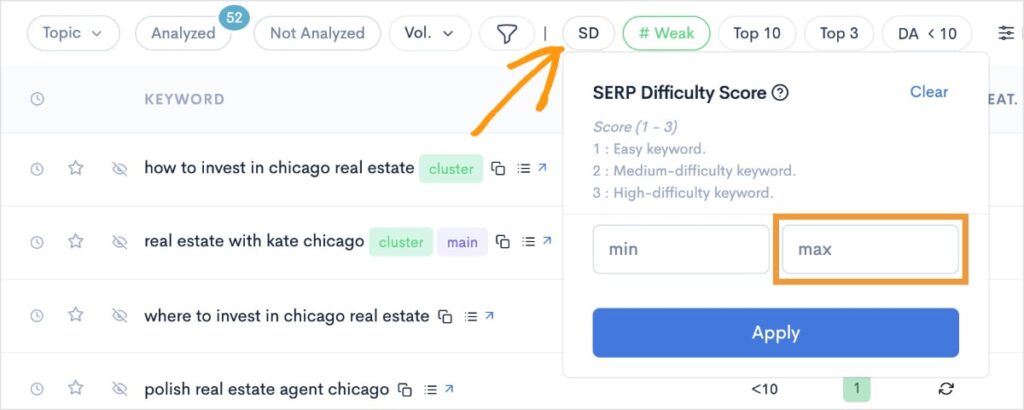
Next, click the SD (SERP Difficulty) filter, and set the maximum to 1.
Finally, click the Volume (Vol.) header to sort the keywords by descending search volume.
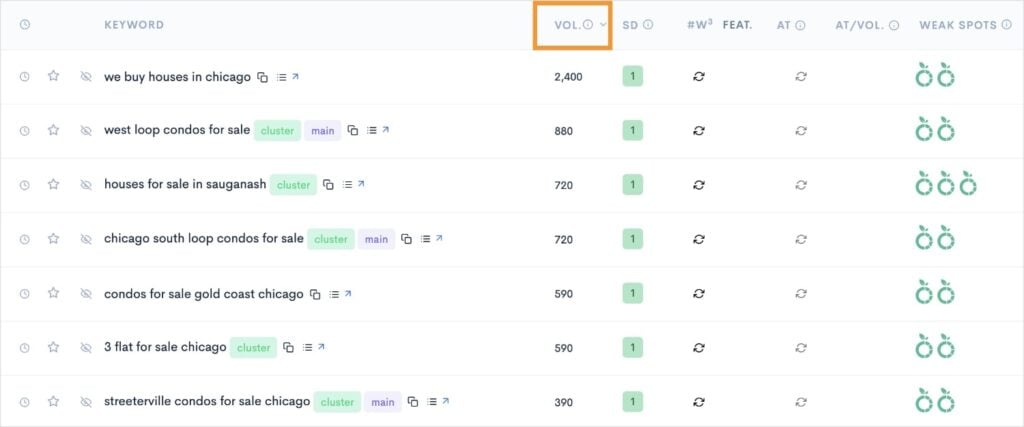
Now, you’ll have a list of real estate SEO keywords that:
- Have good search volumes
- Are low difficulty (1 SD score)
- Have multiple Weak Spots (at least 2)
These are easy keywords that are relevant to your business and location. At LowFruits, we like to call them “low-hanging fruit” because they’re ripe for taking.
Step 3: Analyze the SERPs for Search Intent
Don’t just grab keywords and start writing blindly. Understanding what’s currently ranking helps you create better content.
This is why it’s important to do a SERP analysis.
A SERP analysis tells you what users and search engines are looking for regarding a specific query. You can do one manually by entering your keyword into Google and analyzing the results, or you can do it right in LowFruits.
In LowFruits, click View the SERP next to your keyword of interest.
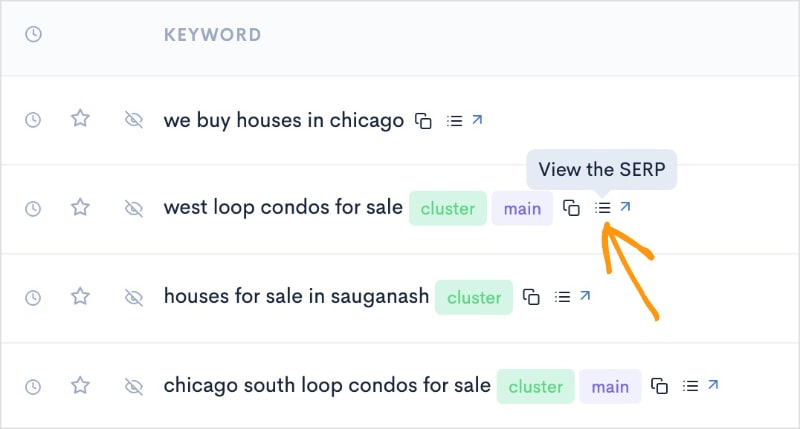
This action will open a pop-out window of the current top 10 search results in Google.
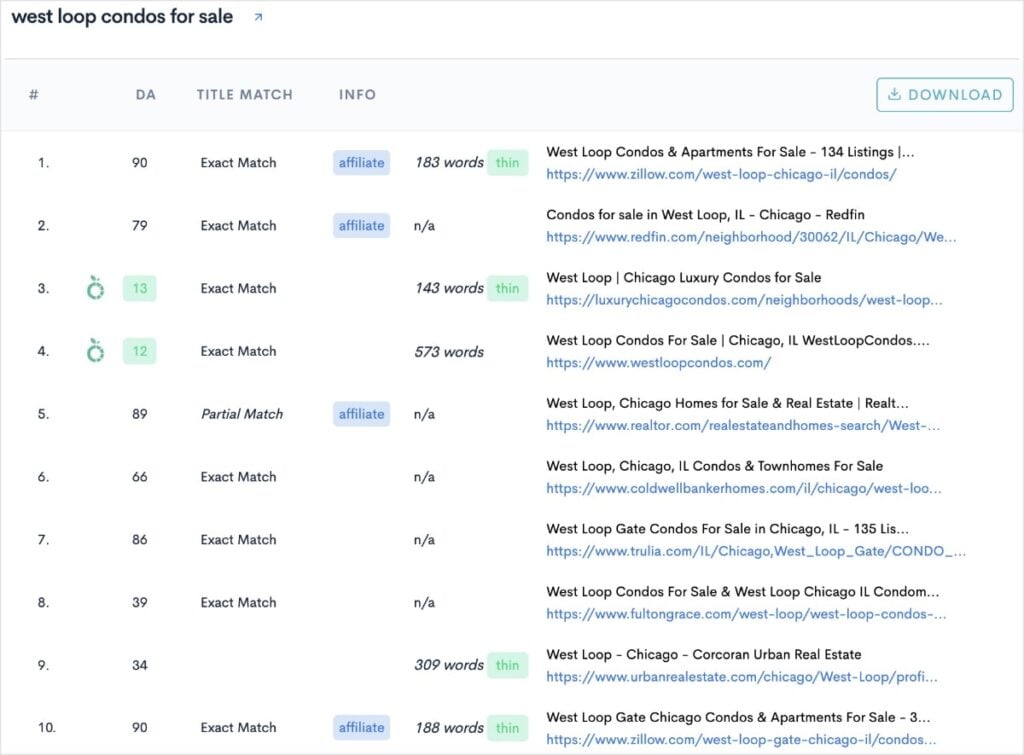
You can explore this content to see what type of content is ranking (e.g., blog posts, listing sites, local business pages).
In this example, we see that landing pages for condos in the West Loop are the main content type. If we were targeting this keyword, we’d want to create the same (but better).
Why it works: This process helps you understand the user’s intent—are they looking for information, or are they ready to buy or sell? Creating content that aligns with where they are in their real estate journey will win you more clients and traffic.
Step 4: Explore Related Questions and Clusters
This is where you unearth the hidden gems that truly drive qualified leads.
Go to the Questions tab at the top of your keyword report. This will open a list of questions related to your main keyword.
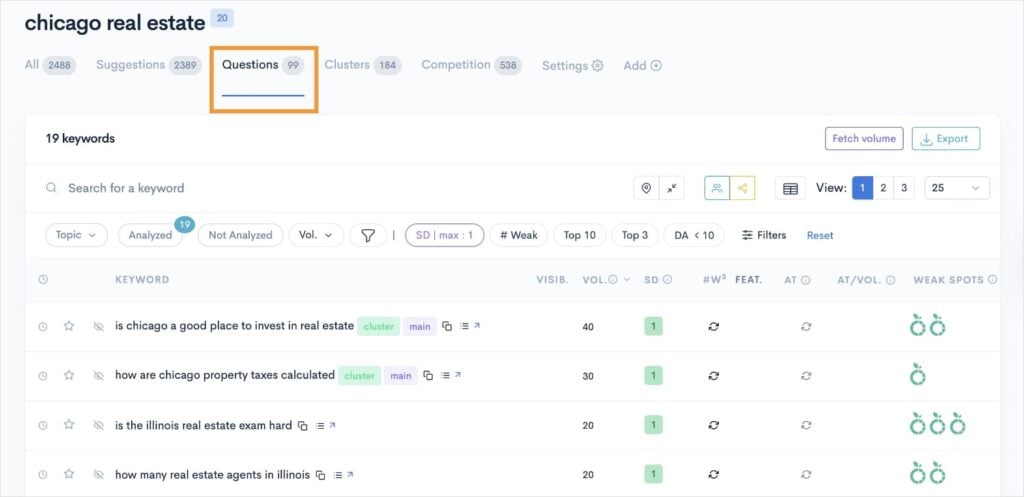
These are actual questions people are typing into Google. I recommend weaving these questions into your content for the best results.
Did you know? Targeting question keywords is one of the most effective ways to rank in Google People Also Ask. This section of the SERP showcases popular user questions near the top of search results. Ranking here is great for boosting trust and visibility.
You should also check out the Clusters tab. This section organizes related keywords and groups them together automatically for you.
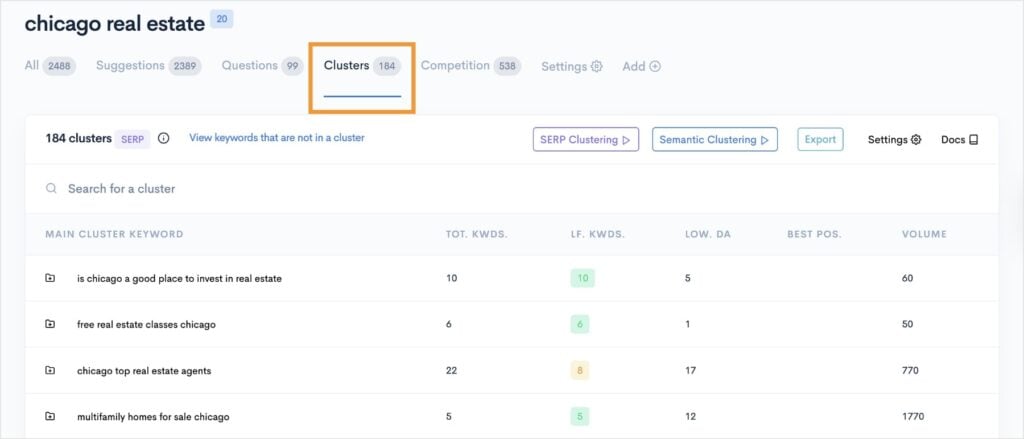
Topic clusters are the cornerstone of an effective real estate SEO strategy. They help you target multiple keywords on the same web page, increasing its visibility in search results. They also ensure that you’re covering a topic in its entirety through separate articles and pages.
Step 5: Map Keywords to Your Content Strategy
If you used the LowFruits Clustering tool in our last step, you’re already half way done with step 5. The idea is to organize your keywords together based on shared search intent.
The second half of this process is to categorize these keywords into the following themes:
- Buyer-focused
- Seller-focused
- Hyperlocal
- Property types
- Any others you want
You can use a spreadsheet for this step.
Once you’ve organized them by theme, decide which keywords will become dedicated blog posts, which will be integrated into existing pages, and which might inspire a new pillar page.
Need help figuring out what type of content to create? Refer back to step 3 and revisit the SERP analysis stage to see what type of content performs well in search.
Why it works: A clear content map ensures you’re systematically targeting your audience at every stage of their real estate journey.
By following this process, you’ll move beyond a generic list and build a powerful, custom-tailored real estate keyword strategy that moves the needle for your business.
Final Thoughts
Finding the right real estate keywords doesn’t have to be a guessing game. You now have a clear starting point with our list of 100 keywords, ready to be deployed across your website.
More importantly, you’ve learned a repeatable process for uncovering even more keyword opportunities using tools like LowFruits. This blend of ready-to-use keywords and actionable knowledge empowers you to find your niche and attract the exact clients you’re looking for.
Stop hoping clients will find you. Start using these real estate SEO keywords and this proven process to ensure they do.
Real Estate Keyword Research FAQs
Is real estate keyword research different from regular keyword research?
Yes, real estate keyword research is different from regular keyword research. For real estate agencies, keyword research is highly localized and focuses on high-intent, long tail queries rather than search volume. Unlike general keyword research, it prioritizes finding the right client by targeting neighborhood-specific terms and understanding the multi-stage buyer’s journey.
What are the best SEO keywords for real estate?
The best SEO keywords for real estate are a mix of high-intent terms and niche-specific, long-tail phrases. They include transactional keywords like “homes for sale [City],” informational keywords such as “how to sell my house fast,” and hyperlocal keywords like “condos for sale in [Neighborhood].” The most effective keywords have high commercial intent and align with what a user is ready to do.
What are good keywords for a real estate website?
Good keywords directly align with your audience’s needs and include terms for buyer leads, seller leads, and commercial intent. Examples are “what is my home worth,” “best neighborhoods to live in [City],” and specific property types like “waterfront homes for sale.” The best websites use these keywords to serve their audience throughout the buying or selling process.
How do you create keyword lists for real estate agents?
Real estate agents can easily create keyword lists by using keyword research tools. Tools like LowFruits, Semrush, and Ahrefs provide extensive keyword ideas and metrics to help you prioritize which keywords to target. Begin with a general seed keyword search, then look for long-tail keywords unique to your area. You can also organize your list into buyer and seller keywords. The key is to serve every type of visitor with your keywords.