Let’s be honest: building a keyword strategy from scratch can be overwhelming, especially for those new to SEO.
You know keywords are important (everyone keeps saying so!), but what are you actually supposed to do with them? And how do you even know which ones will drive traffic and conversions?
Many business owners find themselves facing a similar challenge.
The good news is you don’t need a massive budget or years of SEO experience to create a keyword strategy that works.
In this guide, I’m going to share the exact keyword strategy I use to help my content, and those of clients, rank in top search results. And it only takes 8 beginner-friendly steps.
In This Article
What Is a Keyword Strategy?
A keyword strategy is a research-driven plan to target the search terms your customers use. The goal is to identify and use these keywords in your content to connect with your audience in search engine results pages (SERPs).
It’s important to note that a keyword strategy is not just about finding popular queries.
An effective keyword strategy considers how phrases and terms align with your specific business goals. This approach guides your content creation efforts and produces a higher keyword ROI.
Pillars of an Effective SEO Keyword Strategy
Building a successful SEO keyword strategy is like constructing a house. You need a solid foundation to support the entire structure.
Let’s break down the 3 essential pillars that will make your keyword strategy rock-solid and results-driven.
1. Understanding Your Audience
Here’s the thing about keywords: they’re not just search terms — they’re windows into your audience’s minds.
Every search query represents a real person with a specific need, question, or problem they’re trying to solve. Understanding your audience means getting inside their heads and figuring out how they think, what language they use, and what keeps them up at night.
Start by creating detailed buyer personas for your customers. Think beyond basic demographics. Instead, dive into their pain points, goals, and the exact words they’d use to describe their challenges.
A marketing professional might search for “content marketing strategy,” while a small business owner might type “how to get more customers online.” Same goal, different language.
Once you understand your audience, you can:
- Anticipate their search behavior.
- Refine your keyword strategy.
- Create content that resonates.
Ultimately, it’s the difference between casting a wide net and fishing with precision.
2. Analyzing the Competition
Competitive analysis empowers you to find gaps and opportunities in your market.
Start by identifying your main competitors (both direct business competitors and websites who rank for your target keywords). Analyze their content, keyword targeting, and ranking positions.
What keywords are they ranking for that you’re not? Are there topics they’re covering that you could approach from a different angle?
Ultimately, you should look for keywords where your competitors are vulnerable.
LowFruits makes this easy by revealing “Weak Spots” in SERPs. These are low-authority domains ranking in the top 10 search results, aka weak competitors.
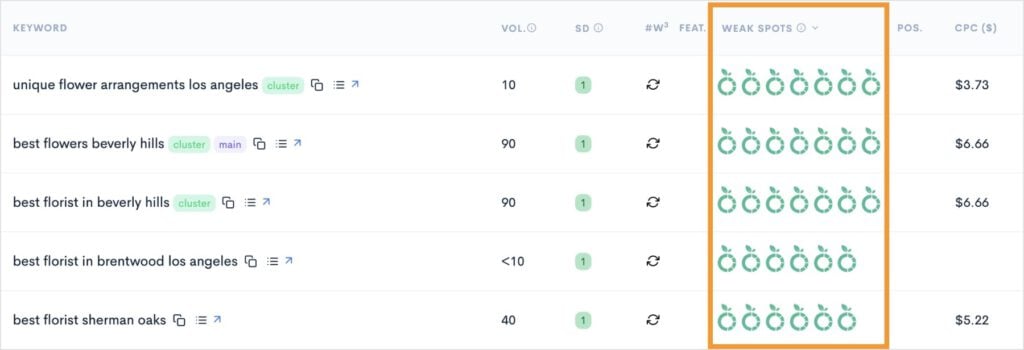
When you find keywords with multiple Weak Spots, these are low-hanging fruit, prime for ranking.
3. Leveraging Topic Clusters
Gone are the days when you could rank by targeting individual keywords in isolation. Today’s SEO landscape rewards comprehensive topical coverage through topic clusters.
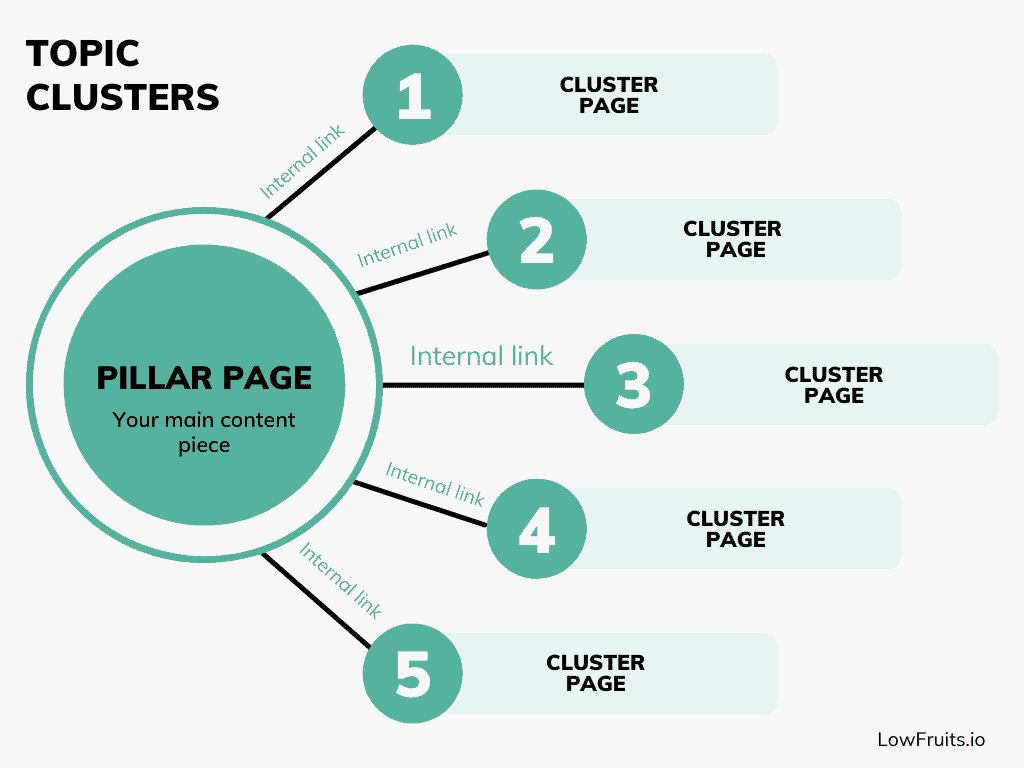
Topic clusters are groups of related keywords with shared search intent. They’re one of the best kept SEO secrets of digital marketers, but in reality, they’re easy enough for anyone to use.
The idea is to create an interconnected network of related articles (with the appropriate keywords) to cover a subject in its entirety. This signals to search engines that you’re an authority on the subject.
Topic clusters use a hub-and-spoke model to build this authority. You use internal links to connect the related content and help users and search engines discover relevant URLs.
How to Create a Winning Keyword Strategy in 8 Simple Steps
Alright, enough theory. Let’s get into the practical stuff.
Here’s your step-by-step guide to creating a keyword strategy that actually works:
Step 1: Define Your SEO Goals
Before you start researching keywords, you need to know what you’re trying to achieve. Are you looking to:
- Increase brand awareness?
- Drive more traffic?
- Boost online sales?
- Get more local customers?
- Generate more leads or email sign-ups?
Your goals will determine which types of keywords you should target and how you’ll measure success.
When setting these SEO goals, use the S.M.A.R.T. framework. This means to create goals that are:
- Specific
- Measurable
- Achievable
- Relevant
- Time-bound
For example: “increase organic traffic by 50% in six months” or “rank in the top 3 for 10 target keywords within the next quarter.”
These concrete goals will keep your keyword strategy focused and give you clear SEO benchmarks for success.
Step 2: Brainstorm Keyword Ideas
Now comes the fun part: brainstorming.
Start with seed keywords (broad terms related to your business) and expand from there. Think about how your customers describe your products or services, what problems they’re trying to solve, and what questions they frequently ask.
Use the “question method” to generate ideas. For each seed keyword, ask yourself:
- What would someone search for if they were just learning about this topic?
- What about someone ready to buy?
- What specific problems are they trying to solve?
This approach helps you capture keywords across the entire customer journey.
Don’t forget about conversational keywords either.
With voice search becoming more popular, people are using more natural, long-tail queries. Instead of just “WordPress hosting,” they might search for “what’s the best WordPress hosting for small businesses.”
Jot these down to use in our next step.
Step 3: Use Keyword Research Tools
While brainstorming gives you a place to start, keyword research tools provide the data you need to make informed decisions.
Tools like LowFruits, Google Keyword Planner, Semrush, or even free alternatives can reveal search volumes, competition levels, and related keyword suggestions.
At this step, you’ll enter your keyword ideas into the tool of your choice.
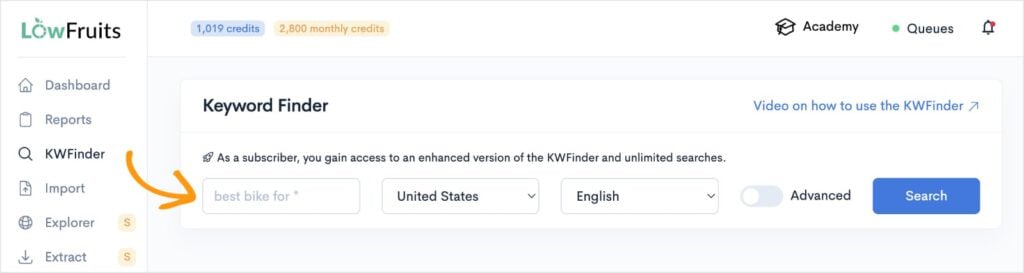
Pro Tip: Don’t just focus on high-volume keywords. Those 10K+ monthly searches might look tempting, but competition will be fierce. As a new or small site, you’ll have a tough time ranking. Instead, look for lower competition and decent search volume.
Pay special attention to keyword difficulty scores and SERP features. If a keyword triggers featured snippets, image packs, or local results, factor that into your strategy.
These features can either provide opportunities (if you can capture them) or make ranking harder (if they push organic results down the page).
Step 4: Identify Easy Ranking Opportunities
Every keyword strategy should include some quick SEO wins. These are keywords you can realistically rank for in the near term.
They’re typically long-tail keywords with lower competition, questions your audience asks, or topics your competitors haven’t covered thoroughly.
Look for keywords where the current ranking pages have obvious weaknesses. Maybe the top result is outdated, lacks depth, or doesn’t fully answer the search query. These represent opportunities where you can create better content and capture those rankings.
LowFruits makes finding these ranking opportunity easy.
When you’re in the KWFinder tool, you’ll get a report that looks like this:
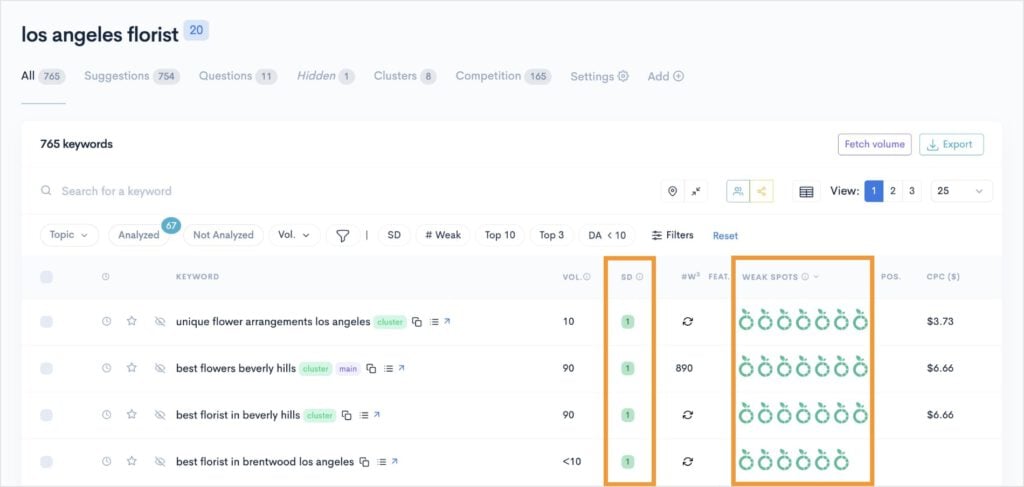
Pay particular attention to the following metrics:
- SERP Difficulty Score (SD): This is the LowFruits metric for keyword difficulty.
- Weak Spots: Each icon represents a low-authority domain ranking in the top 10 search results. These are weak competitors you can outrank.
By looking for keywords with low difficulty and multiple Weak Spots, you’ll find quick and easy SEO targets for your content.
Step 5: Match Keywords to Content Type
Not all keywords are created equal, and they don’t all deserve the same type of content.
Understanding search intent is crucial for creating content that ranks and converts. There are four main types of search intent:
- Informational: Users want to learn something.
- Navigational: Users are looking for a specific place or page.
- Commercial: Users are exploring products or services, but not ready to buy.
- Transactional: Users are ready to take action.
Each intent require a different type of content to serve the user in that moment of their buyer’s journey.
The good news is determining what kind of content matches the keyword intent is easy. All you have to do is look at what’s already ranking.
Users and Google have already determined the type of content they’re looking for. You just need to look through the top results to see how you can serve those needs.
There are a few ways you can do this:
Method 1: Perform a Google Search
This method is straightforward. In fact, you’re probably doing it on a daily basis already.
Open up Google, and enter a keyword you’re interested in. For this example, I typed “best surfboard for kids to learn on.”
After scrolling past the sponsored ads, these were the results:
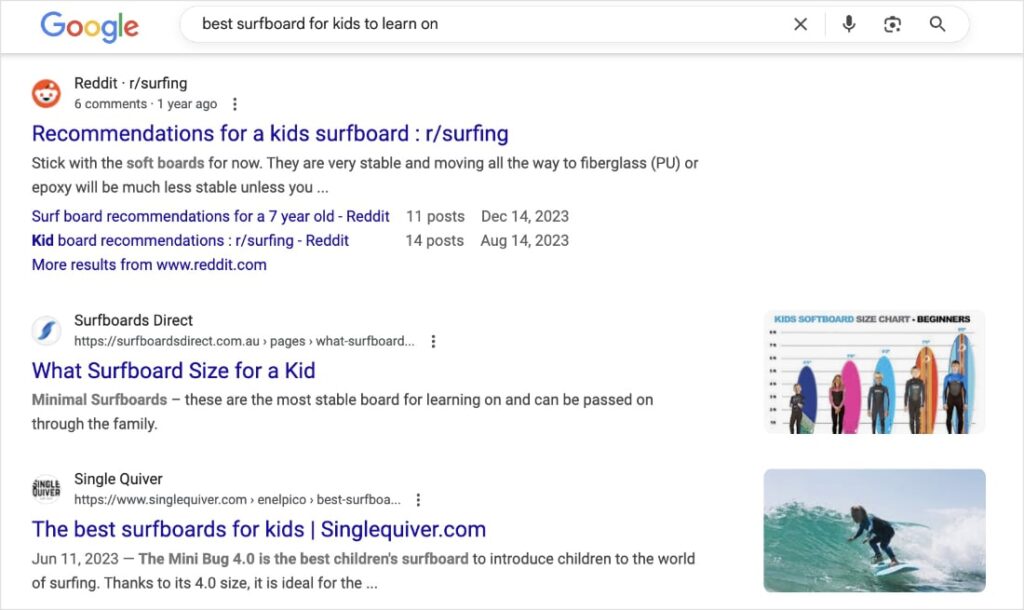
Looking at these search results, we can learn the following:
- This keyword has commercial intent. The top organic results provide specific recommendations (whether size or product) for kids’ surfboards. This means users are looking to make a purchase, but they need some information first.
- The primary content type for this query is educational. The Reddit post shares community insights into what to look for, the second result compares sizes, and the third provides specific product recommendations.
Because of these factors, I would recommend writing a blog post for this particular keyword. This format allows you to address the various facets of choosing a children’s surfboard.
Method 2: Use a SERP Analysis Tool
SERP analysis tools do a similar process, but faster and without manually having to search in Google.
I like using LowFruits for this task.
When you’re in any of your keyword reports, you can click the button to View the SERP.
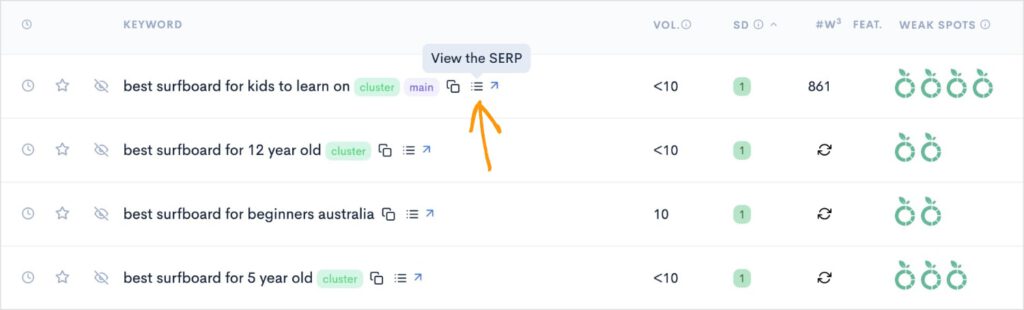
This opens a pop-out window of the top 10 organic search results.
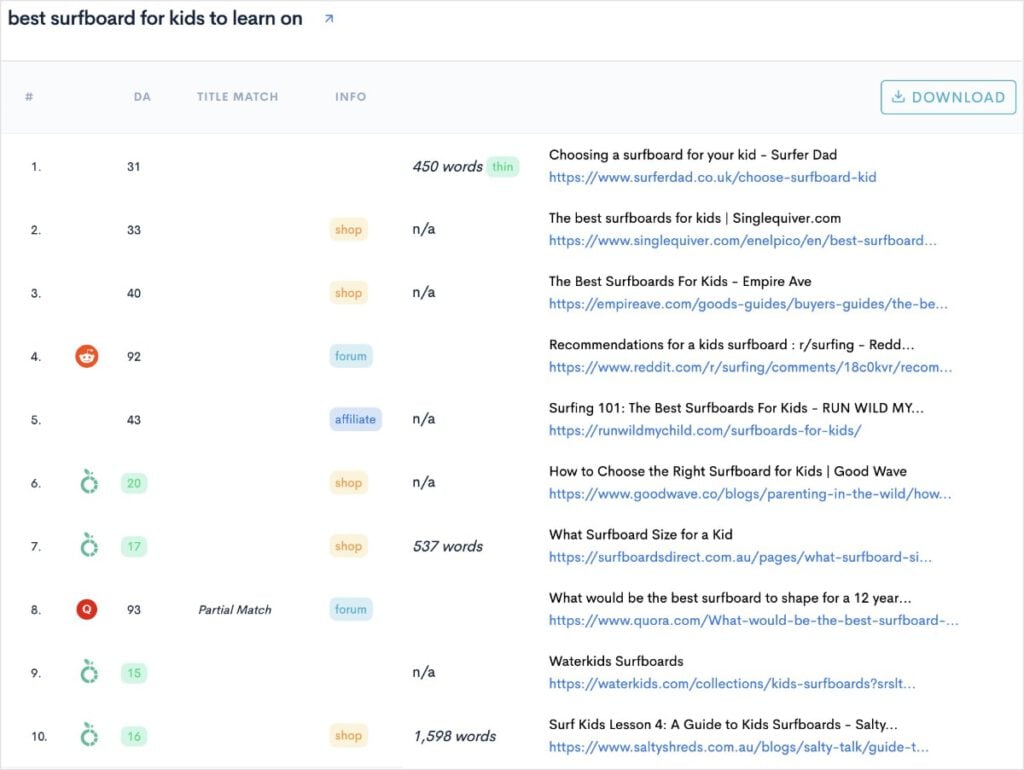
Just by looking at these results alone, you can come to the same conclusion as when we did the process in Google.
However, if you’re researching more than one keyword, you’ll find it much faster to do it in LowFruits. You can save time but not having to search every keyword individually in Google.
Plus, you get the additional keyword metrics that can help you determine if it’s a query you want to try and rank for.
Step 6: Build Authority With Topic Clusters
Remember those topic clusters I mentioned earlier?
Now’s the time to put them into action.
As a refresher, topic clusters are groups of related keywords with shared search intent. The idea is to target multiple keywords in a single piece of content to increase visibility.
You have a main topic (and pillar page) with several smaller subtopics and their corresponding pages. You use internal links to connect them all together.
So, how to do it?
This tutorial shows you how to create topic clusters. However, let me let you in on a little SEO secret: certain tools can do keyword clustering automatically for you.
A prime example is LowFruits’ Keyword Clustering Tool. When you’re in a keyword report, click on the Clusters tab. This will bring you to a page that has automatically grouped related keywords together.
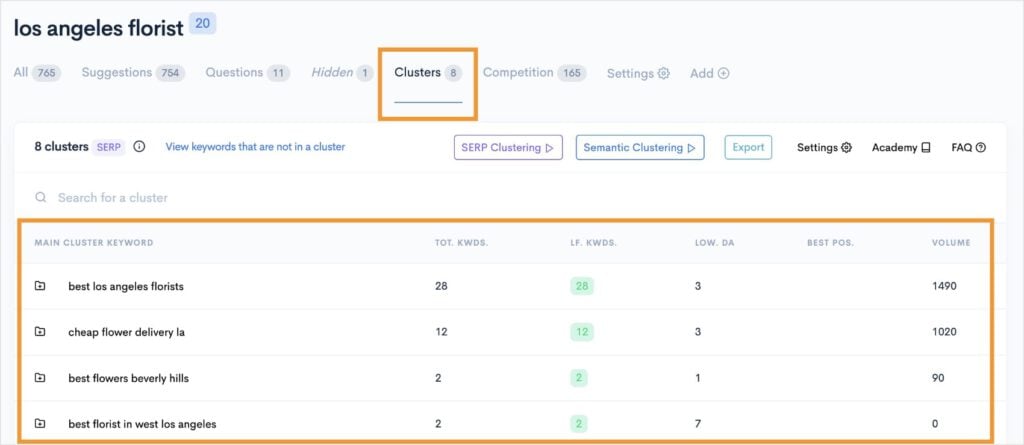
You can open any of these clusters to view the individual keywords within.
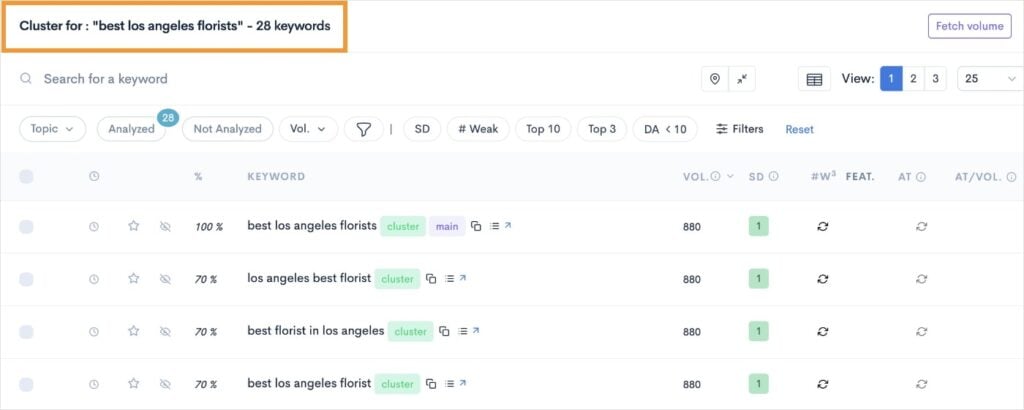
Ultimately, it’s the fastest way to do keyword clustering. And as someone who used to have to do the whole process manually (back in the days of spreadsheets), let me tell you what a time-saver this feature has been in my workflow.
It can take hours upon hours to organize keywords, let alone thousands of them.
The Keyword Clustering tool reduces this to literal seconds. You just have to do decide what to do with them! (We’ll get into this next.)
Step 7: Create SEO-Friendly Content
Now comes the execution phase — creating content that serves both search engines and real people.
Start with your focus keyword, but don’t force it into every other sentence. (Seriously, don’t fall victim to keyword stuffing. It doesn’t work anymore.)
Modern SEO is about creating comprehensive, valuable content that naturally incorporates your keywords and related terms.
Structure your content with clear headings, use lists to break up text, include related keywords throughout the piece. This approach will improve readability and the user experience.
I like using optimization tools to ensure my content is SEO-friendly and publish-ready. One of my favorites is SEOBoost.
This all-in-one content management platform streamlines every step of the content creation process, from initial topic ideation to final on-page SEO touches.
You can put your text into the Content Optimization tool, and it will provide real-time feedback regarding your SEO.
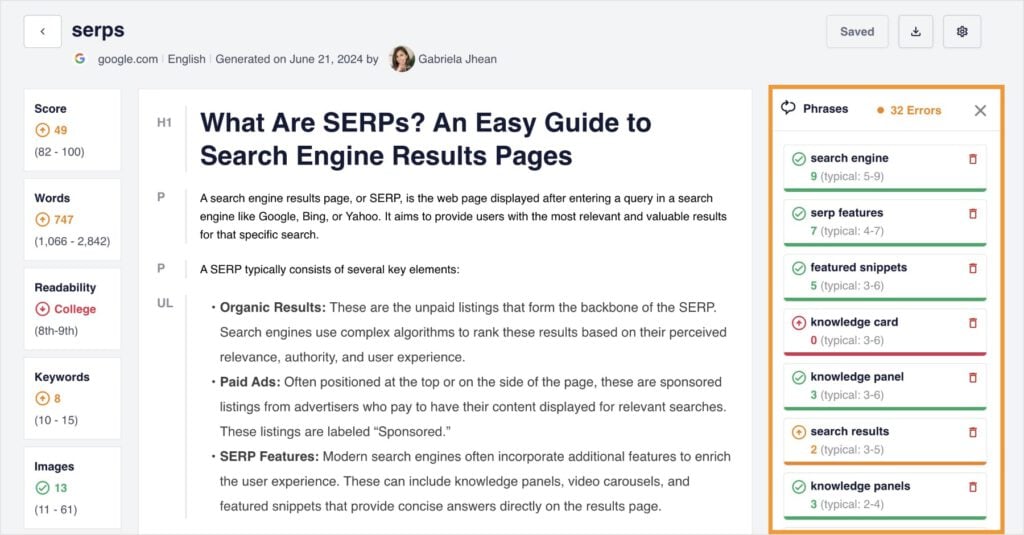
It suggests related keywords, word count, readability level, image quantity, and more.
SEOBoost gathers this data by analyzing the top-ranking content, then synthesizes it into your dashboard. It’s intuitive and easy to follow, making content optimization a breeze.
If you have a WordPress site, you can also integrate SEOBoost into the WordPress editor by using the All in One SEO (AIOSEO) plugin. Its AI Writing Assistant connects to your SEOBoost account to provide competitor insights right where you work.
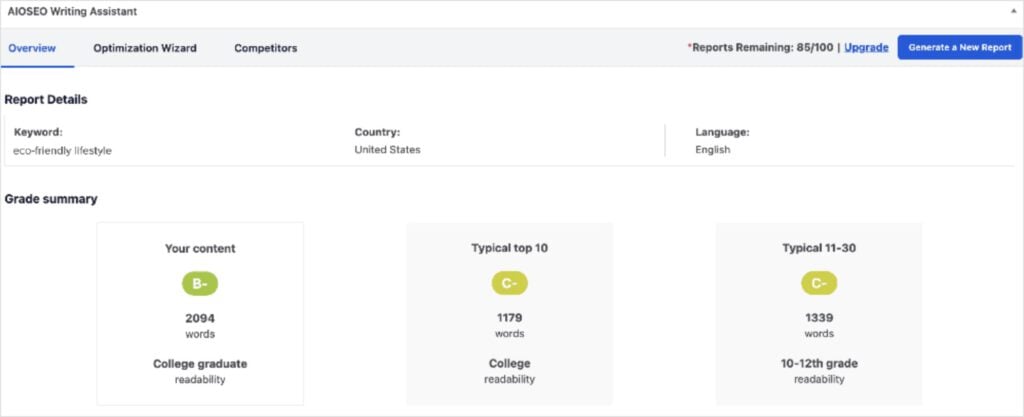
I’ve used both AIOSEO and SEOBoost (together and separately), and find the recommendations can often be what transforms good content into great content.
Related reading:
Step 8: Track & Refine Your Keyword Strategy
Alright, you’ve built and executed an SEO keyword strategy. Bravo!
Now, it’s time to monitor the results.
To see how your efforts are paying off, you’ll want to set up tracking for your most important keywords. Rank tracker tools can help with this process.
Let’s use LowFruits as an example.
Not sure which keywords to track? Here’s a beginner-friendly tutorial on seeing what keywords your website ranks for.
When you’re in the Rank Tracker, all you have to do is enter your top keywords. You can paste them in from another tool or type them out if you don’t too many to track. From here, you’ll adjust the settings to your preferences and click Track.
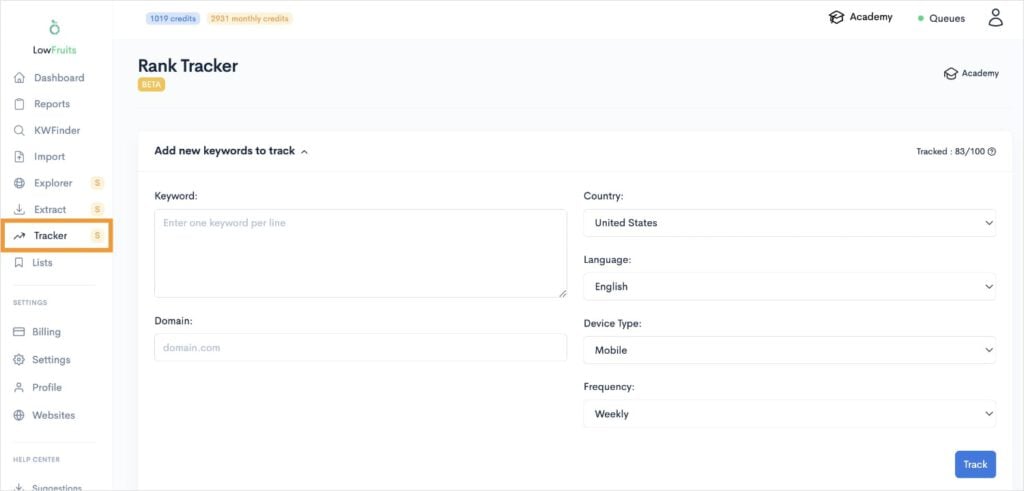
Pro Tip: Debating which frequency to use? For small business owners, bloggers, and solopreneurs, I recommend setting a weekly fetch. This gives you enough keyword data to extract insights without being overwhelmed by daily fluctuations or underwhelmed by monthly updates.
Once Rank Tracker has fetched your Google rankings, your dashboard will look like this:
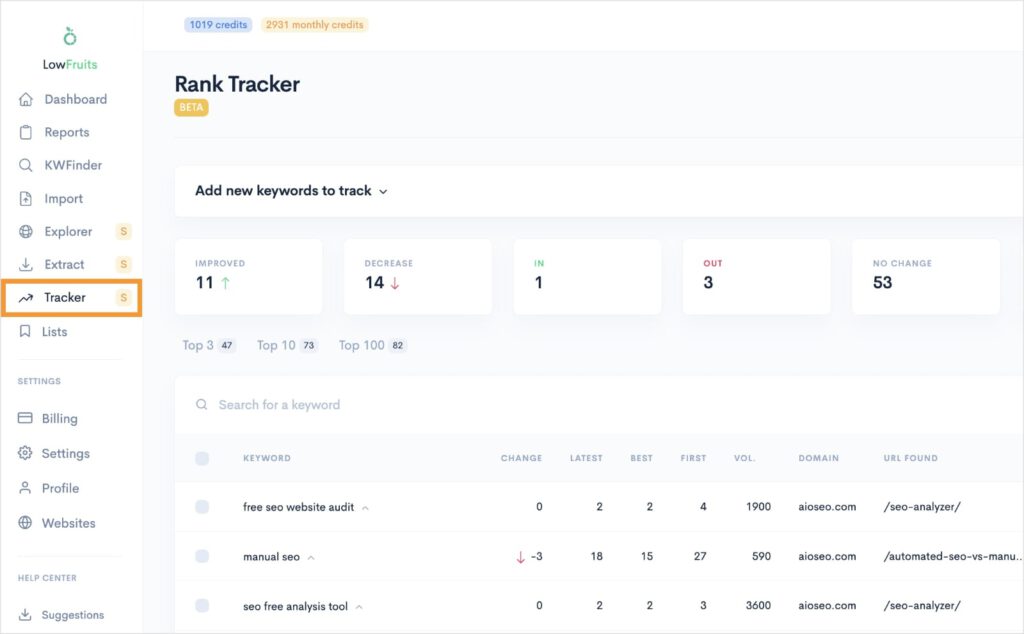
I like how easy it is to get big picture view of how your rankings have changed since the last fetch. The top metrics show which keywords improved, decreased, started or stopped ranking, or didn’t change in position.
You can also go more granular and see the specific position changes over time by expanding any of your keywords.
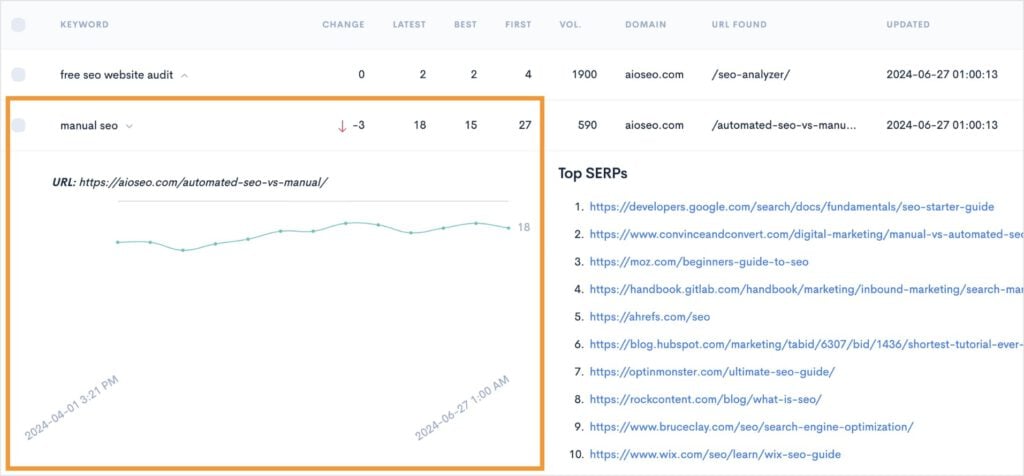
As a visual person, this view is gold. You can see the effectiveness of your SEO efforts in a glance, and refine your keyword strategy as necessary.
It also shows the current top 10 search results, allowing you to check out the competition.
Finally, I want to mention that you shouldn’t be afraid to pivot if something isn’t working.
Maybe a keyword you thought would be easy to rank for is more competitive than expected, or perhaps you’ve discovered new opportunities you hadn’t considered.
The best keyword strategies evolve over time.
Common Keyword Strategy Pitfalls to Avoid
Even with the best intentions, it’s easy to make mistakes that can derail your keyword strategy. Here are the most common pitfalls and how to avoid them.
- Keyword Stuffing: Cramming your target keyword into every paragraph doesn’t help. In fact, it can do the opposite and hurt your rankings. Search engines are smart enough to recognize when you’re trying to manipulate rankings, and users will click away from content that reads unnaturally.
- Ignoring Search Intent: Ranking for a keyword is pointless if you’re not satisfying what searchers actually want. Always analyze the top-ranking pages to understand what type of content performs best for each keyword.
- Focusing Only on High-Volume Keywords: Those 100,000 monthly search keywords might look attractive, but they’re often too competitive for newer sites. Build your authority with long-tail keywords first, then gradually target more competitive terms.
- Not Considering the Full Customer Journey: Your keyword strategy should include terms for people at every stage — from awareness to consideration to purchase. Focusing only on bottom-funnel keywords limits your reach and authority-building potential.
FAQs: Your Keyword Strategy Questions Answered
What is an SEO keyword strategy?
An SEO keyword strategy is a plan that identifies the specific search terms your audience uses and maps them to relevant content on your website. Rather than just finding popular keywords, a strong strategy focuses on understanding search intent, analyzing competition, and creating a clear roadmap for content creation.
What is a good keyword strategy?
A good keyword strategy balances search volume with competition level, focuses on user intent rather than just traffic, and includes keywords across the entire customer journey. It should be based on solid research, aligned with your business goals, and organized into logical topic clusters that build authority over time.
Which SEO tools can help you build a keyword strategy?
There are several SEO tools you can use to build an effective keyword strategy. Some popular ones include: LowFruits for finding long-tail keywords, Google Search Console for uncovering your existing rankings, and Google Keyword Planner for paid campaigns.
Final Thoughts
Creating a winning keyword strategy isn’t about gaming the system or finding secret shortcuts. It’s about understanding your audience, providing value, and building authority over time.
The 8 steps we’ve covered give you a solid framework to identify the right keywords and create content that ranks.
My #1 tip? Start with your audience. Everything else flows from there. When you truly understand what your readers are searching for and why, you can create content that serves their needs while achieving your business goals.