A common thought that goes through the minds of marketers and business owners alike is “Are my keywords truly pulling their weight?”
It’s a good question to ask, and for many, the answer tends to gravitate to understanding keyword return on investment (ROI). However, this financial calculation doesn’t tell the full story of a keyword’s value — and what it can do for your business.
This post will help you look beyond simple traffic numbers and sales to understand the full value of your keywords. You’ll learn that figuring out a keyword’s worth involves more than just ROI. It includes understanding:
- What people are truly looking for
- How much competition there is
- How your keywords fit into your long-term plans.
The good news is that tools like LowFruits can make this much easier.
By the end, you’ll have a clear way to evaluate your keyword ROI so every effort helps your business succeed.
In This Article
What Is Keyword ROI, Really?
Keyword ROI is about seeing if the money you spent on SEO brought in more money than you invested. The basic formula is:
(Revenue Generated – Cost of SEO Investment) / Cost of SEO Investment
For example, if you spend $1,000 on an SEO campaign and it brings in $3,000 in sales, your ROI is ($3,000 – $1,000) / $1,000 = 2, or a 200% return. This seems straightforward, and for some types of advertising, it works well.
However, for SEO, this formula can be tricky.
Unlike paid ads where you can often directly link a click to a sale, people’s journeys on organic search are rarely straight. Someone might find your content through one keyword, leave, and come back later through a different search or even directly before buying something.
It’s hard to say one specific organic keyword caused that sale.
Also, SEO offers benefits that aren’t immediately about money. Things like better brand visibility, increased website authority, and a better user experience all contribute to long-term success but don’t fit into a simple sales calculation.
This is why relying only on traditional keyword ROI can make you underestimate your SEO efforts and spend your money in the wrong places.
To truly understand your keywords’ impact, we need to think about keyword value, not just immediate financial return.
Beyond the Numbers: Understanding True Keyword Value
If keyword ROI is a snapshot, keyword value is the full picture. It recognizes that not all keywords help your business in the same way, and they don’t always lead to an immediate sale. True keyword value looks at many factors that build your online presence and help you reach your business goals.
Search Intent: The ‘Why’ Behind the Search
Understanding search intent is key to figuring out a keyword’s true value. It’s about what a user wants to achieve when they type something into a search engine. There are four main types:
- Informational: The user wants to learn something (e.g., “how to bake bread”).
- Navigational: The user is looking for a specific site or page (e.g., “LowFruits blog”).
- Commercial: The user is researching products or services (e.g., “best cameras”).
- Transactional: The user is ready to buy or take action (e.g., “buy flour online”).
Each type of intent adds value differently.
A transactional keyword might lead directly to a sale, but an informational keyword, even if it doesn’t immediately make money, can be incredibly valuable. It helps build your brand as an expert, attracts potential customers early in their journey, and helps your website be seen as an authority on a topic.
Keyword Difficulty: Picking Your Battles
Another important factor is keyword difficulty (KD), which tells you how hard it will be to rank for a keyword.
A common SEO mistake is to go after keywords with huge search volumes without considering how competitive they are. A keyword with lots of searches but also very high competition might not be valuable for your site, especially if you’re a newer or smaller business. It’s a waste of time and money to fight battles you can’t win.
This is where “low-hanging fruit” keywords come in.
These keywords have a good number of searches but relatively low competition. They give you a much better chance of ranking quickly and bringing in targeted visitors. Finding these manually can be a lot of work, but that’s exactly what a tool like LowFruits is for.
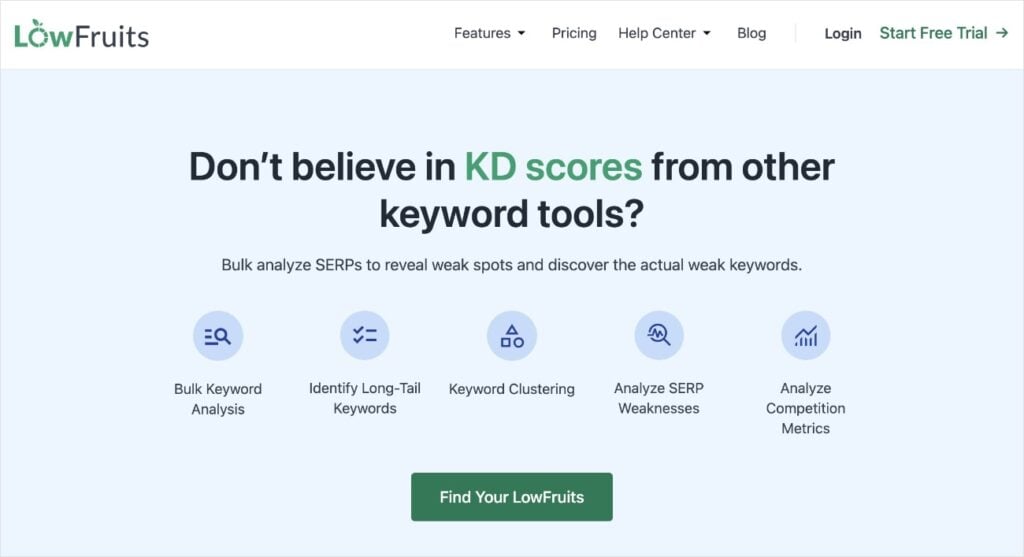
LowFruits helps you find these overlooked, low-competition keywords that your competitors might might. All you have to do is look for a low SERP Difficulty Score (keyword difficulty) and Weak Spots in SERPs (low-authority competitors).
LowFruits makes this easy by putting these keyword metrics in all your keyword reports.
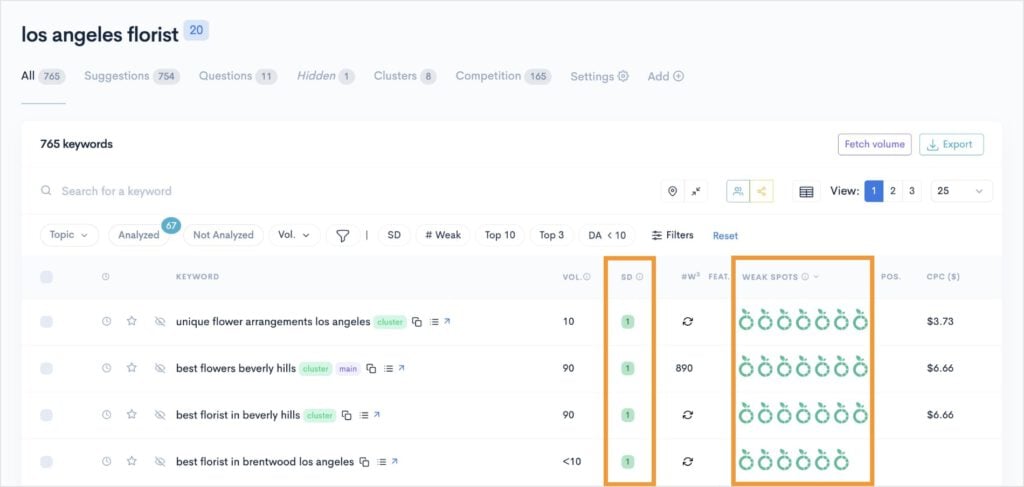
Ultimately, this lets you focus your efforts on keywords that will actually deliver results and give you a much better return on your content investment.
Conversion Potential: Beyond Just “Buy Now”
When we talk about conversion potential, it’s easy to only think about direct sales. But true keyword value goes beyond just the “buy now” button. Conversions can take many forms:
- Lead generation: Filling out forms, requesting demos, signing up for newsletters
- Engagement: How long people stay on your page, if they leave quickly (bounce rate), how many pages they visit per session, and if they leave comments
- Brand mentions: Social shares, links to your website from other sites, and people coming directly to your site.
- Assisted conversions: Keywords that help a conversion happen later in the customer’s journey, even if they weren’t the final step
Measuring the conversion potential for different keyword types requires a broader view.
An informational keyword might lead to a newsletter sign-up, which then helps turn that person into a customer over time.
A commercial investigation keyword might lead someone to download a product comparison guide.
All these actions, even if not direct sales, contribute to your business goals and have significant value. Understanding which keywords drive these different conversions helps you accurately assess their overall worth.
Topical Authority & Semantic SEO: Playing the Long Game
Finally, a keyword’s long-term value is tied to topical authority and semantic SEO.
Google’s systems are getting smarter, moving beyond just matching keywords to understanding the bigger picture and how topics relate to each other. By creating a lot of detailed content around a main theme, you show that you’re an expert in that area. This helps you rank for more related terms and tells search engines that you’re a trustworthy source.
This means that even seemingly “low-value” informational keywords, when used strategically within a larger content plan, add a lot to your overall website authority. They act as supporting pillars, making your entire content stronger and boosting the ranking potential of your more sales-focused keywords.
Ultimately, investing in content that builds topical authority is a long-term strategy that can bring growing returns.
How to Calculate Your True Keyword Value (With a Little Help From LowFruits)
Now, let’s look at how you can actually calculate and use the true value of your keywords. It’s a multistep process that combines smart thinking with powerful tools.
Step 1: Define Your Goals: What Does “Value” Mean for You?
Before you can measure keyword value, you need to decide what “value” means for your specific business. Are you mainly focused on:
- Direct Sales: For online stores, value might mean actual product purchases.
- Lead Generation: For B2B businesses or service providers, value could be measured by qualified leads (like demo requests or contact form submissions).
- Brand Awareness & Authority: For content-heavy sites or new businesses, value might initially be about getting seen, building trust, and showing expertise.
- Audience Engagement: For publishers, value could be how long people stay on a page, how often they return, or how much they share content on social media.
Your definition of value will decide which metrics you focus on and how you understand your keywords’ performance. A keyword that brings a lot of brand awareness might be very valuable, even if it doesn’t immediately lead to a sale.
Step 2: Use LowFruits for Smart Keyword Research
Once your goals are clear, it’s time to dig into the data.
This is where LowFruits can help you find keywords that truly match what you define as valuable. Regular keyword research often focuses on keywords with high search volume, but LowFruits helps you find the hidden gems—keywords with less competition that offer great potential for your specific niche.
Here’s how LowFruits helps you:
Find Low-Competition, High-Intent Keywords
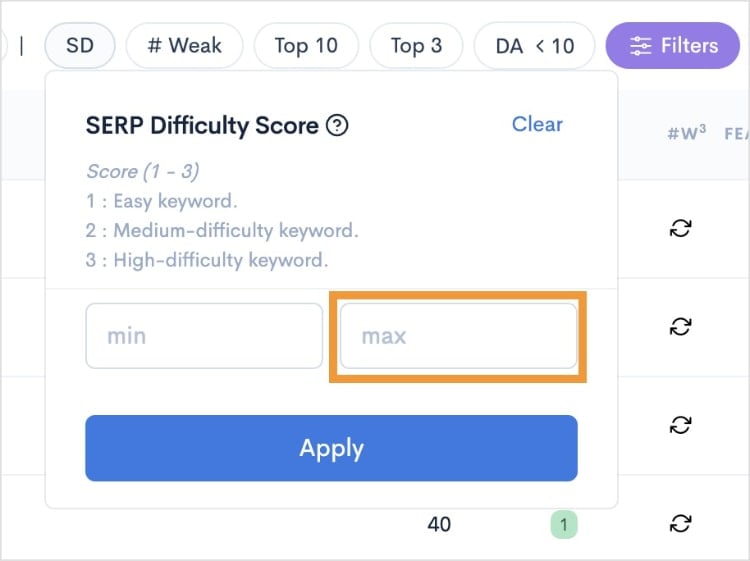
LowFruits is great at finding keywords with low difficulty, often called “low-hanging fruit.” These are searches where the existing content on the SERPs isn’t very competitive, meaning you have a good chance to rank quickly.
Pro Tip: Set the SERP Difficulty Score (SD) max filter to 1 to only see easy keywords.
Discover Weak Competitors
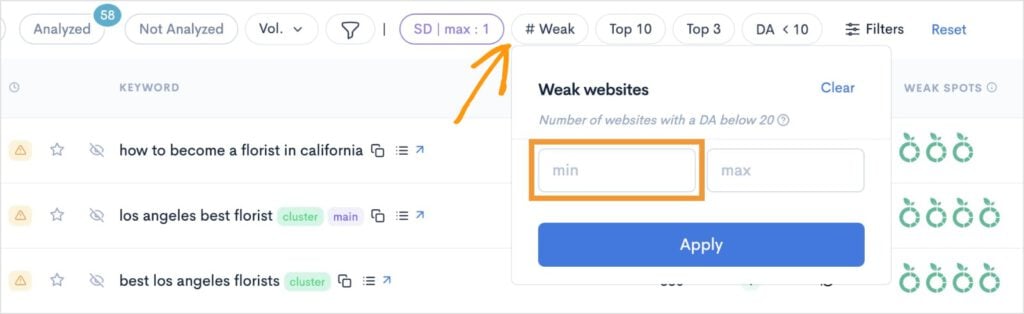
LowFruits doesn’t just give you numbers; it provides insights into the actual search results. One of the standout features is its ability to spot Weak Spots for your chosen keyword. These are low-authority domains that are ranking in the top 10 search results.
Pro Tip: Set the number of weak websites to a minimum of 2 to see results with multiple Weak Spots in SERPs.
You can also see what kind of content is ranking and find gaps. This helps you create content that perfectly matches what users are looking for and outperform existing pages.
Create Topic Clusters for Niche Authority
Beyond individual keywords, LowFruits helps you find related keywords and questions, allowing you to build groups of comprehensive content. This is essential for building topical authority.
It also allows you to create topic clusters in seconds.
Topic clusters are groups of related keywords with a shared search intent.
You can locate these automatic groupings by selecting the Clusters tab at the top of any keyword report.
By covering a topic thoroughly, you show search engines that you are a definitive resource, boosting your overall website authority and helping all your keywords rank better.
Step 3: Track More Than Just Direct Sales
To calculate keyword value, you need strong tracking that goes beyond just sales numbers. You should also monitor the following metrics to understand the full impact of your keywords:
- Organic Traffic: Use tools like Google Analytics and Google Search Console to track how much traffic each keyword brings.
- Keyword Rankings: Use rank tracker tools to monitor your keywords and their ranking positions over time. (The LowFruits Rank Tracker can help with this.)
- Engagement Metrics: Look at metrics like time on page, bounce rate, and pages per session.
- Assisted Conversions: Many conversions aren’t direct. A user might discover your brand through an informational blog post (driven by a specific keyword), then come back later through a different way to make a purchase. Google Analytics can help you identify these assisted conversions, giving credit to the keywords that played a role earlier in the customer’s journey.
Step 4: Improve & Adapt Your Keyword Strategy
SEO isn’t a one-time task. Regularly check your keyword performance against your defined value metrics.
Are certain low-competition keywords bringing in more qualified leads than you expected? Are high-volume informational keywords significantly helping with brand awareness?
Use these insights to improve your content strategy, find new opportunities, and constantly get better at targeting keywords.
You can use LowFruits repeatedly to find new opportunities and track your progress, making sure your strategy stays flexible and effective.
FAQs About Keyword Value & ROI
What is the difference between keyword ROI and keyword value?
Keyword ROI measures direct financial return from SEO investment. Keyword Value is a broader concept that includes direct sales, brand visibility, user engagement, and long-term authority, not just immediate revenue.
What Is SEO ROI?
SEO ROI is a way to measure the financial gain from your overall search engine optimization efforts. It’s calculated by comparing the revenue generated from SEO activities against the cost of those activities.
Why isn’t traditional Keyword ROI enough for SEO?
Traditional keyword ROI is limited because organic search journeys are rarely direct. SEO also provides non-monetary benefits like brand building and authority that aren’t captured in a simple sales-to-cost calculation. That’s why understanding the keyword value can provide a more complete picture of your SEO efforts than just monetary gains.
Final Thoughts: Focus on Value, Not Just Keyword ROI
In SEO, it’s easy to get caught up in chasing high search volumes and immediate returns. While keyword ROI is an important metric for understanding the financial impact of your SEO efforts, it’s crucial to realize it’s just one piece of a much bigger puzzle.
The real measure of success comes from understanding and maximizing keyword value—a complete concept that includes search intent, competition, conversion potential, and the long-term benefits of building topical authority.
By changing your focus from just volume to value, you create a more sustainable and impactful SEO strategy. This approach allows you to find and use opportunities your competitors might miss, build a stronger, more authoritative online presence, and ultimately drive more meaningful results for your business.