Let’s be honest — B2B SEO isn’t getting any easier. If anything, the landscape has become more complex, competitive, and frankly, more crucial to your bottom line than ever before.
While your B2C counterparts are busy optimizing for impulse purchases and emotional triggers, you’re dealing with multi-stakeholder decision processes, longer sales cycles, and audiences that actually read the fine print.
But here’s the thing: that complexity is also your competitive advantage. Most businesses are still treating B2B SEO like it’s 2010, focusing on basic keyword stuffing and hoping for the best. Meanwhile, you could be crushing it by getting with the latest B2B SEO trends of 2026.
In this guide, you’ll learn:
- What makes B2B SEO unique
- Why it matters now more than ever
- How to build a B2B SEO strategy that moves the needle
Let’s dive in.
In This Article
What Is B2B SEO?
Business to business (B2B) SEO is the practice of increasing your B2B company’s visibility in search results. Its main goal is to put your website in front of the right professionals at the exact moment they’re looking for a solution your business provides.
While the fundamentals of SEO—like on-page optimization, link building, and technical health—remain the same for both B2B and B2C, the audience you are marketing to and how you speak to them is not the same. The way a professional searches for a work-related solution is fundamentally different from how a consumer shops for a personal item.
Understanding these differences are key to a successful strategy, so let’s dive into what makes B2B SEO a distinct discipline.
B2B vs. B2C SEO: Differences Compared
These are the main differences between business-to-business SEO and business-to-consumer SEO:
Targeting a Professional Audience
Your audience isn’t looking for entertainment. They’re looking for a solution to a specific business problem. Your content needs to speak their language, address their specific pain points, and provide expert, actionable advice.
Multiple Decision-Makers
While B2C is often a single-person decision, B2B sales often involve many people—the end-user, the manager, the purchasing department, and the C-suite. Your content needs to provide value to each of them.
Longer Sales Cycles, Not Instant Gratification
In business to consumer (B2C), a user can see a product and buy it in minutes. In B2B, a single deal can take months, even a year, as multiple stakeholders and decision-makers get involved. Your content needs to support the buyer at every stage of their journey, from initial research to the final decision.
Lower Search Volume, Higher Value
A B2C keyword might have a search volume of 10,000, but a single conversion might only be worth a few dollars. In the world of business to business SEO, a keyword with only 100 searches a month could generate a lead worth thousands. The value of a conversion is exponentially higher.
The Foundational Pillars of Effective B2B SEO Strategies
Despite its differences with the more common B2C SEO, B2B SEO actually follows many of the same core principles for search engine optimization. Here are the 5 foundational pillars of successful B2B SEO strategies:
Pillar 1: Keyword Research
Keyword research is the process of identifying keywords your audience uses in search engines. And while the steps of finding them remains largely unchanged between B2C and B2B SEO, the types of keywords you’re looking for are significantly different.
Traditional keyword research often looks for popular search terms that many people use (aka, high search volumes). B2B research is more nuanced. It’s about finding high-intent, long-tail keywords that signal a user is a potential lead.
This is where keyword research tools like LowFruits shine.
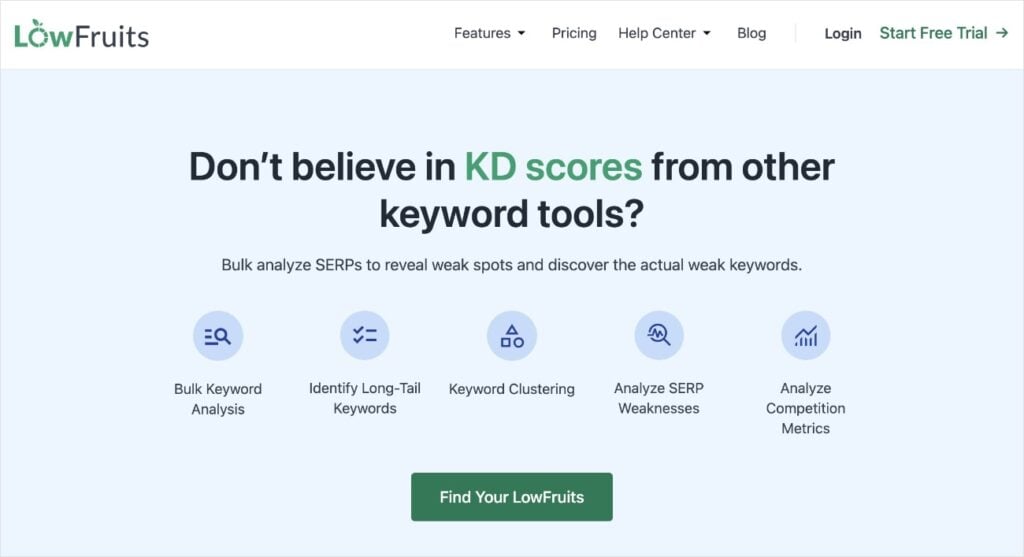
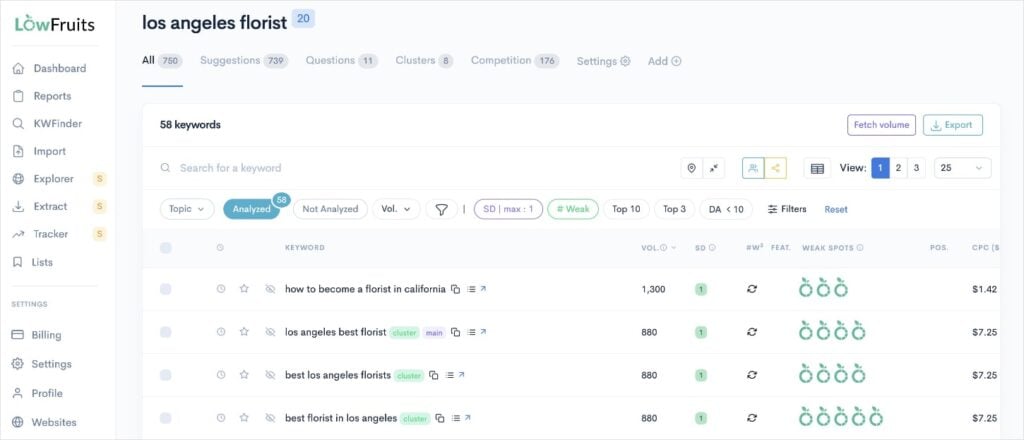
LowFruits is designed to help users uncover low-competition keywords that are easy to rank for. It looks for “low-hanging fruit” in search engine results pages (SERPs) and identifies weak competitors ranking in top positions. These are called Weak Spots and are represented by LowFruits icons as shown in the report below.
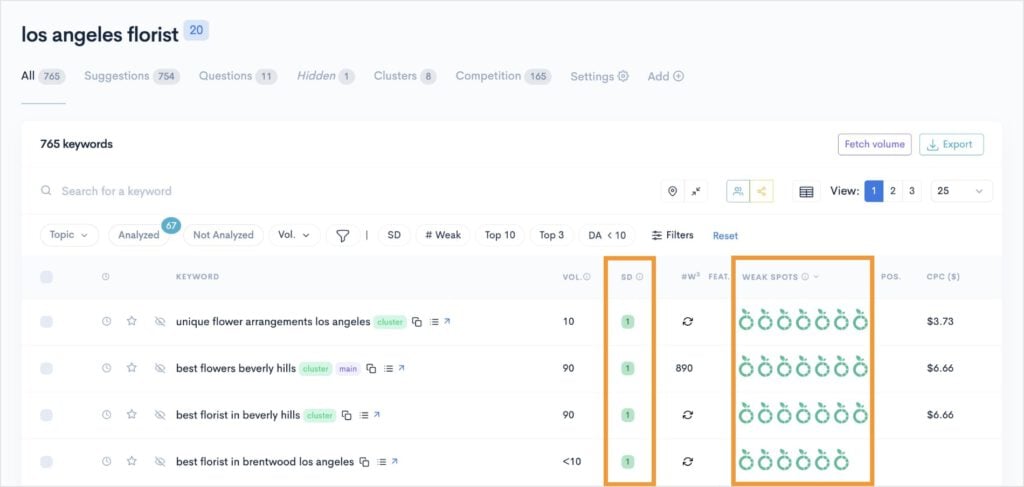
There’s also the SERP Difficulty Score (SD), which is equivalent to keyword difficulty.
Ultimately, these keyword metrics help users determine if a keyword is worth targeting and whether they can realistically rank for it. You can use these insights to inform your B2B keyword strategy and ensure your SEO team’s efforts aren’t wasted on unattainable terms.
Pillar 2: Content Marketing for the B2B Buyer’s Journey
B2B content needs to be more than just a blog post; it needs to be a valuable asset. The goal is to create content that serves your audience at every stage of their journey. You can do this by building niche authority and using a topic cluster strategy.
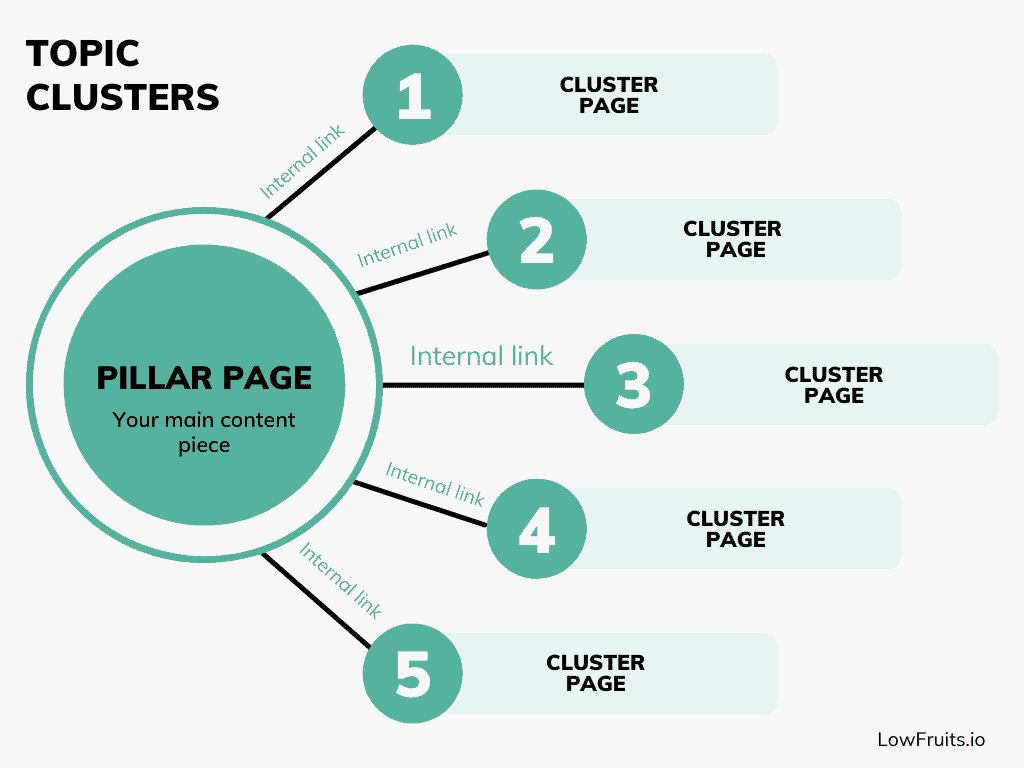
Topic clusters are groups of related keywords with shared search intent. The idea is to target multiple, related keywords on the same page to increase its visibility in search results.
Then, you create an interconnected network of related content to show users (and search engines) that you’re an authority on a topic, which is crucial for B2B.
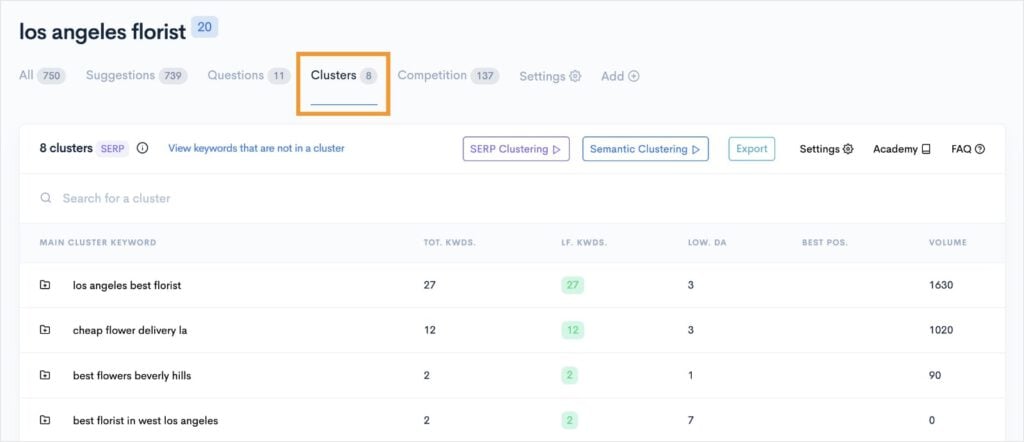
LowFruits can help you with keyword clustering, making it easier to build out a comprehensive content strategy for your brand.
Its Cluster tool automatically groups semantically-related keywords (meaning users are searching for the same thing) and presents the data in your keyword report.
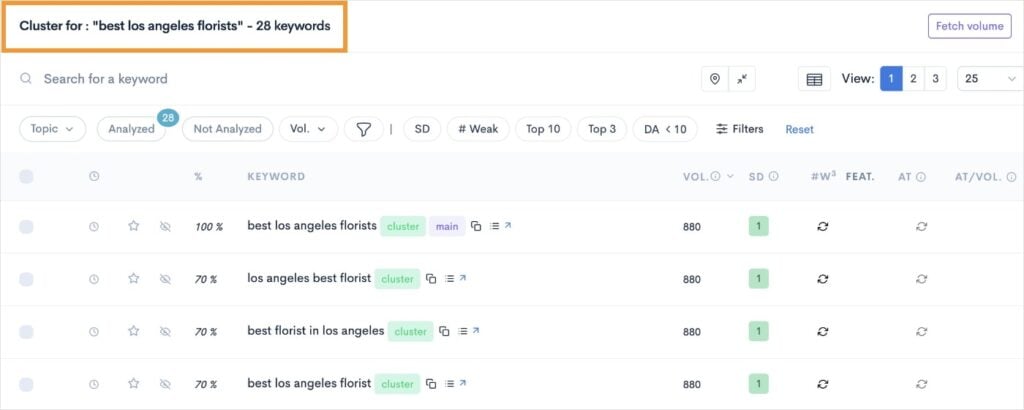
You can open these clusters to view the individual keywords within and inform your content optimization efforts.
To recap: Keyword clusters are critical for establishing authority in the organic search landscape. They allow you to build a catalog of content related to your business and foster trust with users and search engines.
They’re also foundational for creating pillar pages, which are comprehensive guides on a broad topic that links to more specific, “cluster” pages. Using this model, you can rank for both broad and long-tail keywords.
Pillar 3: On-Page SEO
On-page SEO includes all the optimizations you do directly on your website to improve its ranking. This is where you implement SEO best practices like adding keywords to your page titles, headings, and meta descriptions, and optimizing your images with proper alt text. This is a crucial step for helping both users and search engines understand exactly what your content is about.
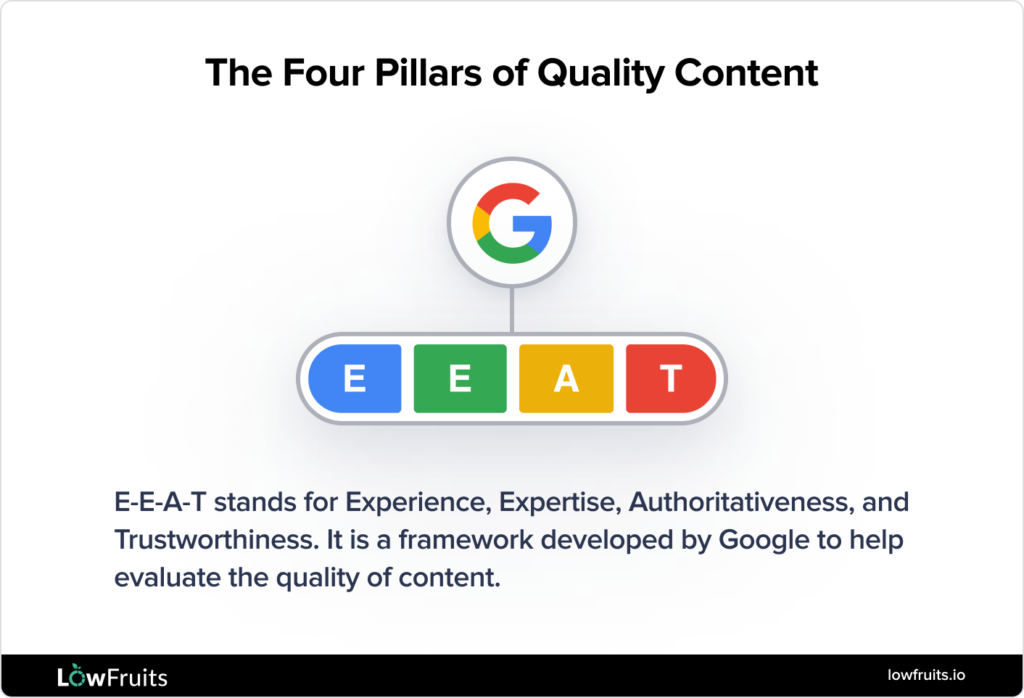
For B2B, a key element of on-page SEO is demonstrating E-E-A-T (Experience, Expertise, Authoritativeness, and Trustworthiness). This Google framework is all about proving to search engines that your content is high-quality and created by a trusted source. You can demonstrate E-E-A-T by:
- Showcasing your Experience: Write from a first-person perspective, sharing personal anecdotes and real-world results.
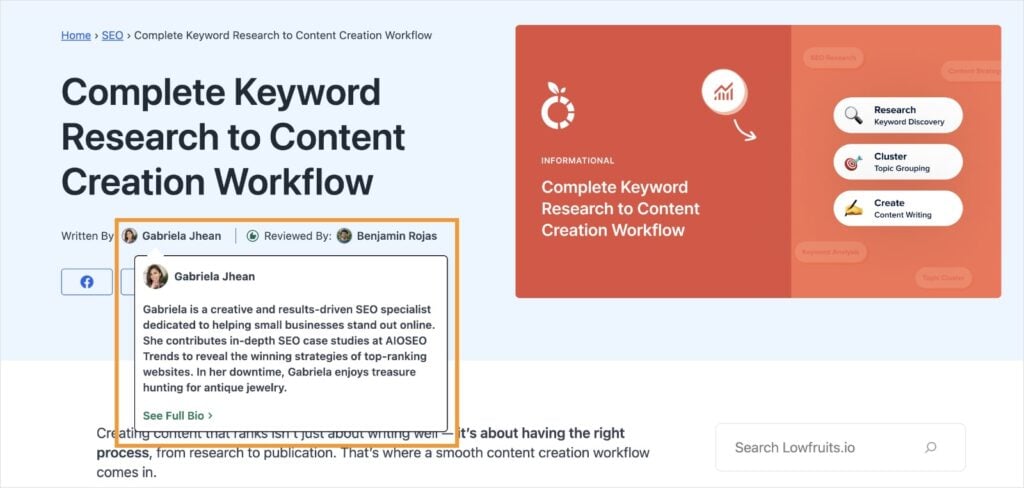
- Proving your Expertise: Use data, statistics, and industry-specific language. Include author bios that highlight professional credentials.
- Building your Authoritativeness: Link to other authoritative sources and create original content, like a data study or an industry report, that others will want to link to.
- Earning Trustworthiness: Ensure your website is secure, provides clear contact information, and has a transparent content policy.
At LowFruits, we use All in One SEO (AIOSEO) to display author bios that align with Google E-E-A-T. It has an Author SEO feature that makes creating and displaying these bios quick and easy.
Pillar 4: Technical SEO
Technical SEO is about optimizing your website’s overall health and performance. This includes ensuring your site is fast, mobile-friendly, and easy for search engine crawlers to navigate. A strong technical foundation is essential for a professional audience that values efficiency and a seamless user experience.
For B2B websites, technical SEO often involves a few key areas:
- Site Speed: Fast-loading pages are critical for retaining busy professionals.
- Structured Data: Using structured data (or schema markup) helps search engines understand what your content is about, which can lead to rich results in search.
- Secure Site: Ensuring your site uses HTTPS is a must for building trust with potential clients.
Ultimately, investing in a technically sound website pays off in improved user experience and higher search rankings.
Pillar 5: Off-Page SEO & B2B Link Building
Off-page SEO includes all the actions taken outside of your own website to improve your search engine rankings. This is where you build trust and authority in the eyes of search engines by getting others to vouch for your content.
For B2B, this is a more strategic effort than in B2C. Instead of getting a thousand low-quality links, you’re better off with a handful of high-quality links and brand mentions from authoritative, B2B-relevant publications and partners.
A few key off-page strategies include:
- Link Building: Earning high-quality links from other trusted websites.
- Brand Mentions: Getting your brand and content mentioned in industry publications, news articles, and blogs.
- Community Engagement: Building a strong presence on industry-specific forums.
- Social Media & Brand Building: While social signals aren’t a direct ranking factor, they can lead to increased brand awareness and more inbound links. Having a strong, professional presence on platforms like LinkedIn and X (formerly Twitter) can boost your content’s visibility.
The goal with every off-page technique is to prove to Google that your business is a trusted, authoritative source in your industry.
Your B2B SEO Blueprint: 6 Steps to Higher Rankings
Ready to put it all together? Here’s a clear, actionable blueprint for executing your B2B SEO strategy. We’ll dive into each step in greater detail after.
- Define Your Audience: Start with detailed buyer personas. Understand your customer’s pain points, job role, and what they search for. This will inform your entire content strategy.
- Conduct Keyword Research: Use a tool like LowFruits to find low-competition, high-intent keywords with weak spots. Remember, a single high-value keyword is all you need to change your business.
- Map Keywords to the Buyer’s Journey: Don’t just target a keyword. Organize your content to answer questions at every stage of the funnel, from broad, informational questions to specific, commercial-investigation queries.
- Create Your Content Strategy: Use a topic cluster model to build a robust content calendar that establishes you as a thought leader in your niche.
- Optimize for On-Page SEO and E-E-A-T: Ensure your content is helpful, authoritative, and speaks directly to your professional audience.
- Build Strategic Backlinks: Focus on quality links from authoritative B2B publications and partners.
Now, let’s look at these steps one by one.
Step 1: Define Your Audience
Before you can create content that converts, you have to know who you’re talking to. In the B2B world, that means going beyond basic demographics and building detailed buyer personas.
Buyer personas are detailed, semi-fictional profiles of your ideal customers. It focuses on gaining a deep understanding of a person’s:
- Background
- Goals
- Challenges
- Motivators
- Behaviors
- And more
The idea is to understand the mentality of your customers and what influences their purchasing decisions. The better you understand them, the more targeted and valuable your content will be.
Need help coming up with buyer personas? This article shows you how to create B2B buyer personas and includes a template.
Step 2: Conduct Keyword Research
In B2B, keyword research is less about finding massive search volume and more about uncovering high-intent, low-competition opportunities. Your goal is to find the exact terms and questions your potential clients are using. A single high-value keyword is all you need to change your business, so you should focus on terms that signal they are ready to engage.
Here’s a simple process you can follow to find your keywords:
- Start With Seed Keywords: These are the most basic terms related to your business. For example, if you sell project management software, your seed keywords might be “project management” or “project planning.”
- Uncover Long-Tail Keywords: These are longer, more specific phrases that often reveal user intent. For example, instead of just “project management,” you might find “best project management software for small businesses” or “how to create a project plan.”
- Assess Ranking Potential: Look at keyword metrics like difficulty, volume, and Weak Spots to determine if your website can realistically rank for that specific keyword. It’s better to curate your keyword list to realistic targets than try to rank for everything.
I find LowFruits particularly useful in the B2B keyword research phase because it’s a long-tail keyword research tool instead of a more generic SEO tool that returns as many results as possible. It uncovers long, specific phrases that are highly effective for B2B SEO because they have hyper-targeted search intent.
The KWFinder shows all the keyword metrics you need to complete this step with ease and confidence.
Helpful resources:
Step 3: Map Keywords to the Buyer’s Journey
Not all keywords are created equal. You need to organize your content to answer questions at every stage of the B2B buyer’s journey, from when they first realize they have a problem to when they are ready to make a decision. This means using different types of keywords for each stage. Failing to do so is a common SEO mistake that can lead to misaligned content and wasted effort.
- Awareness Stage Keywords: The user is just discovering a problem and is looking for a solution. They’re not yet familiar with your business. Content for this stage should be educational and broad, like a comprehensive guide or a detailed blog post. Keywords will be informational (e.g., “how to improve sales team communication”).
- Consideration Stage Keywords: The user knows their problem and is actively researching possible solutions. They are comparing different options, features, and benefits. Your content should provide them with the information they need to evaluate your product or service. Keywords at this stage are more specific and often include terms like “best,” “vs.,” “comparison,” or “review” (e.g., “best team collaboration software”).
- Decision Stage Keywords: The user has evaluated their options and is ready to buy. They just need a final push. Your content for this stage should be highly persuasive and provide a clear path to conversion. Keywords are often transactional and include terms like “pricing,” “demo,” “free trial,” or “buy” (e.g., “marketing software pricing”).
By mapping your keywords to these stages, you can create a complete content funnel that guides your audience from a search query all the way to a sale.
Step 4: Create Your B2B Content Strategy
Once you have your keywords, you can build your content strategy. The most effective way to do this is to use the topic cluster model we discussed earlier. This is where you’ll group related keywords into comprehensive content pieces that build topical authority for your site. This shows Google you’re a true expert on a subject, which is crucial for B2B.
Here’s how to do it:
- Map Your Keywords to Your Content: Take the keywords you’ve identified and group them into logical topics. For example, all your keywords related to “sales automation” might be a single topic cluster.
- Create a Content Calendar: Organize your topic clusters into a content calendar. A simple spreadsheet works wonders for this. A content calendar is essential for consistency and helps you visualize your entire content strategy for the next few weeks or even months.
- Prioritize Your Content: Start with the content that will give you the quickest SEO wins—those keywords with low competition and high intent. Then, build out the foundational content (cluster pages) that will help establish your topical authority.
Reminder: LowFruits can automate this entire process for you, so you can build out a robust content calendar that establishes you as a thought leader in your niche without the manual effort.
Step 5: Optimize for On-Page SEO & Google E-E-A-T
Even with great content, your web page still needs to be optimized for search engines and users.
On-page SEO involves the technical optimizations you do directly on your page, like using keywords in your headings and meta descriptions. Just as important is demonstrating E-E-A-T. This is how you prove to Google that your content is high-quality and trustworthy.
Here’s a breakdown of how to optimize your content for both:
On-Page Optimization
- Keyword Placement: Make sure to include your focus keyword in your page title, URL, H1 heading, and within the first 100 words of the body. This signals to both Google and users what your content is about.
- Header Tags: Use H2, H3, and H4 tags to break up your content into logical sections. This improves readability and helps Google understand your content’s structure.
- Image Optimization: Use descriptive filenames and alt text on all your images. This helps with accessibility and provides search engines with more context about your page.
Related reading:
Google E-E-A-T
- Showcasing your Experience: Write from a first-person perspective, sharing personal anecdotes and real-world results to prove your hands-on experience.
- Proving your Expertise: Use data, statistics, and industry-specific language. Include an author bio that highlights your professional credentials.
- Building your Authoritativeness: Link to other authoritative sources and create original content, like a data study or an industry report, that others will want to link to.
- Earning Trustworthiness: Ensure your website is secure (HTTPS), provides clear contact information, and has a transparent content policy.
These B2B SEO strategies will help your website stand out to search engines and earn higher rankings in organic search.
Step 6: Build Strategic Backlinks
Link building is an essential part of any SEO strategy. But for B2B, it’s all about quality over quantity.
Instead of getting hundreds of low-quality links, you should focus on a handful of high-quality links from authoritative, B2B-relevant publications and partners. This is how you build true authority and trust in the eyes of Google, which pays off in long-term rankings and traffic.
Here are a few powerful B2B link building strategies:
- Guest Blogging: Writing for established, reputable industry blogs not only gets you a valuable link but also introduces your brand to a new, highly-relevant audience.
- Partnership Links: Collaborate with complimentary businesses in your industry to exchange links, such as on a partners page or in a collaborative case study. This builds a network of trust within your niche.
- Digital PR: Create newsworthy content, like an original data study or an industry report, that others will want to link to and share. This is one of the most effective ways to earn high-quality links at scale.
- Unlinked Brand Mentions: Look for mentions of your brand on other websites that don’t link back to you. Reach out to the site owner and politely ask them to turn the mention into a link. This is a low-effort, high-reward tactic.
Backlinks are like virtual word of mouth. The more mentions you can get, the likelier you are to connect with the right B2B customer.
Essential B2B SEO Tools for Faster Growth
A strong B2B SEO strategy is impossible without the right tools. They help you make data-driven decisions and automate the time-consuming parts of the process, allowing you to focus on high-impact work.
Here are some of the best B2B SEO tools for growing your business in less time:
For Keyword Research & Competitive Analysis
- LowFruits: This is your secret weapon for B2B keyword research. Unlike other tools, LowFruits doesn’t just give you a generic difficulty score; it finds “Weak Spots” in the SERPs and helps you find low-competition keywords that you can actually rank for. It’s built for the B2B mindset of finding high-value opportunities with less effort.
- Ahrefs or Semrush: These are the industry standard for comprehensive SEO. They provide powerful data on keyword search volume, competitor backlinks, and technical site audits. While they can be pricey, they offer a deep well of information for a serious SEO professional.
- Google Keyword Planner: This is a free tool from Google that can help you find new keyword ideas and get a general sense of search volume. While it was designed for paid campaigns, It’s a great starting point for general B2B keyword research.
For Analytics & Tracking
- Google Search Console (GSC): GSC is a free search performance tool. It shows you what keywords your website is ranking for, how many impressions and clicks you’re getting, and any technical errors on your site.
- Google Analytics (GA): GA helps you understand how users are interacting with your website. You can see which pages are getting the most traffic, how long users stay on your site, and where they’re coming from.
For Content Optimization
- All in One SEO (AIOSEO): This popular WordPress plugin helps you with on-page SEO basics directly within your content editor. Its AI Writing Assistant (powered by SEOBoost) can provide real-time suggestions to improve your content’s quality and relevance.
- SEOBoost: This tool helps you ensure your content is comprehensive and covers a topic in its entirety. It analyzes the top-ranking pages for a keyword and provides you with a list of related keywords and concepts to include.
The most successful B2B SEO strategies use a combination of tools to increase their online visibility and attract the right audience.
Looking Ahead: B2B SEO Trends to Watch
The SEO landscape is evolving rapidly. B2B companies that understand these emerging trends early will gain significant competitive advantages. Here’s what to look for in 2026 and beyond:
AI & Machine Learning Impact
Artificial intelligence (AI) is fundamentally changing how search engines understand and rank content. It also has specific implications for complex, technical industries within the B2B space:
- Advanced Context Understanding: Google’s AI algorithms now better comprehend technical terminology, industry jargon, and complex topic relationships that are common in B2B content. This benefits companies that create comprehensive, authoritative resources over those publishing thin content.
- Search Generative Experience (SGE): AI-powered search features provide direct answers to complex B2B queries. Your content must be structured to rank in traditional results while also being featured in AI-generated responses. This requires clear, well-structured information that answers specific questions.
- Enhanced Quality Assessment: AI can better evaluate E-E-A-T factors, which are crucial for establishing genuine expertise with B2B customers.
TL;DR: Surface-level content won’t cut it anymore. You need deep, demonstrable expertise in your subject matter.
Voice & Visual Search in B2B Contexts
While adoption rates are lower than B2C, voice and visual search are beginning to influence B2B research behavior, particularly during the initial discovery phase:
- Conversational B2B Queries: Voice search in professional contexts tends to be question-driven and specific: “How does marketing automation reduce customer acquisition costs?” or “What compliance requirements apply to cloud-based HR software?”
- Visual Search Applications: Industries like manufacturing, architecture, construction, and design are seeing increased visual search usage for product research and specification comparisons.
- Featured Snippet Optimization: Position zero results are increasingly important for voice search responses. B2B content that clearly answers specific questions in 40-60 words performs best.
TL;DR: B2B professionals increasingly use voice search for research questions and visual search in technical industries like manufacturing and design. Optimize for featured snippets and conversational queries to capture this growing search behavior.
Final Thoughts
Successful B2B SEO isn’t just about following a set of rules. It’s about understanding your specific industry, audience, and business model, then executing a strategy aligned with how your ideal customers search for and evaluate solutions.
Companies that invest in smart business to business SEO will get more valuable traffic. And those that don’t will be harder to find.
Remember, B2B SEO is a long-term investment. The content you write today can still bring in leads and build your authority months or even years from now. As the costs of paid ads go up, a strong organic search strategy is one of the best ways to get high-quality leads for your business.
FAQs About SEO for B2B Companies
What is the difference between B2B and B2C SEO?
The main differences are in what people are searching for, the words they use, how long the sales process is, and how detailed your content needs to be. B2B buyers do a lot of research, use specific industry words, and often have a team of people involved in the decision.
How can I make my B2B website better for SEO?
Start by doing keyword research for your industry. Create detailed, helpful content for everyone involved in the buying process. Make sure your website works well and loads fast. Also, focus on creating content that makes you an authority on the topic.
What are the best SEO tools for B2B?
Good tools to use are LowFruits or Semrush for finding keywords, and Google Analytics to see who is visiting your site. For writing, a tool like Clearscope or SEOBoost can help you create content that covers a topic completely. And if you have a WordPress site, SEO plugins like All in One SEO can help with your B2B SEO.
How do I adjust my SEO for my industry?
To adjust your SEO, you need to understand your industry. Look at what your competitors are doing, and listen to the words your customers use in online forums or on social media. Create content that directly solves their problems and build links from other trustworthy websites in your field.