Ever feel like you’re endlessly searching for keywords, but the ones with high search volume are too competitive, and the easy ones have almost no traffic?
This is a common challenge I see website owners run into time and time again.
The quest for the “perfect” keyword can be exhausting. But what if I told you there’s a better way to spot keyword opportunities?
A method that doesn’t require expensive SEO tools or a Herculean effort.
It’s possible, and I’m going to show you exactly how I do it. You’ll also learn why finding the right keyword opportunities is critical to SEO success and how LowFruits can help you uncover these valuable, overlooked gems.
In This Article
What Is a Keyword Opportunity, Really?
At its simplest, a keyword opportunity is a search term where two key factors align:
- Enough Search Interest: People are actually typing this phrase into search engines. If no one’s searching, it won’t bring traffic.
- Realistic Chance to Rank: The existing competition on the search engine results pages (SERPs) for that keyword isn’t too strong for your website to realistically break into the top positions.
This second part (realistic chance to rank) is the crucial differentiator. It goes beyond just looking at generic keyword difficulty scores, which can sometimes be misleading.
To truly identify a good keyword opportunity, you need to consider:
- Relevance: The keyword must be relevant to your business, products, or the content you create. Attracting irrelevant traffic doesn’t help your bottom line.
- Intent Match: Does the keyword align with the type of content you can provide? If someone’s searching for “buy running shoes,” and you write blog posts about running tips, that’s not a good intent match for a transactional keyword, even if the opportunity is there. (Check out this search intent guide to learn more.)
- Competitive Weakness: This is the most vital piece. Even a keyword with moderate competition can be a massive opportunity if the top-ranking pages are weak.
What Is a Keyword Opportunity Score?
You may have come across the term “keyword opportunity score” during your keyword research.
And while there isn’t one universal formula for calculating it, the concept remains generally the same across SEO tools. In theory, a perfect keyword opportunity score would combine:
- Search Volume: Is there enough demand?
- Relevance: Is it a good fit for your business?
- Intent Match: Can you create content that perfectly answers the user’s need?
- Competitive Weakness: Are the top-ranking pages vulnerable?
At LowFruits, we don’t provide a single keyword opportunity score. We believe reducing a keyword’s value to one metric doesn’t give you an accurate picture of its worth or potential.
Instead, we give you the key data points to assess the opportunity yourself, ensuring you pick keywords that genuinely align with your specific business and SEO goals.
We do this primarily through SERP Difficulty Scores and Weak Spots, which we’ll cover next.
Why Prioritize Keyword Opportunities?
Focusing on strong keyword opportunities is a smarter, more efficient way to approach SEO. Here’s why:
- Faster Rankings: By targeting keywords where the competition is already weak, you have a much higher chance of ranking quickly, sometimes within weeks or months, rather than battling for years.
- Higher ROI for Content: Less effort, faster results. Your content investment delivers traffic more efficiently when it’s targeted at achievable opportunities.
- Targeted Traffic: Many keyword opportunities are longer, more specific phrases (long-tail keywords). Users searching for these terms often have a very clear intent, meaning the traffic they bring is highly relevant and more likely to convert.
- Build Authority: Ranking for multiple keyword opportunities helps your website build overall domain authority and trust with search engines. Each “win” makes the next one easier.
- Beat Competitors: You’re finding keywords your competitors might be overlooking or undervaluing, giving you a stealthy advantage.
How to Identify Keyword Opportunities (With LowFruits’ Help)
Identifying keyword opportunities requires analysis. The good news is that it doesn’t have to be hard or involve hired help.
LowFruits simplifies and accelerates the process, making it easy for you to find keywords worth targeting.
1. Start With Broad Ideas (Seed Keywords)
Every keyword research journey begins with a few broad seed keywords related to your business or industry. Think about your core products, services, or overarching topics. These seeds will help LowFruits sprout thousands of potential opportunities.
Once you’ve got a list of keyword ideas, you’ll enter them into the LowFruits KWFinder. You can also select the location and language of results you’d like to see.
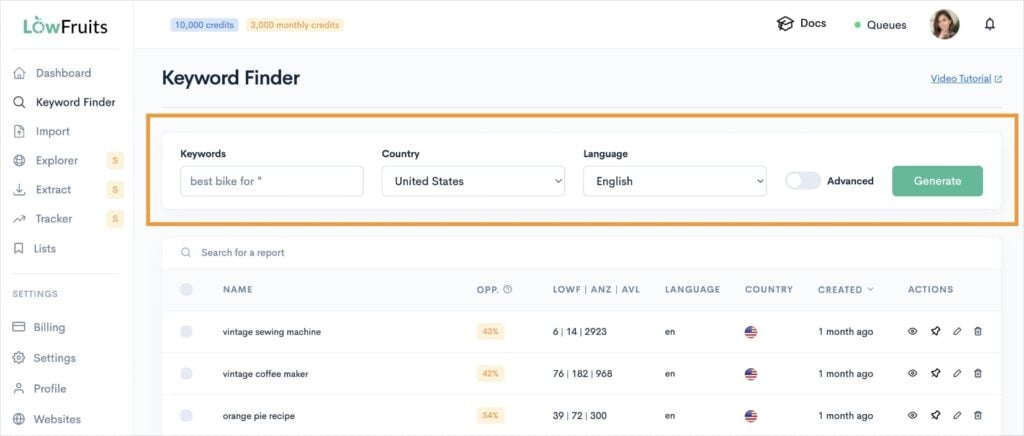
After clicking “Generate,” you’ll get a pop-out window that looks like this:
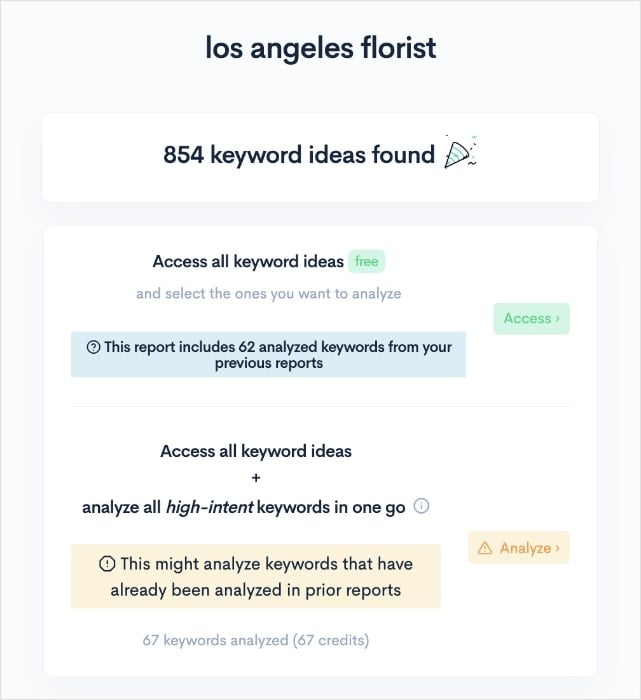
LowFruits gives you two options:
- To access all keyword ideas, which is free (LowFruits uses a credit system).
- To access all keyword ideas and analyze high-intent keywords. In this option, you’ll still get all the keywords but LowFruits analyzes the SERPs for keywords where users are likely to take action. Each keyword analyzed costs 1 credit, and LowFruits will tell you how many high-intent keywords it found, so you know the credit cost in advance.
Personally, I prefer selecting the second option (analyzing high-intent keywords). This saves me time on manual analysis (having to select keywords to analyze) and gives me important metrics on keywords that are likely to convert.
However, if you’re low on credits, you can always select the first option and pick which keywords to analyze manually. This keeps the credit cost down.
For this tutorial, I went with the second option and got the following report:
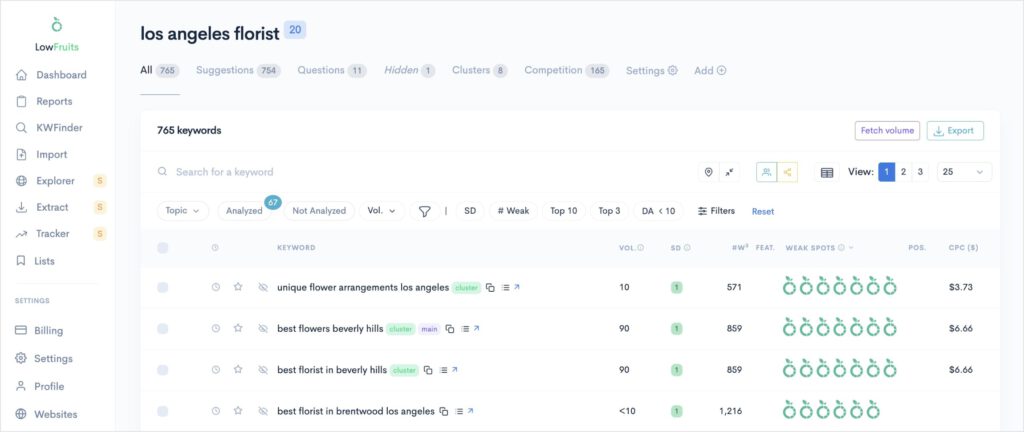
Note: If you selected the first option, all the columns on the right will be blank except volume and SD. You can select keywords to analyze manually by clicking the box to the left of the keyword and clicking “SERP Extract.” This will populate the keyword metrics in the other columns.
Now, let’s move on to the next step to learn what to do with this data.
2. Uncover Long-Tail Variations & Questions
Specific, longer phrases often reveal clearer user intent and less competition. This is where many keyword opportunities live.
Traditional SEO tools make finding these keywords difficult. You have to set filters, comb through thousands of results, and turn away keywords that have super-high search volumes.
LowFruits, on the other hand, reveals these long-tail keyword opportunities automatically for you.
Let’s revisit our earlier report, paying attention to the keywords generated.
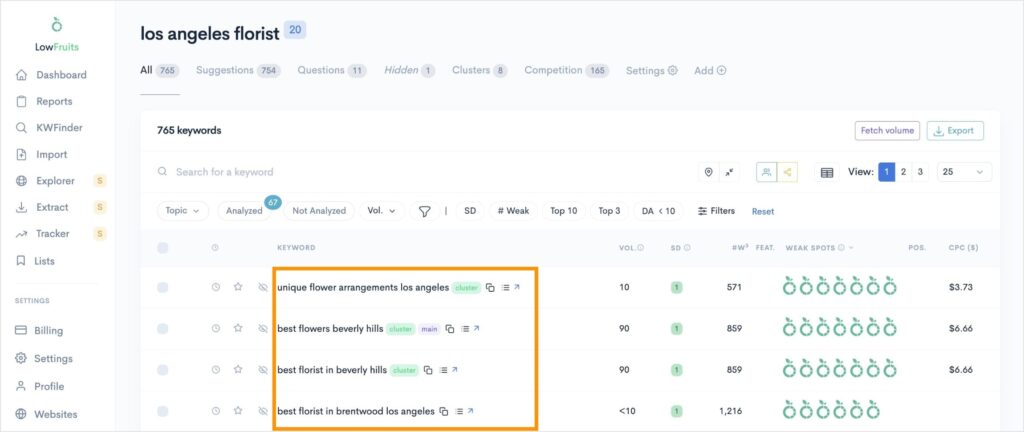
Do you notice a pattern?
All our keywords have 4 or more words. These are long-tail keywords.
Typically, long-tail keywords are phrases that consist of at least 3 words. Short-tail keywords only have 1 or 2 words.
LowFruits specializes in long-tail keyword research, which is why your results will generally be these longer, more specific queries. No filtering required.
You can also get question keywords by clicking on the Questions tab.
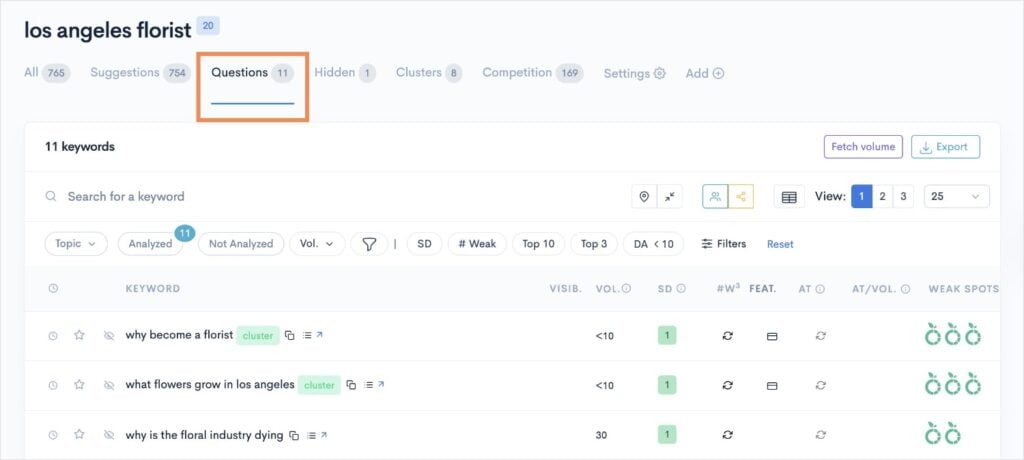
These search queries also have a high keyword return on investment (ROI) due to their specificity.
Pro Tip: Don’t have LowFruits? Use Google Autocomplete (the suggestions that pop up as you type) to get long-tail keyword ideas. You can also explore the People Also Ask (PAA) boxes to get question keywords for your content.
3. Analyze SERP Competition for “Weak Spots”
This is the core of identifying a true keyword opportunity. You need to know if you can realistically compete with the websites already ranking.
After all, you don’t want to waste time chasing keywords and creating content that never stands a chance.
So, what do you look for?
Weak Spots.
In the context of SEO, “Weak Spots” refers to low-authority websites ranking high in search results. These can include:
- Forums: (e.g., Reddit, Quora, niche-specific forums) often indicate that Google doesn’t have a better, authoritative answer.
- Q&A sites: (e.g., Quora, Stack Exchange) similar to forums, they show a direct question being answered, often without deep content.
- User-Generated Content (UGC) platforms: Sites heavily reliant on user submissions.
- Low-authority blogs or websites: Sites with low Domain Authority (DA) or Page Authority (PA) scores, indicating they haven’t built strong trust with Google.
- Outdated or thin content: Pages that are old, lack depth, or don’t fully answer the query.
LowFruits automates the tedious process of SERP analysis.
It visually flags Weak Spots within your keyword reports using special icons. (Green is for a low-authority website, blue is for a forum or UGC.)
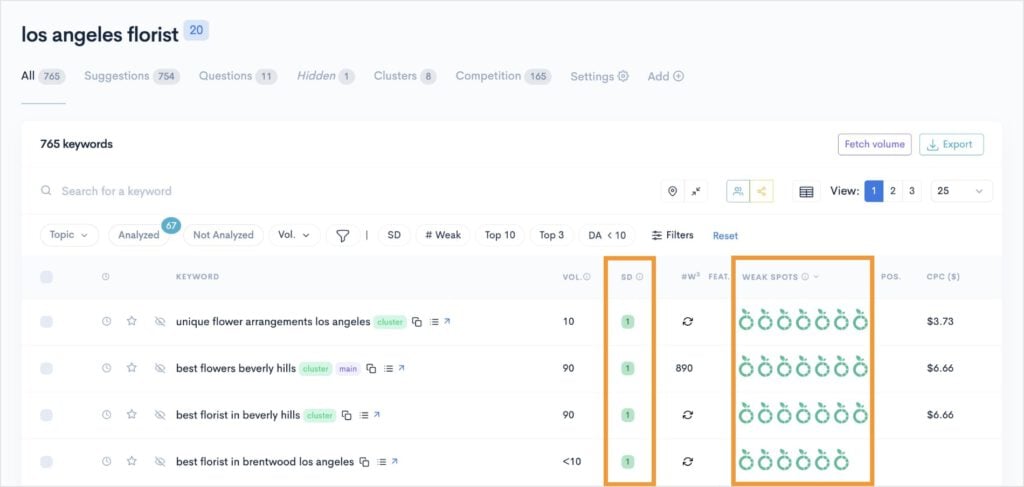
You’ll also see a SERP Difficulty Score (SD) for each keyword, which is LowFruits’ unique metric indicating how easy or hard it is to rank based on the top 10 results. An SD of 1 means it’s relatively easy, while an SD of 3 means it’s very challenging.
Actionable Tip: Look for keywords with a low SD score (preferably 1) and multiple Weak Spots. These are prime keyword opportunities where you have a clear path to ranking high.
4. Assess Search Intent
Even if a keyword has search volume and weak competition, you won’t rank unless you can match the user intent with your content.
How to quickly check: Look at the top results in LowFruits’ SERP overview. If every result is an e-commerce product page, the intent is likely transactional. If it’s all “how-to” articles, the intent is informational.
You can do this for any keyword by clicking the View the SERP button.
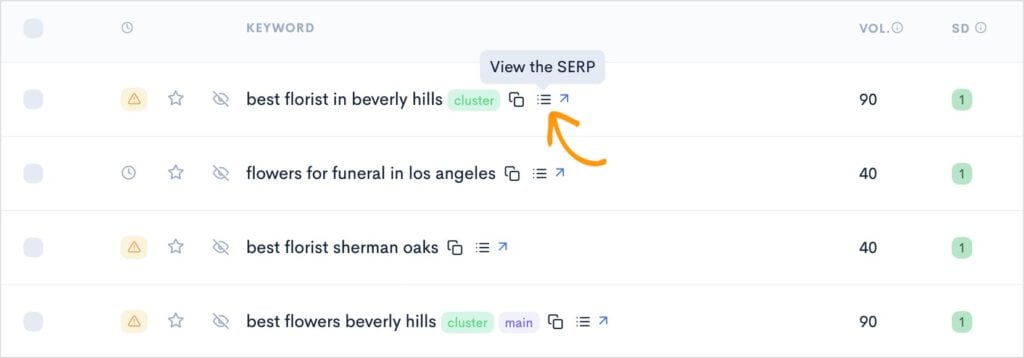
This action will open a pop-out window of the top 10 search results currently ranking in Google.
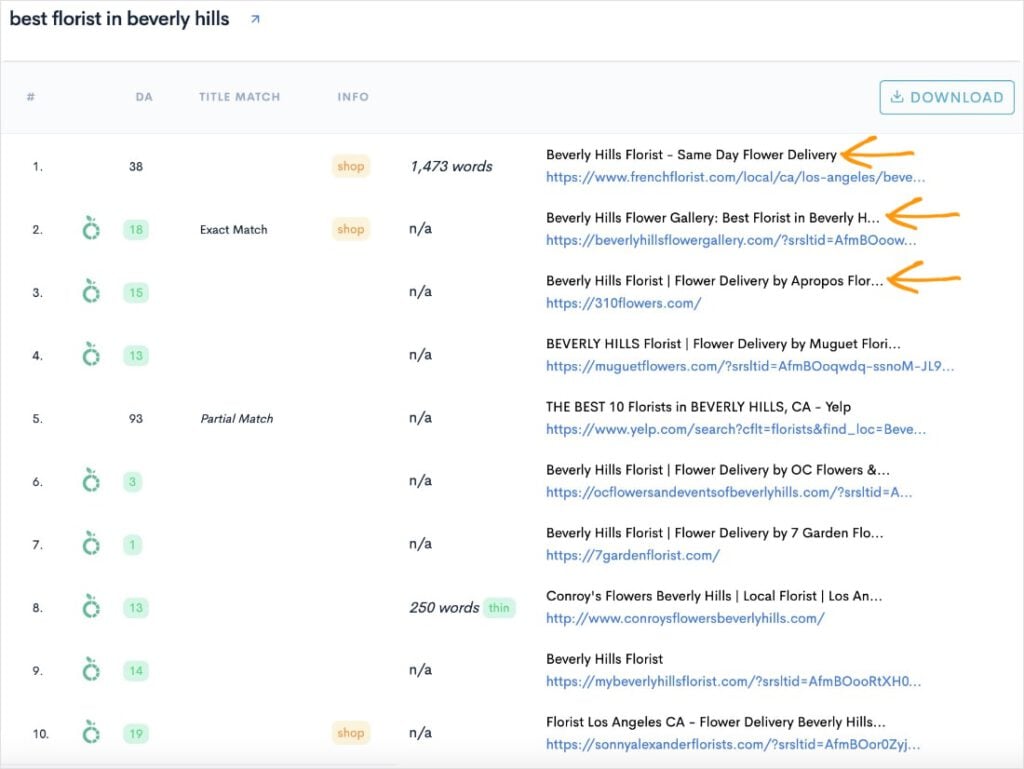
Glance over the results and SEO titles to get an idea of what type of content to create.
You can also clink any of the hyperlinks to visit the competitor’s page and get even more insights into their on-page SEO and content strategy.
Want a free alternative? You can always manually analyze the SERPs by performing a Google search. Enter your seed keyword, see what type of content is ranking, and determine the search intent from your findings.
5. Filter for Your “Low-Hanging” Keyword Opportunities
After generating and analyzing keywords, you’ll have a massive list. The final step is to filter down to your top keyword opportunities.
In LowFruits, you can easily set filters that narrow down your results. Here are some I recommend to find low-competition keywords you can rank for:
- SERP Difficulty Score (SD): Filter for keywords with an SD of 1 or 2.
- Number of Weak Spots: Only show keywords with 2 or more Weak Spots.
- Search Volume: Set a minimum volume to ensure enough interest.
You can edit these filters at the top of any keyword report.
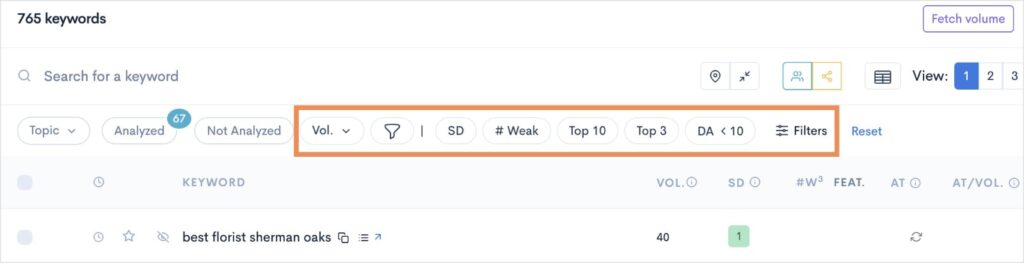
Ultimately, this allows you to quickly transform a vast database into a concise list of highly promising keyword opportunities.
Pro Tip: Sort your final keyword list by search volume by clicking the “Vol.” column. This will put your list in descending order, allowing you to prioritize higher-volume keywords first.
Leveraging Keyword Opportunities for Your Content Strategy
Once you’ve identified the best keyword opportunities for your business, it’s time to integrate them into your SEO strategy.
Here are the key stages to keep in mind:
Content Planning
Each opportunity should translate into a specific piece of content, whether that’s a detailed blog post, a new product page, a how-to guide, or an FAQ section.
By starting with keywords you know you can win, you’re not just creating content — you’re filling a specific need in the market where the current answers are weak.
This approach ensures every piece you publish has a high chance of success in SERPs.
Topic Clustering
To build long-term authority, you need to show Google that you’re an expert on an entire topic, not just a single keyword.
This is where topic clustering comes in.
A cluster consists of a comprehensive “pillar page” on a broad topic, supported by multiple, more specific articles that answer related questions or cover sub-topics. You use internal links to connect them together and pass link juice (aka SEO value).
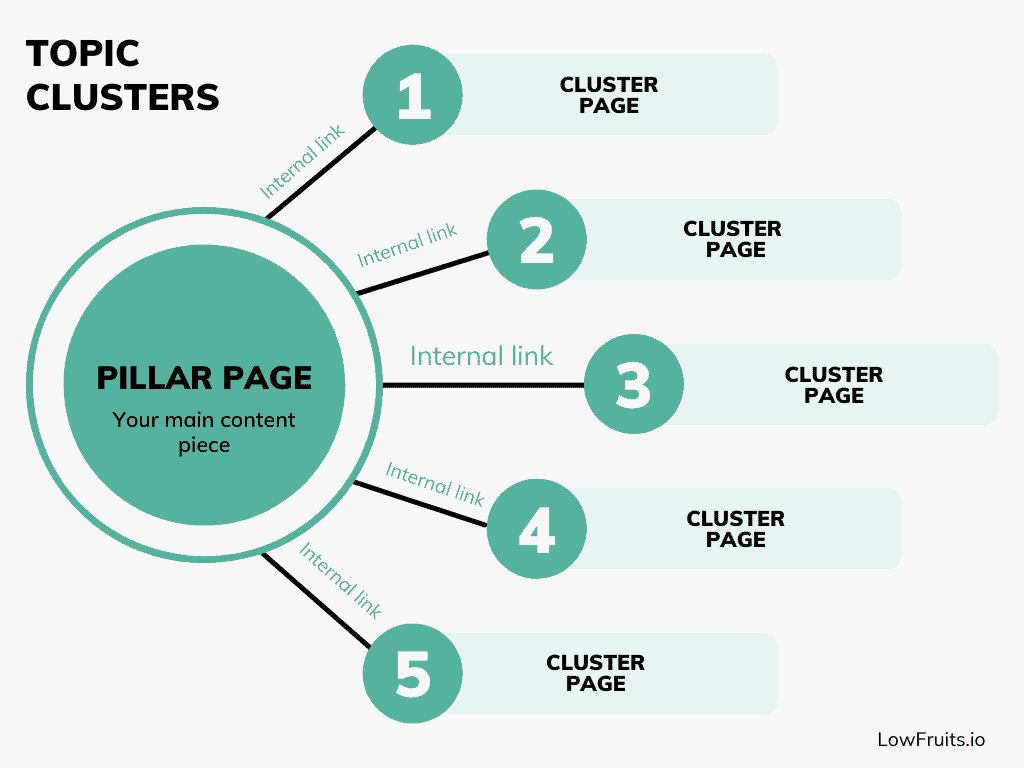
LowFruits automates the clustering process with its Keyword Clustering Tool.
Just click on the Cluster tab at the top of your KWFinder report, and you’ll get an organized view of all the clusters for your seed keyword.
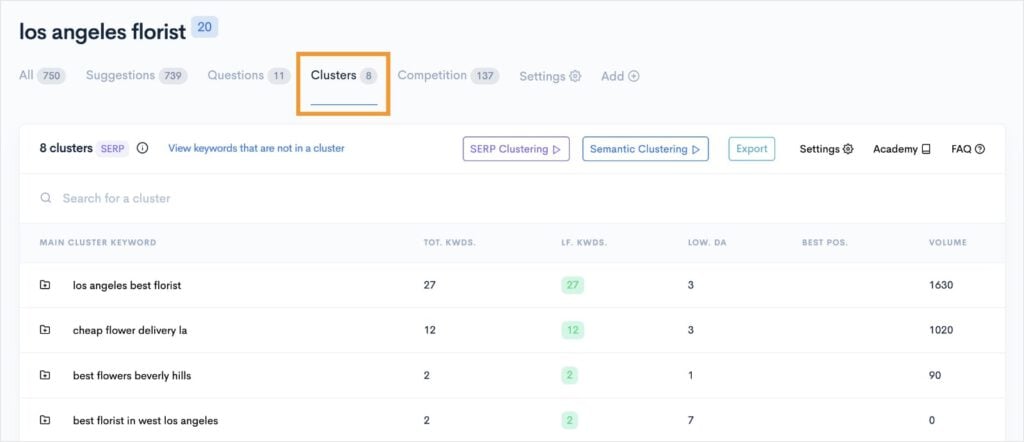
You can open any of these clusters to view the individuals keywords within.
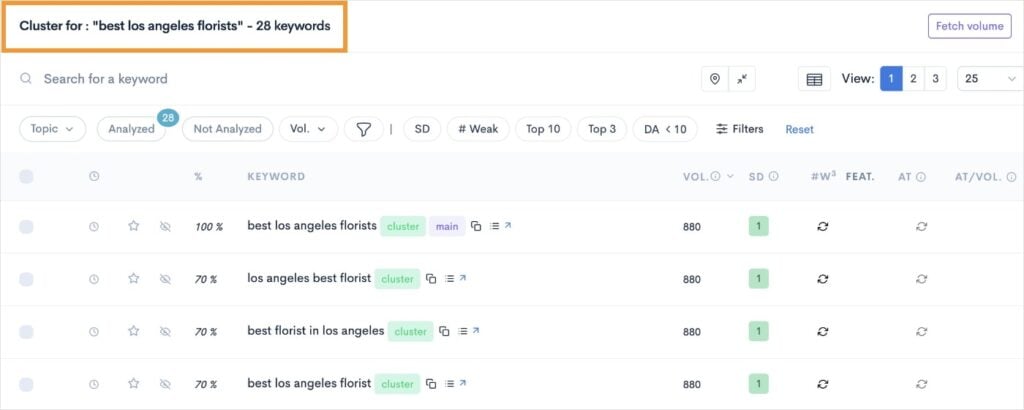
Ultimately, it’s an effortless way to do topic clustering and get multiple keyword targets per page.
On-Page SEO
After you’ve planned and created your content, you must ensure it’s properly optimized. This involves applying on-page SEO best practices to each piece.
Your focus keyword should go in the following areas:
- SEO title
- Meta description
- URL slug
- Introduction
- Body copy
- Conclusion
SEO tools can help with this process. I like using SEOBoost for my own content optimization efforts.
SEOBoost has a user-friendly interface, similar to Google Docs or Microsoft Word. You can type directly in the platform (or paste from another location) and get real-time feedback on your on-page SEO.
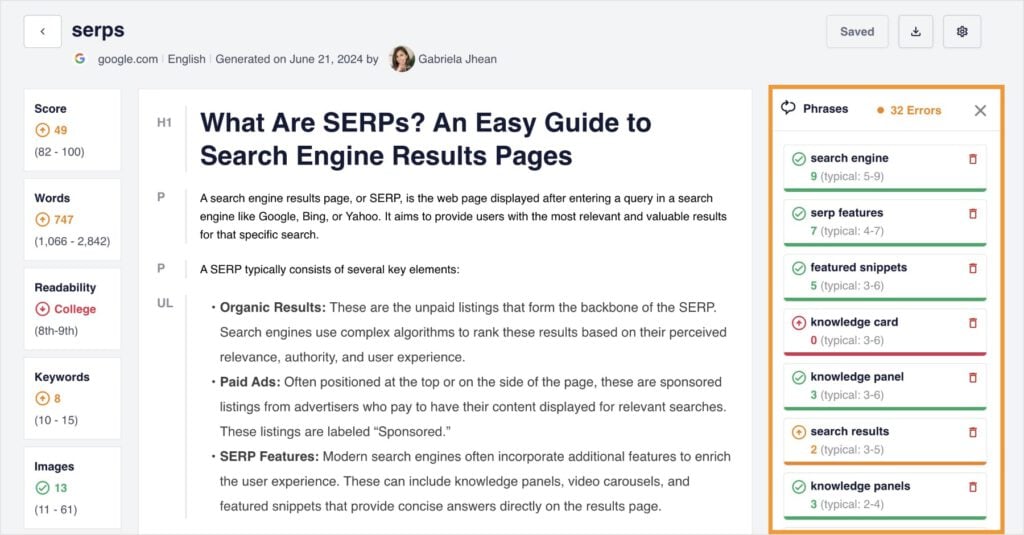
It also gives you related keywords that you should try to incorporate into your text to increase its visibility in SERPs.
WordPress Users: SEOBoost integrates with WordPress via the All in One SEO (AIOSEO) plugin. You can get the same feedback while working directly in the WordPress editor when you connect both accounts.
Final Thoughts
The days of simply chasing high-volume keywords are over.
In today’s landscape, focusing on the right keyword opportunities is the smartest, most efficient way to achieve SEO success. It also allows you to transform overwhelming keyword lists into actionable insights, leading to faster rankings and more targeted traffic.
Looking to level up your keyword research? Check out our other beginner-friendly articles:
- Keyword Research for Small Business Owners
- 8 Keyword Research Tips You Should Know
- Best Long-Tail Keyword Research Tools
- How to Do a Keyword Gap Analysis
- Complete Keyword Research Checklist
Keyword Opportunity FAQs
A keyword opportunity is a search term that has enough user interest (search volume) but where the existing competition in the search results is weak enough for your website to realistically rank highly. It’s the sweet spot where effort meets impact.
A “regular keyword” is just a term people search for, regardless of competition. A keyword opportunity specifically highlights a keyword where you have a genuine, achievable chance to rank because the competing pages are vulnerable (e.g., low-authority sites, forums, or outdated content).
While there isn’t one universal “keyword opportunity score” metric used by all tools, the concept refers to a combined assessment of factors like search volume, relevance, user intent, and crucially, the weakness of the existing competition on the SERP. Tools like LowFruits help you assess this through their SERP Difficulty Score and identification of Weak Spots.
You can find keyword opportunities by starting with broad ideas, then using tools to uncover long-tail variations and high-converting queries. Most importantly, you should analyze the SERPs to identify vulnerable competitors you can outrank.