The dream of automated keyword research is enticing. You enter a few seed keywords, click a button, and a perfect report lands on your screen—search volumes, competition, and a content plan, all ready to go.
While this hands-off approach isn’t quite realistic, there are ways to make keyword research more efficient.
This is where modern tools like LowFruits come in, automating the most repetitive and data-heavy tasks while leaving the strategic thinking where it belongs — with you.
In this automated keyword research guide, I’ll show you how to use LowFruits to master automation while leaving room for irreplacable human expertise.
Let’s get started.
In This Article
- Why Automation in Keyword Research Matters
- LowFruits: Automating Critical Keyword Research Tasks
- Beyond Automation: Where Human Insight Still Reigns Supreme
- A Simple Workflow to Automate Keyword Research With LowFruits
- FAQs About Automated Keyword Research
- Final Thoughts: Smarter, Faster Keyword Research
Why Automation in Keyword Research Matters
If you’ve ever tried to do keyword research manually, you know it can be a massive time sink. It’s tedious and easy to end up off track.
That’s why automating specific parts of the process can be a serious game-changer:
- Time-Saving: The most obvious benefit. Instead of hours of clicking and analyzing, automated tools crunch numbers in minutes. This frees you up to focus on higher-level strategy and content creation.
- Accuracy and Consistency: Manual analysis is prone to human error and inconsistency. Automation ensures that data is collected and processed uniformly every single time, leading to more reliable insights.
- Uncovering Hidden Opportunities: It’s hard for a human to spot subtle patterns or weak competition across hundreds or thousands of search results. Automated analysis helps quickly highlight trends and overlooked opportunities you might otherwise miss.
- Scalability: When you can automate core tasks, you can process a much larger volume of keywords and topics. This is vital for growing businesses or agencies managing multiple projects.
LowFruits: Automating Critical Keyword Research Tasks
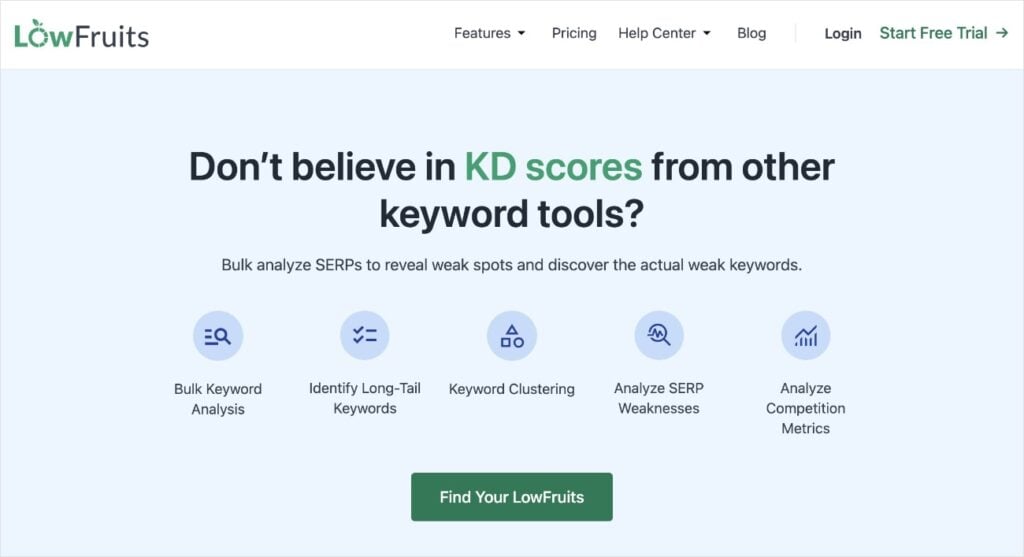
LowFruits isn’t just another SEO tool; it’s built to streamline and automate keyword research tasks that used to take hours.
Let’s explore how it does this.
Automated SERP Analysis
SERP analysis is the backbone of effective keyword research, but it’s also one of the most tedious tasks you’ll encounter. Manually, this means checking the top 10 search results for every keyword you’re considering.
You need to visit each page, see how competitors are optimizing their content, check domain authority, and gauge whether you could realistically compete for that position.
It takes a lot of time and brain power.
The good news is that LowFruits streamlines this process by tenfold. When you’re in the KWFinder, you can “extract” SERP insights with the click of a button. This action populates data like:
- SERP Difficulty Score (SD): The LowFruits metric for keyword difficulty. 1 is easy, 3 is hard.
- Weak Spots: Each icon represents a low-authority domain ranking in the top 10 organic positions. The more Weak Spots there are, the easier it is to rank high in search results. (I’ll tell you more about this metric in the next section.)
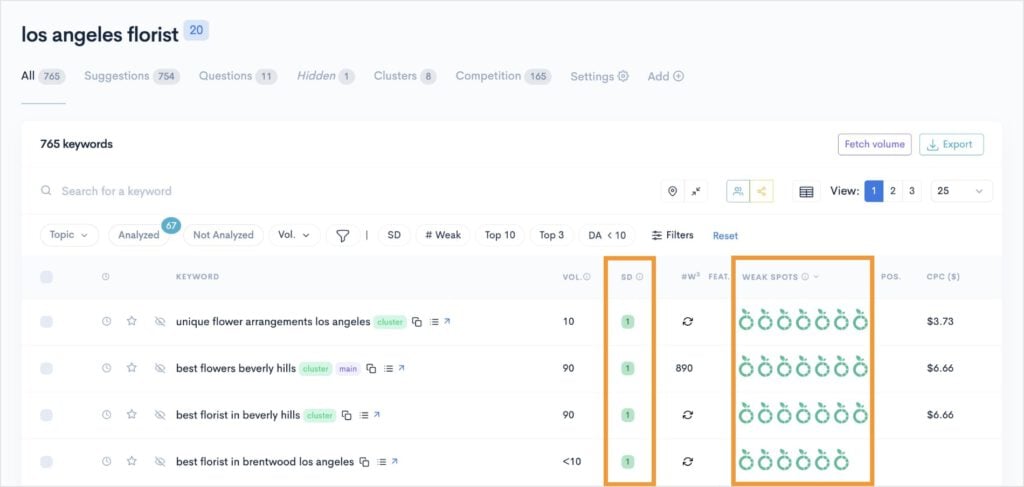
By looking for keywords with a low SD (preferably 1) and multiple Weak Spots, you’ve found “low-hanging fruits” that are prime ranking opportunities.
And it only took a few seconds versus hours of manual research.
Benefit: You instantly grasp the competitive landscape for dozens or even hundreds of keywords without manual clicking. This drastically speeds up your initial screening process, allowing you to move quickly toward keywords that genuinely offer a chance to rank.
Automatic Weak Spot Identification
One of the biggest hurdles in keyword research is finding opportunities where you can actually win. Strong competitors dominate many high-volume keywords. And manually sifting through SERPs to find weak rivals is like looking for a needle in a haystack.
LowFruits identifies these “Weak Spots” automatically, making it a powerful feature for automated keyword research.
Weak Spots are low-authority websites or content formats that rank surprisingly high in search results. They include:
- Forums (e.g., Reddit, Quora, dedicated forums)
- Q&A sites (e.g., Quora, Stack Exchange)
- User-Generated Content (UGC) platforms
- Low-authority blogs or websites (often with low DA/PA scores)
- Outdated content
LowFruits automatically flags these Weak Spots directly within your keyword reports. You’ll see clear indicators next to keywords where low-authority sites are ranking.
This tells you that the existing content isn’t incredibly strong, and a well-optimized piece from your site could potentially outrank them.
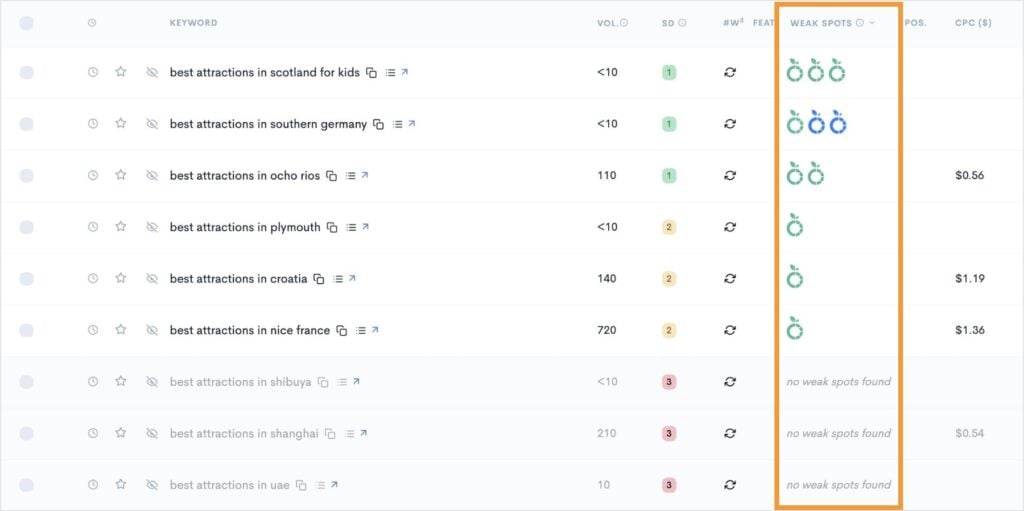
Pro Tip: LowFruits uses a color-coded system to differentiate website types. For example, green icons are websites with domain authority under 20, blue icons are forums or UGC content, and yellow icons represent your website. You may also see purple icons if you set a custom domain you want to highlight.
Streamlined Topic Cluster Creation
Topic clusters have become essential for modern SEO success and building topic authority.
The concept is simple: instead of targeting individual keywords in isolation, you target groups of related keywords. This ensures comprehensive topic coverage in your content and increases the visibility of your web pages in search results.
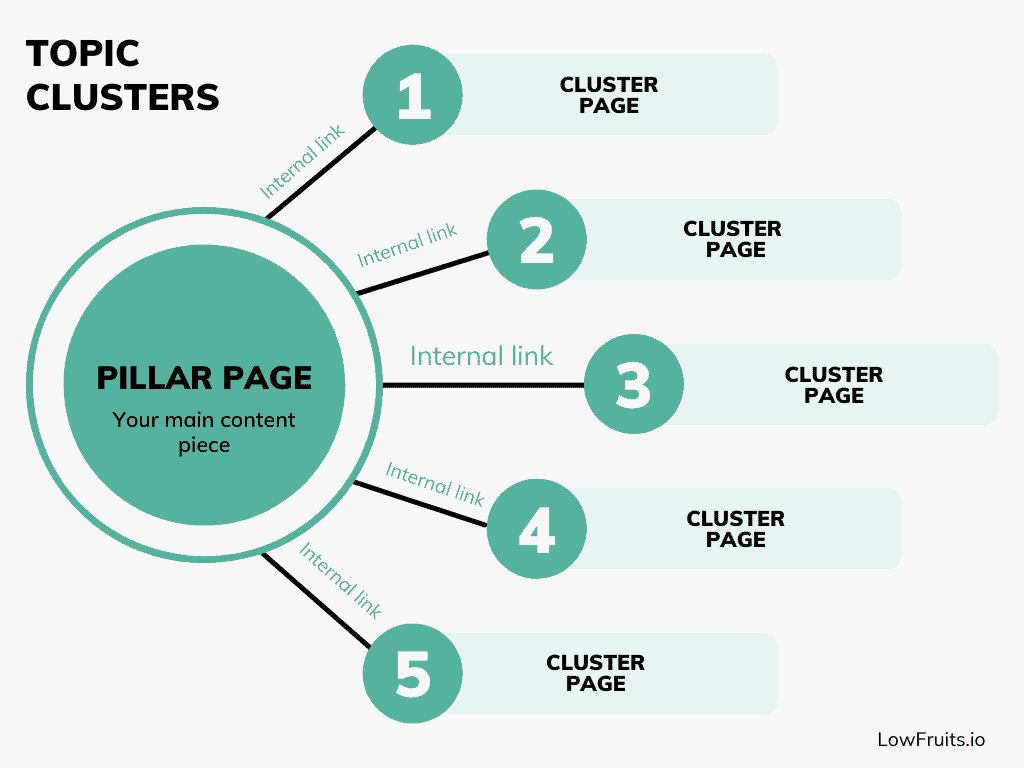
The challenge of topic clusters is that they’re extremely time-consuming to create.
You need to identify all the related keywords, group them by search intent, understand how they connect to each other, and come up with a content strategy that links them all together.
It’s a lot of work. (And that’s coming from someone whose done the process manually. Yep, I used good ol’ spreadsheets before keyword clustering tools were a thing.)
Luckily, LowFruits does this entire process automatically for you.
Whenever you’re in one of your keyword reports, just click the Clusters tab at the top of the screen.
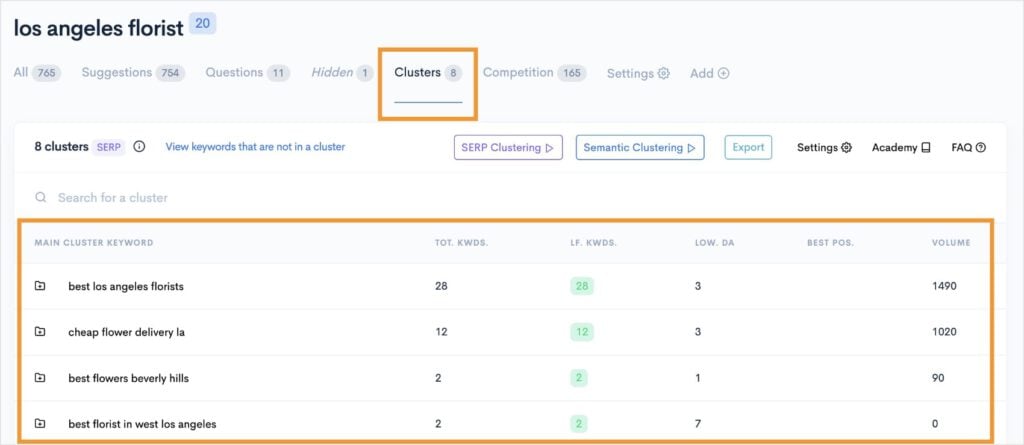
This view will show you all the clusters with shared intent related to your initial seed keyword search.
Pro Tip: This is called “SERP Clustering” in LowFruits. However, you can also do “Semantic Clustering,” which groups keywords by shared common words.
This automation saves hours of manual grouping and ideation. It also empowers you to build comprehensive content strategies that increase your niche authority.
Talk about a win-win!
Automated Keyword Ranking Tracking
Once you’ve done your research and published your content, the work isn’t over. You need to know if your efforts are paying off.
Manually checking keyword rankings daily or weekly for dozens or hundreds of terms is simply not feasible. (Because who has time for that, really?)
LowFruits includes a built-in rank tracker that automatically monitors your keyword positions. You get a centralized dashboard that tells you exactly what’s changed since the last fetch. (You tell it how often you want it to check Google rankings.)

It makes it really easy to see what’s improved or decreased since the last SERP fetch.
I like how you can also expand any of your tracked keywords to see how its position has changed over time.

This allows you to pinpoint if your on-page SEO efforts are making a difference. It also helps you assess if you’re on track to meeting your SEO goals.
Overall, it’s an incredibly intuitive feature that makes tracking keyword performance effortless and accurate.
Beyond Automation: Where Human Insight Still Reigns Supreme
It’s important to remember that while you can automate keyword research tasks with LowFruits, it doesn’t replace the need for human intelligence and strategy. The most successful SEO strategies combine powerful tools with expert human insight.
Here’s where your human touch is still irreplaceable:
- Interpreting Data: LowFruits provides reliable data, but it’s up to you to interpret what that data means for your business. A “Weak Spot” is an opportunity, but you need to decide if it aligns with your brand and audience.
- Understanding Nuance: Search intent can be complex. While tools categorize, only a human can truly understand the subtle psychology behind a query, seasonal trends, local slang, or emerging topics that haven’t shown up in data yet.
- Content Creation: Tools can guide you on keywords, but they can’t write compelling, engaging, and valuable content that truly connects with your audience. That’s your job! (Although, AI SEO tools can help speed up the process.)
- Strategic Planning: Integrating keyword opportunities into a broader marketing plan, understanding your competitors’ overall strategy, and adapting to industry changes still requires human oversight and strategic thinking.
A Simple Workflow to Automate Keyword Research With LowFruits
Here’s how you might leverage LowFruits’ automated features in a practical workflow for your own keyword research:
- Start Broad: Begin by entering a broad seed keyword or topic related to your business into LowFruits. This is your initial input.
- Automated Analysis: Let LowFruits do its magic. After selecting which keywords you want it to extract, it will automatically analyze the SERPs. You’ll get essential metrics and competitor insights, like Weak Spots.
- Filter for Opportunity: Use LowFruits’ filters to quickly sort through the results. Look for keywords with good search volume, low difficulty, and multiple Weak Spots. These are your prime “low-hanging fruit” opportunities that are easier to target.
- Plan Content with Clusters: Head to the “Clusters” tab. LowFruits will have already automatically grouped related keywords into topic clusters. Use these to plan comprehensive articles or content series that build topical authority.
- Track Performance: Once your content is live, add your target keywords to the LowFruits Rank Tracker. It will automatically monitor your positions, giving you real-time feedback on your efforts.
This approach allows you to focus less time on keyword research and more energy on creating content that ranks.
FAQs About Automated Keyword Research
Can keyword research be fully automated?
No, keyword research cannot be fully automated in a “set-it-and-forget-it” way. Human insights remain essential for interpreting data and nuances. With that said, keyword research tools can significantly speed up the process and automate specific tasks.
What parts of keyword research can be automated?
You can automate specific keyword research tasks, such as gathering large lists of keyword ideas, analyzing the SERPs (like domain authority and backlinks), identifying weak competitors, grouping related keywords into topic clusters, and tracking keyword ranking performance.
Is automated keyword tracking reliable?
Yes, automated keyword tracking tools like LowFruits’ built-in rank tracker are generally reliable. For LowFruits, they extract your ranking positions directly from Google. This means your data is straight from the source and updated frequently.
Final Thoughts: Smarter, Faster Keyword Research
The future of keyword research isn’t about complete automation. It’s about smart automation that amplifies human expertise rather than replacing it.
Tools like LowFruits represent this perfect balance, dramatically reducing the time spent on tedious data collection while freeing up mental bandwidth for the strategic thinking that actually drives SEO success.
Related reading: