You’ve built a website, started posting content, and set up your Google Business Profile for your local business. The goal? To get found online and bring local customers through your door.
But how do you know if your search engine optimization (SEO) efforts are actually working?
While you’re unlikely to have a line out the door as soon as your site goes live, there are ways to see if your local rankings are on the rise.
Say hello to local rank tracker tools, your most valuable ally for monitoring your visibility in local search results.
In this article, I’m going to share the 7 best local rank trackers I’ve personally used to help my clients monitor their local SEO and grow their visibility online. You’ll learn:
- Why local rank tracking is essential for small businesses to compete and grow.
- The best tools for tracking local SEO on a map and in traditional search.
- Each tool’s strengths and weaknesses, as well as tips for how to use it.
Let’s get started.
In This Article
Are Local Customers Finding You Online?
Before we dive into the specifics of rank tracking, let’s talk about the bigger picture.
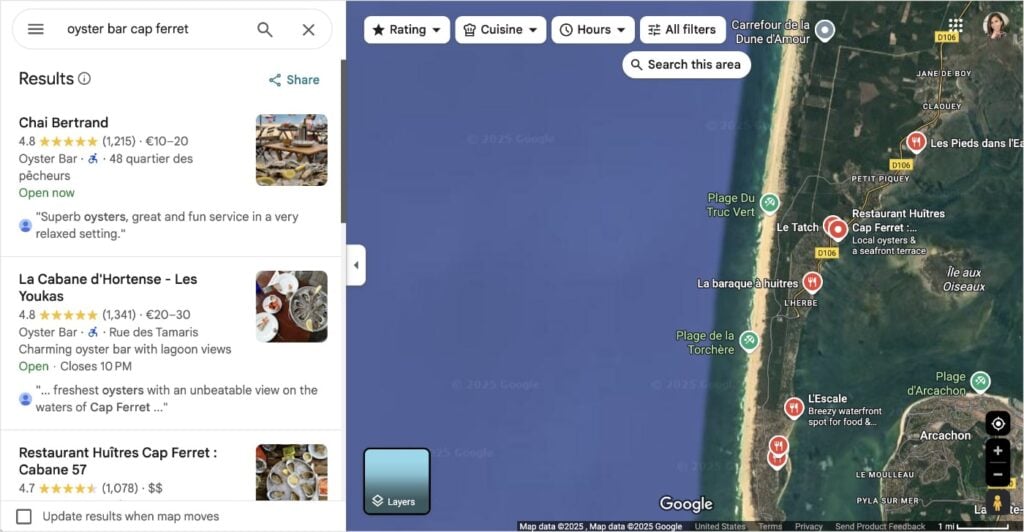
Local SEO is the process of optimizing your online presence to attract more customers in your area. It goes beyond your website, and focuses on making your businesses visible in all digital places local customers look, like Google Maps (shown below) and online directories.
Here’s why it’s so powerful for local businesses:
- You connect with mobile users: Most local searches are done on mobile with “near me” keywords. A strong local SEO strategy ensures you appear for these critical, high-intent searches.
- Your GBP becomes a sales magnet: Your Google Business Profile (GBP) is the new front door for your business, giving customers a clear path to get directions, call you, or visit your website.
- You build trust and credibility: Positive reviews, accurate business information, and an active online presence all build social proof that tells customers and Google you are trustworthy.
- You compete against national brands: Local SEO allows a small business to compete with national brands that don’t have a physical presence in the area.
Ultimately, by focusing on local SEO, you’re building a foundation that directly impacts your foot traffic, phone calls, and, your bottom line.
5 Reasons Why You Need to Use a Local Rank Tracker
Here are the key reasons why a local rank tracker tool can benefit your business:
Want to jump straight into the tools? Go ahead and hop over to my picks for the best local rank trackers.
1. Reveals Your True Visibility
Standard rank tracker tools only tells you your average national rank.
A local rank tracker, however, can simulate searches from different locations around your business. Some even show visual “heat maps” of your rankings from streets and neighborhood, revealing exactly where you’re strong and where you have blind spots.
Without this granular data, you might think you’re ranking well in your city, when in reality, you’re only visible in a very small area.
2. Helps You Outmaneuver Local Competitors
Local SEO is a hyper-competitive game. The best way to win is to know exactly what your competition is doing.
A local rank tracker allows you to track your direct local competitors to see where they’re outranking you for your most important keywords.
This data allows you to focus your efforts on the specific areas where you can steal their traffic and dominate the local market.
3. Secures Rankings in the Google Local Pack
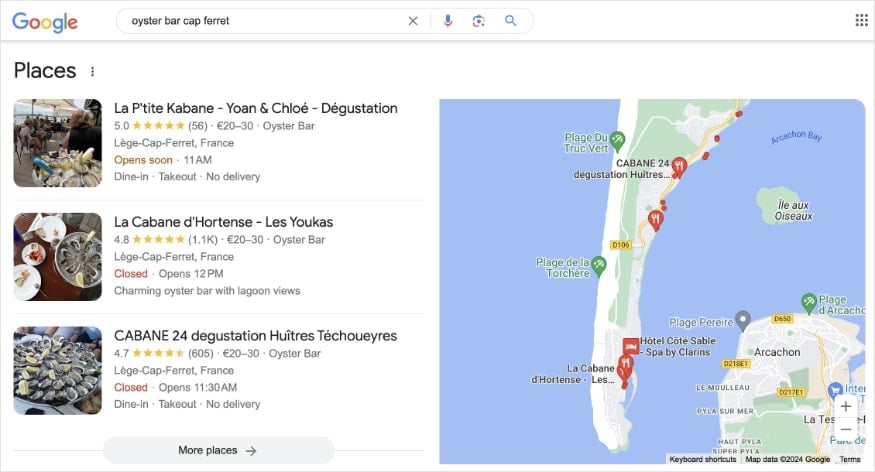
The Local Pack (the map with the top 3 business listings) is where the majority of local clicks happen. A good local SEO rank tracker will show if you’re appearing in this section and help you optimize to stay there.
4. Informs Your SEO Strategy
Instead of guessing what’s working, you can see how your local SEO efforts are impacting your visibility in real-time
For example, if you get a surge of new positive reviews, you can use your rank tracker to see if your rankings have improved in response.
This data-driven approach helps you double down on successful strategies and adjust what isn’t working.
5. Saves Time and Money
Manually checking your rankings from different locations is tedious and inaccurate.
A local rank tracker automates this process, providing you with precise, clean data in minutes.
This saves you countless hours and helps you focus your budget on strategies that actually work.
7 Best Local Rank Trackers in 2026
1. Semrush
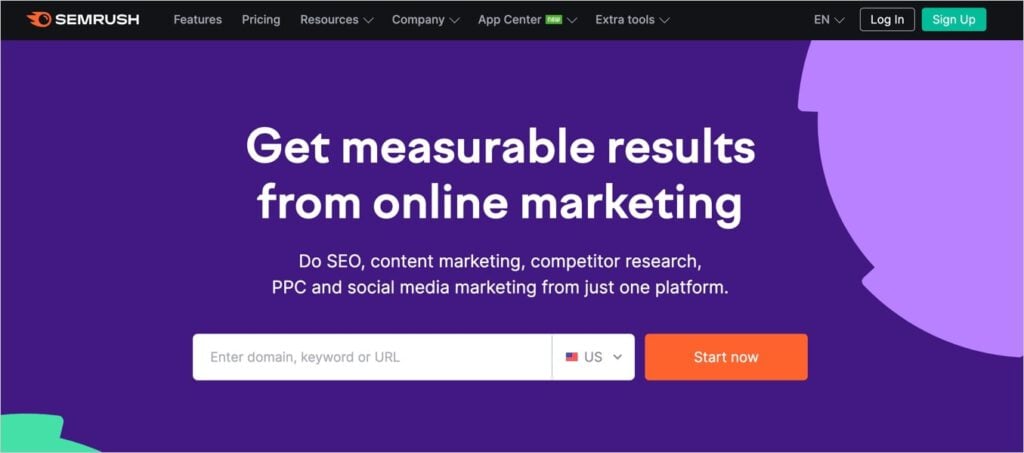
Semrush is an industry standard for a reason. Its local rank tracking feature, while part of a larger suite, is powerful and user-friendly. I appreciate that I can track local rankings alongside my keyword research and content marketing efforts, all from one dashboard.
Local SEO Key Features:
- Map Rank Tracker: Provides a geo-grid heat map that visualizes your rankings in Google Maps across a specific area.
- Competitor Analysis: Track your direct local competitors to see how you stack up in both local and organic search results.
- Local Pack and Organic Results: Monitors your visibility in both the Local Pack and the traditional organic search results.
- Google Business Profile Integration: Allows you to manage and optimize your Google Business Profile directly within the platform.
How to Use It: Use the Map Rank Tracker to set up a geogrid scan around your business location. This will give you a visual overview of your rankings. Then, use Semrush’s other tools to find content and keywords that can help you fill in the “cold” spots on your map.
Pricing: Starts at $129.95/month.
2. BrightLocal
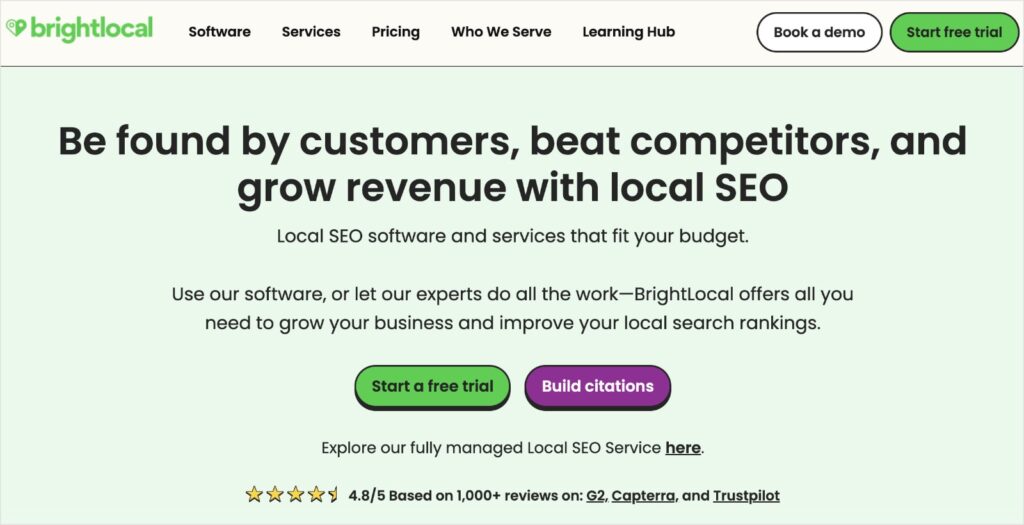
BrightLocal is a key player in the local SEO market, and their platform is built specifically for local businesses. Its strength lies in a comprehensive suite of tools that go far beyond just rank tracking.
I’ve used BrightLocal for years to ensure my clients have a solid foundation of local listings and reviews, which are critical ranking factors. It’s the ultimate tool if you want to manage every aspect of your local SEO from a single platform.
Local SEO Key Features:
- Local Search Grid: A geogrid tool that visualizes your rankings across a service area.
- Local Rank Tracker: Tracks daily keyword rankings for your business in Google and Bing.
- Reputation Management: Monitors and helps you generate reviews on platforms like Google, Yelp, and Facebook.
- Citation Building and Auditing: Identifies inconsistent business listings and helps you build new ones to improve local authority.
How to Use It: Start with the Citation Tracker to identify and fix inconsistent business listings. Then, use the Local Search Grid to track your rankings in your key service areas.
Pricing: Local rank tracking starts at $29/month.
3. Whitespark
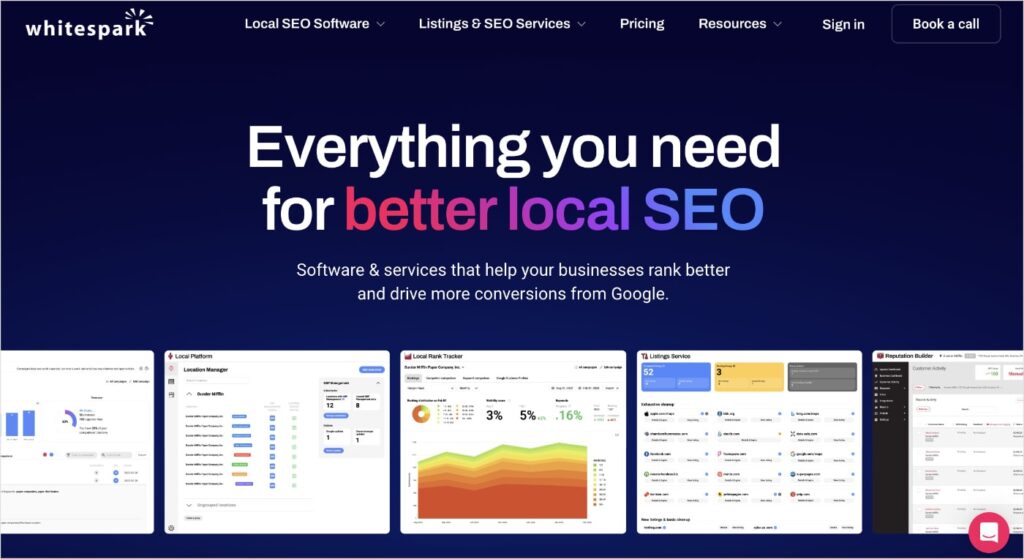
Whitespark is a veteran in the local SEO space, and their expertise shows in their tools. I’ve always admired their Local Citation Finder, which is a simple way to find new backlink opportunities and audit existing ones.
Their Local Rank Tracker is also a powerful solution for tracking local rankings with visualization features. Whitespark’s focus on local search means their tools are highly specialized and effective for both small businesses and larger agencies.
Local SEO Key Features:
- Local Rank Tracker: Provides geogrid visuals and tracks local pack, maps, and organic results.
- Local Citation Finder: Helps you discover citation and backlink opportunities from your competitors.
- Reputation Builder: An automated review-getting platform that helps you build a strong online reputation.
- Google Business Profile Management: Tools to manage your GBP listings and profiles from a single dashboard.
How to Use It: Use the Local Citation Finder to find where your top local competitors are getting their citations. This can help you build your own a list of new citation opportunities.
Pricing: Whitespark has a unique pricing structure compared to other SEO tools. They don’t bundle all their software and tools into a single platform. Instead, you can pick and choose which ones to buy and use. To give you an idea, the Local Rank Tracker starts at $14/month and the Local Citation Finder starts at $33/month.
4. Local Falcon
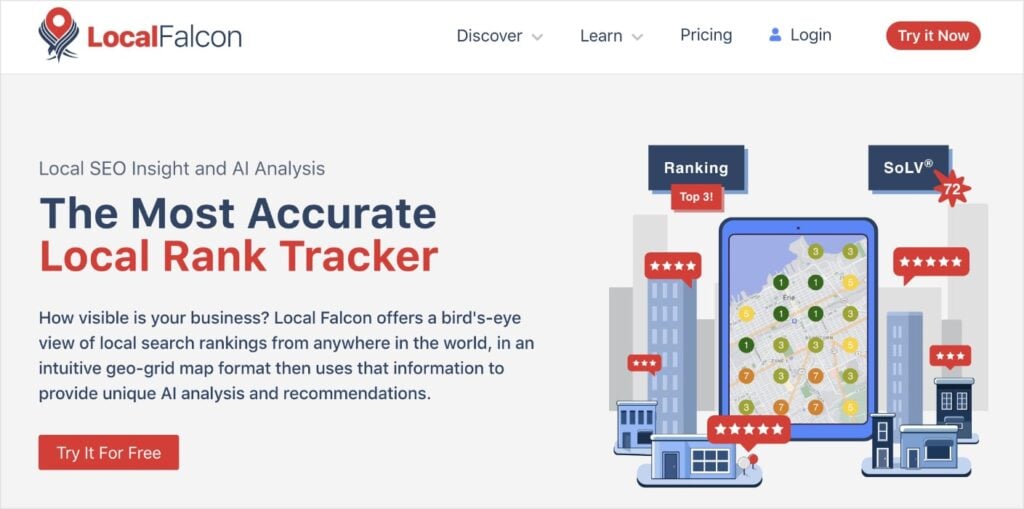
Local Falcon pioneered the geogrid visualization, and it has remained a top choice since its debut.
If your primary goal is to see a visual map of your rankings, Local Falcon is one of the best choices on the market. It’s highly effective for getting a clear snapshot of your local search performance.
I like how it makes the invisible world of local rankings visually clear and easy to understand.
Local SEO Key Features:
- Geogrid Map: Visualizes your rankings on a map with customizable grid sizes.
- Flexible Grid Points: Allows you to adjust your scan area to get hyper-specific data.
- Historical Data Tracking: Monitors ranking changes over time, so you can see if your efforts are paying off.
- Competitor Analysis: Compares your rankings side-by-side with your local competitors.
How to Use It: Set up a geogrid scan for your primary keyword. Analyze the map to see where you’re ranking well and where you’re not. Use this data to inform your local content strategy, focusing on the keywords that perform best in your key service areas.
Pricing: Starts at $24.99/month.
5. Moz Local
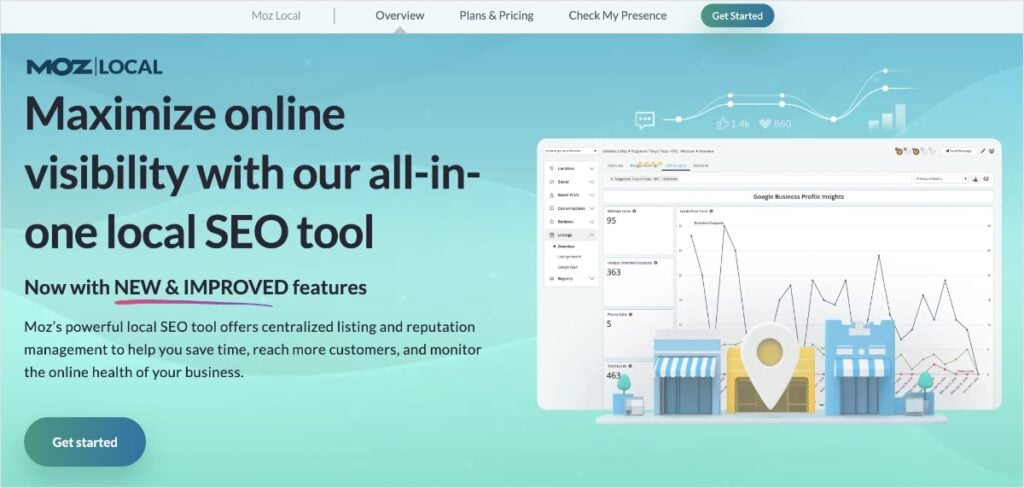
You may already be familiar with Moz, which has been a long-trusted brand in SEO.
Moz Local is their solution to managing your local listings and reputation online. It’s a great choice for beginners who want a simple, clean interface to handle their local SEO basics.
The Moz Local platform helps ensure your business information is consistent across all major directories and is a perfect starting point before you get into more complex tools.
Note: In digital marketing, we call this process NAP SEO. It stands for Name, Address, and Phone Number. The idea is to make your NAP details consistent across the internet to build trust with Google.
Local SEO Key Features:
- Listing Management: Publishes consistent business data (NAP) across a network of directories.
- Reputation Management: Tracks and helps you respond to reviews from a single dashboard.
- Accurate Ranking Data: Provides insights into how you’re ranking for local keywords.
- Google Business Profile Management: Tools to help you optimize your GBP and keep your information up-to-date.
How to Use It: Use Moz Local to audit your business listings and ensure your Name, Address, and Phone Number (NAP) is consistent across all platforms. Inconsistent NAP can hurt your local rankings.
Pricing: Starts at $16/month.
6. SE Ranking
SE Ranking is an all-in-one platform that offers a powerful and affordable alternative to more expensive SEO options. Its local rank tracker is robust and includes features that are ideal for a growing small business, such as competitor tracking and accurate ranking data.
I like it because it makes SEO more accessible than the heavy price tags of some of its competitors.
Local SEO Key Features:
- Local Rank Tracking: Monitors your rankings in Google Maps, Google, and Bing, with customizable location tracking.
- SERP Features and Snippets: Tracks how often your business appears in special SERP features like the Local Pack.
- Competitor Analysis: Helps you monitor the performance of your local competitors.
- Website Audit Tool: Provides technical SEO insights to ensure your website is a strong foundation for your local SEO.
How to Use It: Use SE Ranking’s keyword rank tracker to monitor your top 10 most important local keywords. Then, use the website audit tool to ensure your website is technically sound, which is a major factor for local SEO.
Pricing: Starts at $52/month.
7. Local Dominator
While many tools offer local tracking as a secondary feature, Local Dominator is built from the ground up to be a specialist in geogrid tracking.
I love its focus on providing hyper-accurate, street-level rank data, which is essential for truly understanding your local visibility. It’s ideal for businesses that need to see the most precise picture of where they stand against the competition.
Local SEO Key Features:
- Precision Geogrid Technology: Uses accurate geo-coordinates to provide street-level rank tracking, giving you a true picture of your performance.
- Integrated GBP Management: Manage multiple Google Business Profile listings from a single dashboard, including posts, media, and Q&As.
- Customizable Scan Control: Set custom grid sizes and shapes to get as granular as you need, ensuring you only track within the specific areas that matter.
- AI-Powered Insights: Provides data-driven analysis and optimization recommendations to improve your local rankings.
How to Use It: Use Local Dominator to set up a detailed geogrid scan for your most critical local keywords. Analyze the resulting heat map to identify your ranking “blind spots” and use that data to create a targeted strategy for optimizing your Google Business Profile and website content in those specific areas.
Pricing: Starts at $1.95 for first the first month for new users. From there, plans start at $39/month.
Bonus: LowFruits
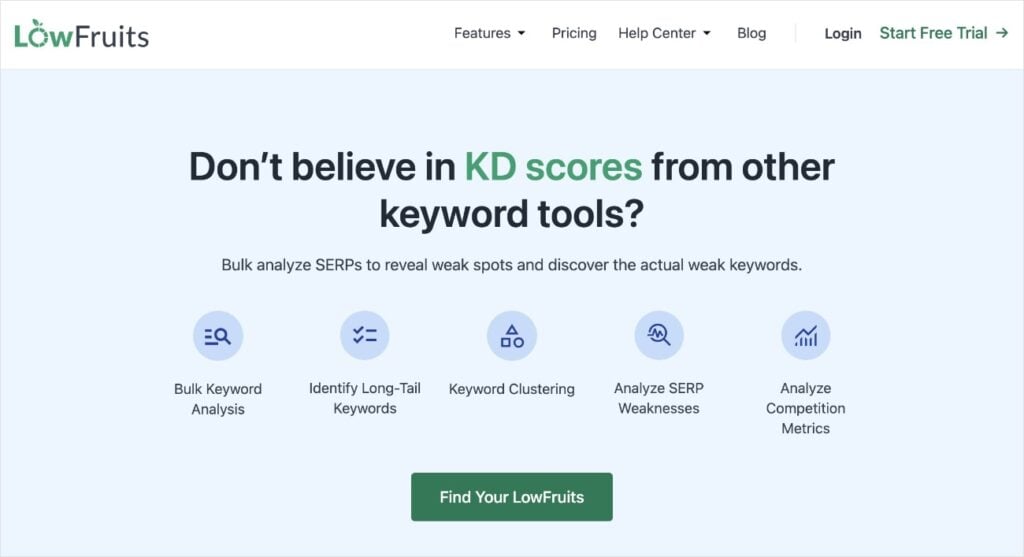
While not a local rank tracker in the traditional sense, LowFruits is a secret weapon for local SEO. It helps you find the low-competition, long-tail keywords that your local audience is actually searching for.
The KWFinder reveals easy keywords by providing the following metrics:
- SERP Difficulty Score (SD): LowFruits metric for keyword difficulty, 1 is easy, 3 is hard.
- Weak Spots: Low-authority domains ranking in the top 10 search results.
- And more
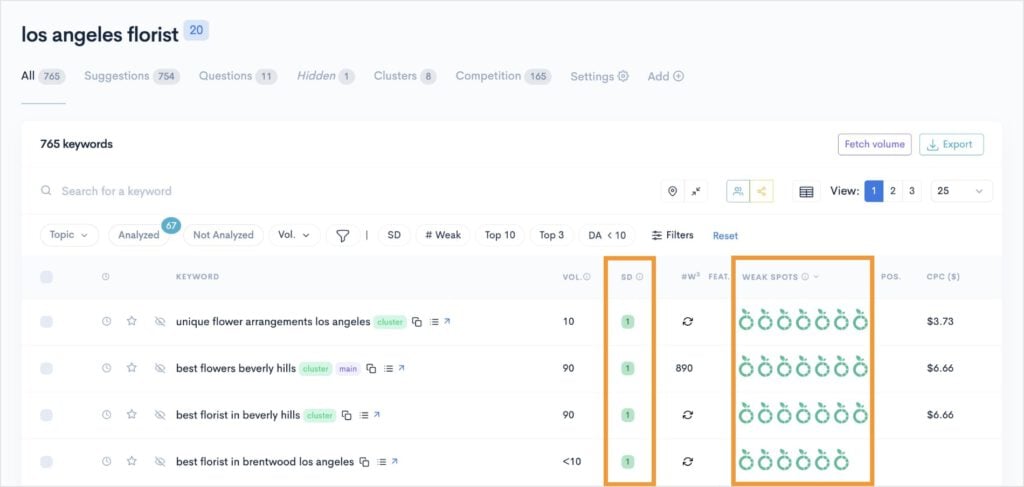
By focusing on the above metrics, you can quickly spot local keywords that are prime ranking opportunities, even for new websites or small businesses.
These keywords can become the heart of your on-page SEO strategy and guide your content optimization efforts., helping you reach more customers in your area.
Further reading: How to Do Local SEO Keyword Research
I also want to point out that LowFruits does have a keyword rank tracker. And while it’s not specific to local SEO only, you can track only local keywords if you want to.
That’s because you decide which keywords the tool tracks. Here’s how it works:
First, add the keywords you want to track to Rank Tracker. Then, adjust your settings and click Track.
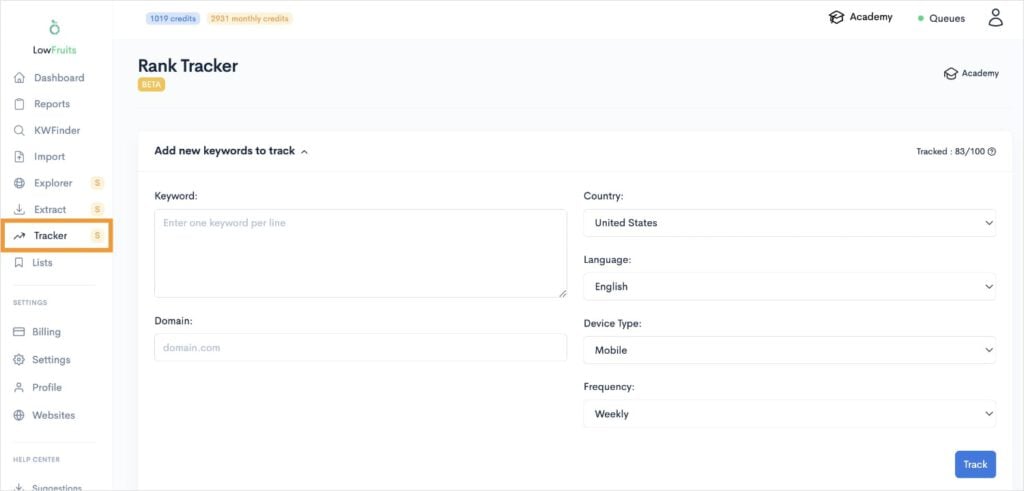
Note: You can track up to 100 keywords with the standard subscription and up to 500 keywords with the premium subscription.
LowFruits will pull your keyword positions straight from Google based on the frequency you selected during setup (daily, weekly, or monthly). You’ll get this data in a dashboard like this:
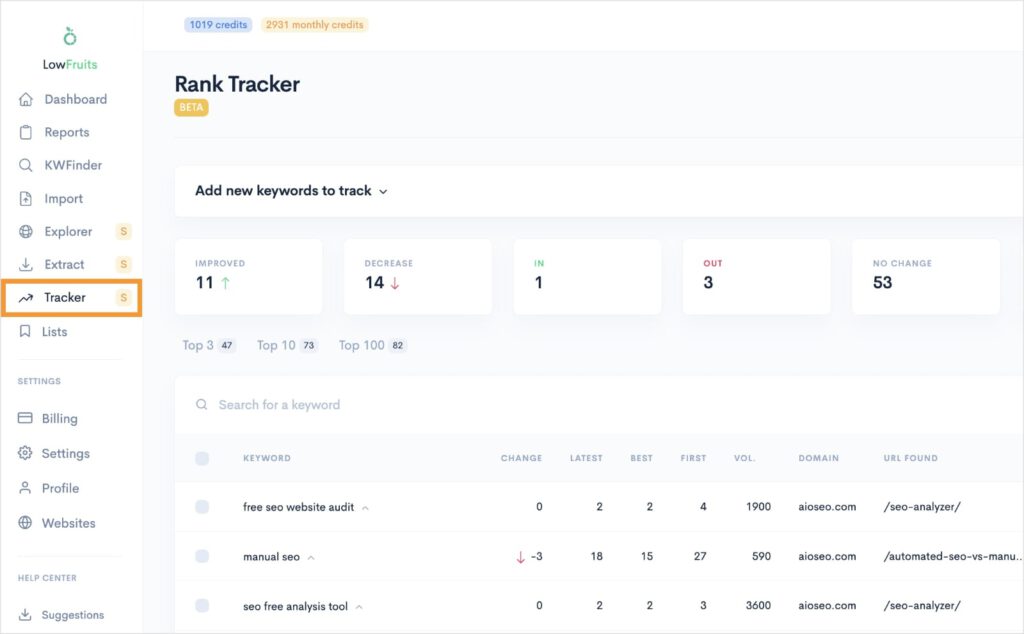
This view makes it easy to see which keywords have improved, or declined, in performance since the last fetch.
I also really like how you can expand any tracked keyword to see its historical performance over time.
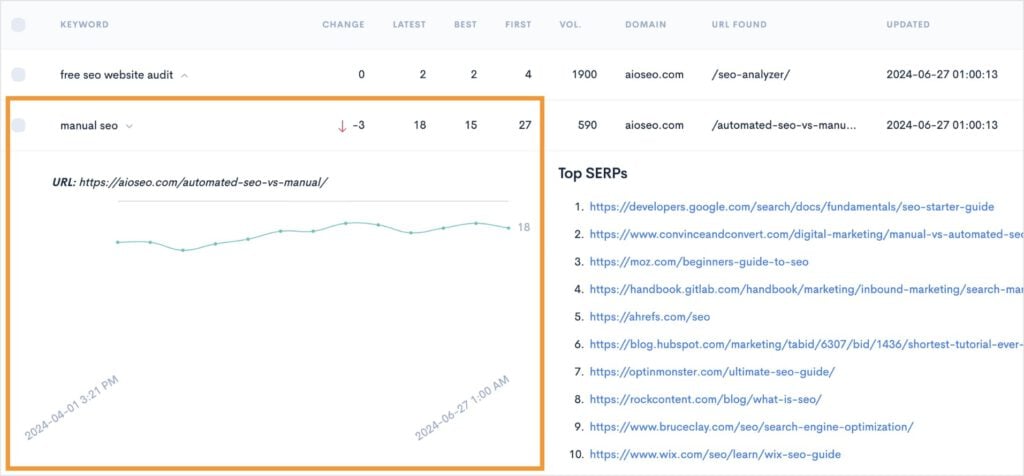
This is a good way to monitor your most important local keywords and see if your SEO efforts are actually paying off. Plus, it’s super beginner-friendly and has basically no learning curve. (All you really have to do is the initial setup, then everything else is automatic.)
Local SEO Key Features:
- Low-Competition Keywords: Uncovers local, long-tail keywords that are easy to rank for.
- Weak Spot Analysis: Identifies low-authority domains in SERPs that you can easily outrank.
- Rank Tracker: Track your most important keywords from a single, user-friendly dashboard.
- Keyword Extractor: Find and steal your competitors’ keywords to grow your own rankings.
- Keyword Cluster Tool: Automatically cluster local keywords into related groups so you can maximize the visibility of each piece of content.
Pro Tip: Once you find a cluster of local keywords with LowFruits, create a single, comprehensive service page or blog post that targets the entire group. This is far more powerful for SEO than creating many separate, thin pages for each keyword variation.
How to Use It: Use LowFruits to find long-tail keywords with low competition (e.g., “best pizza restaurant in [your city]”). These are perfect for creating blog posts or landing pages that attract highly targeted local traffic. You can also use the Rank Tracker to monitor your most important local keywords in Google search results.
Pricing: Subscription plans start at $21/month and give you access to Rank Tracker. LowFruits also offers pay-as-you-go (PAYG) pricing, but you won’t be able to track keywords without a subscription.
My Criteria for Picking the Best Local Rank Trackers
There are a lot of tools on the market, so how did I choose the ones for this list? I picked these tools based on a few key factors that matter most to small businesses and entrepreneurs:
- Accuracy: Does the tool provide accurate, reliable data? Local rankings can be highly volatile, so precision is key.
- Ease of Use: Is the interface intuitive? I prioritized tools that are easy to set up and provide clear, visual reports that don’t require an advanced degree in SEO to understand.
- Affordability: Are the pricing models fair for a small business? I looked for tools with flexible plans, free trials, and competitive pricing.
- Actionable Features: Beyond just tracking, do the tools provide features that help you take action, like managing your Google Business Profile or analyzing competitor strategies?
Final Thoughts: Taking Control of Your Local SEO
Local SEO isn’t a “set it and forget it” strategy. However, with the right local rank tracker, you can take control of your visibility and outmaneuver your competitors.
The best local rank trackers allow you to monitor the impact of your SEO efforts and Google Business Profile optimizations in real time. They also make tracking position changes seamless, allowing you to focus on what matters most: your business.
I hope this article helped you find the best local rank tracker for your specific needs. If you’d like to explore additional LowFruits content, I recommend checking out our on-page SEO guide and our picks for the best AI SEO tools to speed up content creation.
FAQs About Local Rank Tracker Tools
What is a local rank tracker?
A local rank tracker is an SEO tool that monitors your website and Google Business Profile’s performance in local search results. Unlike a national rank tracker, it shows you how your rankings fluctuate based on the user’s physical location, often using a visual “geogrid” map.
What is a geogrid map?
A geogrid map is a visual representation of your local search rankings across a specific geographic area. The map is overlaid with a grid, and each point on the grid represents a simulated search from that exact location. The points are color-coded to show your ranking position for a specific keyword, creating a “heat map” that reveals your local visibility at a glance.
Why is rank tracking important for local businesses?
A geogrid map is a visual representation of your local search rankings across a specific geographic area. The map is overlaid with a grid, and each point on the grid represents a simulated search from that exact location. The points are color-coded to show your ranking position for a specific keyword, creating a “heat map” that reveals your local visibility at a glance.
How often should I check my local rankings?
For most small local businesses, a monthly check is sufficient to spot trends and monitor the impact of your SEO efforts. If you want a more frequent analysis of your rankings, weekly checks can also be valuable.
What’s the difference between the Local Pack and organic results?
The Local Pack is the small map and 3 business listings that appear at the top of Google search results for local queries. Organic results are the traditional blue links that appear below the Local Pack. A good local rank tracker will monitor both.