What makes a keyword “good”? It’s not as simple as a high search volume or a generic difficulty score. In my experience as an SEO specialist, a good SEO keyword is one that you can actually rank for and that brings real value to your business.
Most keyword tools give you a single keyword difficulty (KD) score, a number from 0 to 100 that promises to tell you how hard a keyword is to rank for. But this approach is deeply flawed, often leading to wasted time and effort.
As I’ve learned over the past 6+ years, the real secret to finding profitable keywords lies in going beyond the surface-level metrics.
In this guide, I’ll share the simple framework I use to find good SEO keywords you can actually rank for. It’s a method that works for any business, regardless of your website’s authority or your SEO experience.
In This Article
The 3 Pillars of a Good SEO Keywords
So, what exactly makes a keyword a “good” one?
Forget about the single keyword difficulty score. In my workflow, I use a framework that’s based on the following core pillars:
- Search intent: Do you know what the user wants?
- Realistic keyword difficulty: Can you rank for it?
- Business value: Does it align with your goals?
Let’s look at each in detail.
Pillar 1: Search Intent
Search intent is the most important factor in SEO. It’s the “why” behind a user’s search query.
For example, if a user types in “jaguar” into the Google search bar, what are they looking for? The animal, the luxury car brand, or the operating system?
Understanding the search intent reveals these answers.

In the above example, the search intent is vague, so Google gives me mixed results.
A good keyword must align with what the user is actually looking for, otherwise, your content will fail to rank and drive any real value.
If your content doesn’t align with the user’s intent, it will not rank—no matter how many backlinks you have. Why?
Because search engines like Google are designed to give users the most relevant results. If your content doesn’t fulfill their intent, it’s not relevant.
Pillar 2: Keyword Difficulty
Keyword difficulty (KD) measures how hard it is to rank for a particular search query.
A good keyword has a realistic difficulty—not one that is impossible to rank for. Many keyword research tools give you a generic score, but in reality, a keyword’s difficulty is determined by a variety of factors you can easily analyze.
When I do keyword research, I look for low difficulties and Weak Spots in the search engine results pages (SERPs).
A Weak Spot is a low-authority website that’s ranking on the first page of search results. Their presence is a clear signal that Google is looking for better, more comprehensive content to rank.
In LowFruits, you can get both of these metrics right in any keyword report. (Thank goodness, because manually figuring out this data from Google search results would take forever.)
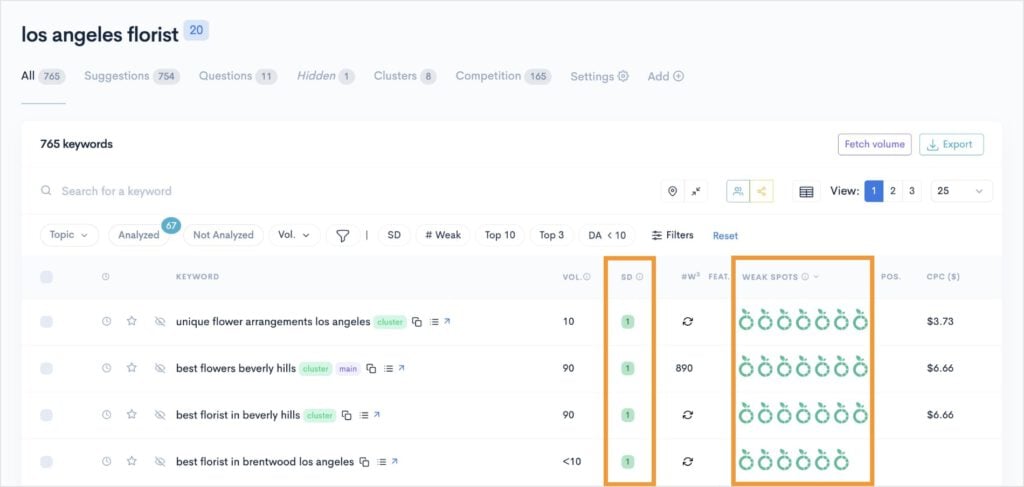
By looking at both the SERP Difficulty (SD) score and Weak Spots, you get a better idea of what a keyword’s actual ranking potential is.
Pillar 3: Business Value
The ultimate goal of SEO is grow your business, not just rank. Therefore, a good keyword must have a clear business value.
This means it has the potential to bring you closer to a goal, whether that’s building brand awareness or generating conversions. A keyword is worthless if it doesn’t help you get closer to your business and SEO goals.
How to Find Good SEO Keywords in 5 Steps
Ready to put it all together? Here’s a clear, actionable blueprint for how to pick good keywords for SEO.
Step 1: Start With a Seed Keyword
Every good keyword strategy starts with a single, broad term related to your business. This is your seed keyword.
It’s not the keyword you’re trying to rank for, but rather the starting point that helps you find all the keywords you’ll actually target. Think of it as the parent of all your keyword ideas.
In LowFruits, you can enter your seed keyword in the KWFinder tool.
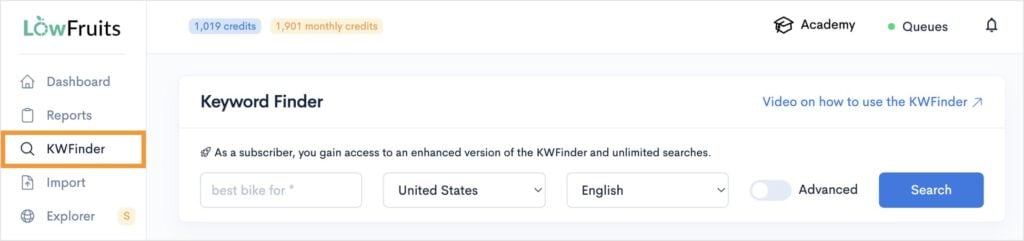
Note: If you have customers outside of the United States, or are targeting a language other than English, just change those settings before clicking “Search.” LowFruits will return keyword metrics based on your selections.
Step 2: Uncover Long-Tail Keywords With High-Intent
Once you have your seed keywords, you’re ready to find the real gems: long-tail keywords.
Long-tail keywords are phrases of 3 or more words that have lower search volume but higher conversion rates. They’re a goldmine for new websites and small businesses because they’re less competitive.

The other good thing about long-tail keywords is that they have clear search intent. Unlike our earlier example of the query “jaguar,” which had a vague intent, users type long-tail keywords when they have a very specific goal in mind.
This makes it easier for you to:
- Decipher the search intent
- Create content that aligns with the user’s goals
- Rank high in search results for that specific query
So, how do you find them?
With a long-tail keyword research tool, of course. (Yep, they exist, and they’re one of the best kept secrets of SEO professionals.)
And naturally, LowFruits is one. So, after performing your seed keyword search from step 1, you would get a keyword report that looks like this:
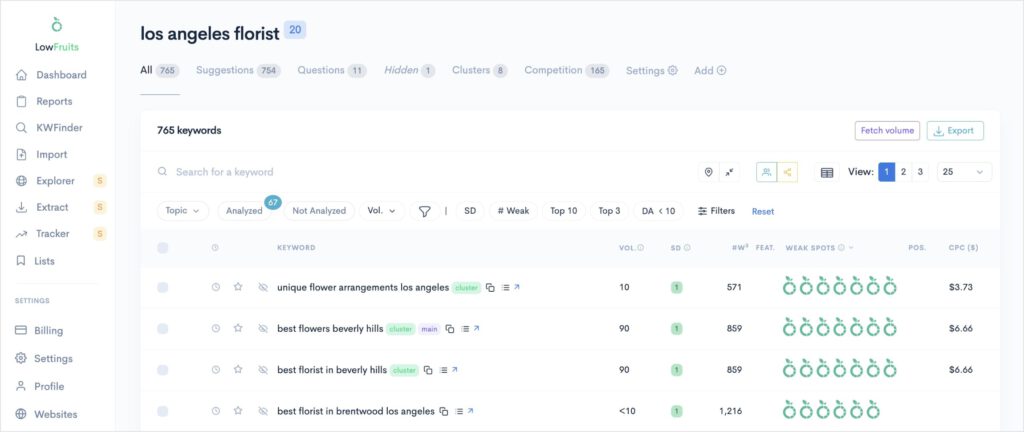
Take a look at the keyword column. Do you see how each result is over 4 words?
That’s because LowFruits extracts data from Google’s Autocomplete feature to generate long-tail results. I remember when I started my SEO journey, I used to have this pull this data manually from Google Autocomplete. It was tedious and time-consuming because you can only perform 1 search at a time.
With LowFruits, you get hundreds—even thousands—of keywords and their metrics all at once.
Step 3: Analyze the SERP for Weak Spots
Remember how I said the key to finding good keywords for SEO is to look beyond surface-level metrics?
This is the step where that happens.
If you want to find good SEO keywords and rank high for them, you have to do a SERP analysis.
A SERP analysis is when you analyze the existing search results to see what search engines are serving and what users want.
In the “old” days (aka, before modern SERP analysis tools were a thing), you had to do this process manually. This meant performing a Google search for every keyword you were interested in. Then, you had to study the search results one-by-one to figure out what type of content was ranking and why.
Today, this process is much easier and faster, thanks to tools like LowFruits.
Let’s go back to our keyword report from step 2. At this stage, I’d add a Weak Spots filter to refine my results.
To do this, just click on the # Weak button at the top of your report. Then, set the minimum number to 2. Click Apply.
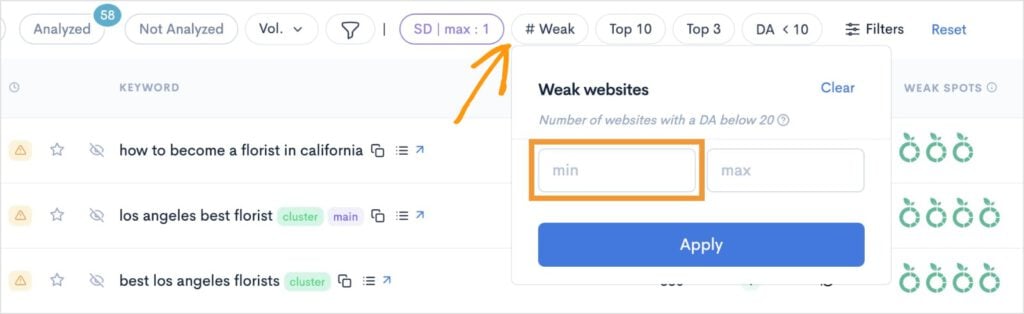
Once you’ve done this, your keyword report will only show results with 2 or more Weak Spots.
This is ideal for finding weak competitors in SERPs that you can outrank with the right content.
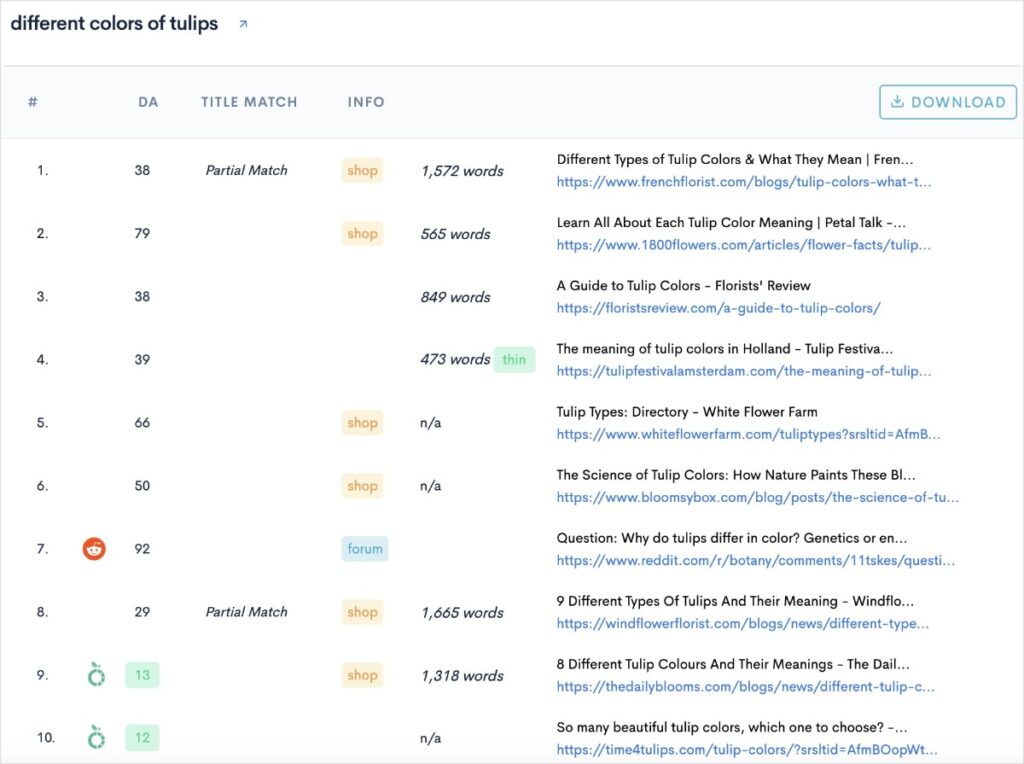
Pro Tip: Take this a step further and click “View the SERP” next to any of the keywords in your list. This action will open a report of the top 10 search results ranking right now. Study these results to inform your own content strategy and outrank the competition.
Step 4: Filter for Easy Opportunities
Now that you have your Weak Spots, it’s time to add one more filter. I like using this SD (SERP Difficulty) filter to make sure I’m only viewing low-competition keywords.
You can do this easily by clicking SD at the top of your report. Then, set the maximum to 1. (SD is on a scale of 1 to 3, with 1 being the easiest.) Click Apply.
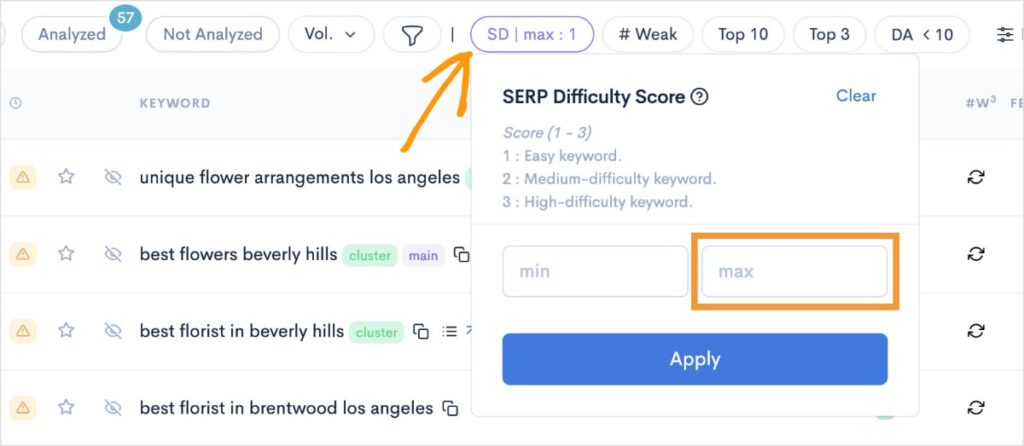
Now, your list will show keywords with:
- A low difficulty
- Multiple Weak Spots
These are your low-hanging fruit keywords.
That means they’re more than just “good SEO keywords,” but quite literally, the best type of keywords to target for fast rankings.
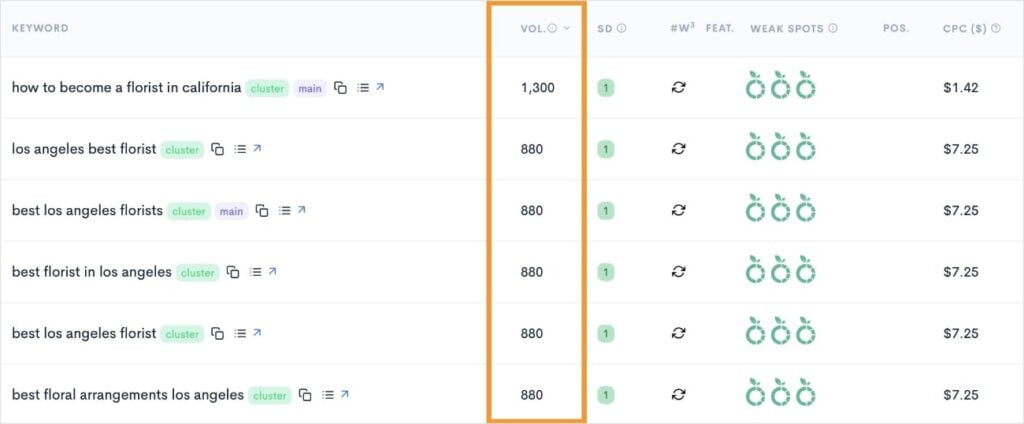
Pro Tip: Click on the “Vol.” column to sort your results in descending order of keyword search volume. This will put your biggest search volumes at the top, helping you prioritize which keywords to target first.
Step 5: Prioritize Keywords by Business Value
The final step is to turn your curated list of keywords into an actionable content plan. This is where you prioritize them based on business value, which estimates how specific keywords help you achieve your goals.
To do this, I suggest creating a simple spreadsheet or a content calendar with 3 columns: “Keyword,” “Search Intent,” and “Business Value.” For each keyword, ask yourself the following questions:
- High Intent: Does this keyword signal a user who is close to making a purchase (e.g., “buy,” “price,” or “coupon”)?
- Revenue Potential: Will a conversion from this keyword generate significant revenue for my business?
- Topical Relevance: Does this keyword fit into a topic I can build a comprehensive content strategy around?
By answering these questions, you can rank your keyword list from most valuable to least, so you can start with the keywords that will have the biggest impact on your bottom line.
Why a “Good” Keyword Is About Quality, Not Just Quantity
I hope this guide helped you redefine what a good SEO keyword truly is. It’s not about a single metric or a high search volume. In the end, it’s about a combination of:
- Search intent
- Realistic difficulty
- What it can do for your business
This is the philosophy behind our entire platform. We built LowFruits not just to show you thousands of keywords, but to help you find the right ones—the ones that will actually help your business grow.
By focusing on these 3 core pillars and using a tool that finds the real opportunities, you can build a content strategy that’s genuinely effective. Stop wasting your time on keywords you can’t rank for and start finding the ones that will change your business.
FAQs About Finding Good SEO Keywords
What are good SEO keywords?
Good SEO keywords combine 3 things: (1) they match a user’s search intent, (2) they are realistically possible for your website to rank for, and (3) they align with your business goals. There’s no generic “good” SEO keyword, but following this criteria will help you target the right kind of visitors and support your business’s growth.
How do I pick good keywords for SEO?
You can pick good keywords for SEO by using keyword research tools. Start with a broad seed keyword, then look for long-tail keywords with high-intent. Analyze the SERPs for “Weak Spots,” which are low-authority websites that are ranking on the first page. Prioritize keywords that have these weak competitors, decent search volume, and align with your business goals.
What are some examples of good SEO keywords?
A good keyword is a long-tail keyword that addresses a specific need. For example, instead of “dog food,” a good keyword would be “best organic dog food for picky eaters.” The latter has higher intent and is more likely to be a “Weak Spot” opportunity, as it’s a specific question that can be answered thoroughly.
Why shouldn’t I just use a high-volume keyword?
High-volume keywords are extremely competitive. If you have a new or low-authority website, you’re unlikely to rank for them, which can lead to wasted time and effort. It’s much more effective to target lower-volume, long-tail keywords that you have a realistic chance of ranking for. These keywords have higher intent and are more likely to convert into customers once you rank.