Choosing the right keyword research tool can feel like a major decision.
For years, I’ve relied on various platforms, and in my experience, two names often come up in the same conversation: LowFruits vs. Mangools. Both are strong contenders, but they tackle keyword research from very different angles.
Mangools is a well-known, all-in-one SEO suite with a clean interface, while LowFruits is a highly specialized tool for finding easy-to-rank keywords.
So, which one is the right fit for your workflow?
In this guide, I’ll provide a head-to-head comparison based on my personal experience using both platforms. We’ll break down their strengths, weaknesses, and core features to help you decide which tool will be the most effective for your SEO strategy.
In This Article
At a Glance: LowFruits vs. Mangools
Before we dive into the details, here’s a quick overview of what each tool is best known for.
Mangools KWFinder
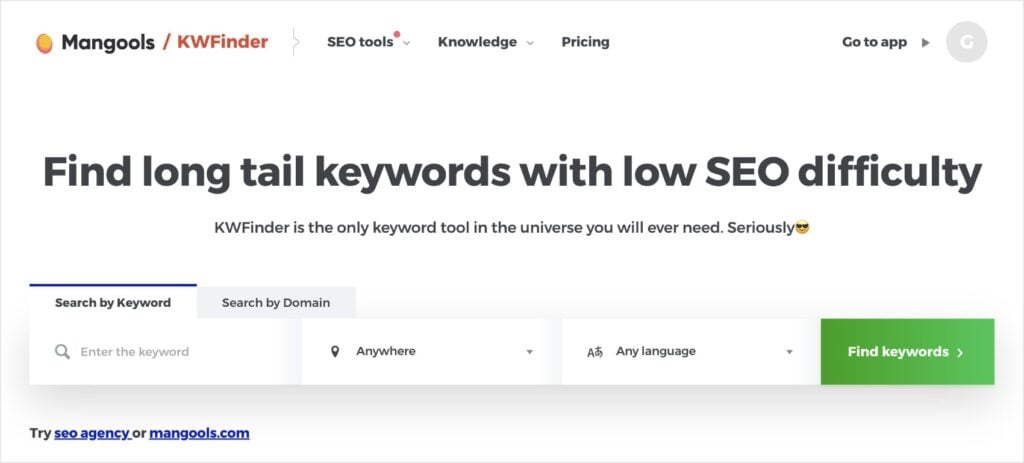
Part of a broader SEO suite, Mangools KWFinder is a comprehensive and user-friendly tool for keyword research.
It’s known for its huge keyword database, extensive filters, and a clear, easy-to-read interface that’s great for getting a full picture of a niche.
It’s an all-in-one solution for those who need more than just keywords.
LowFruits KWFinder
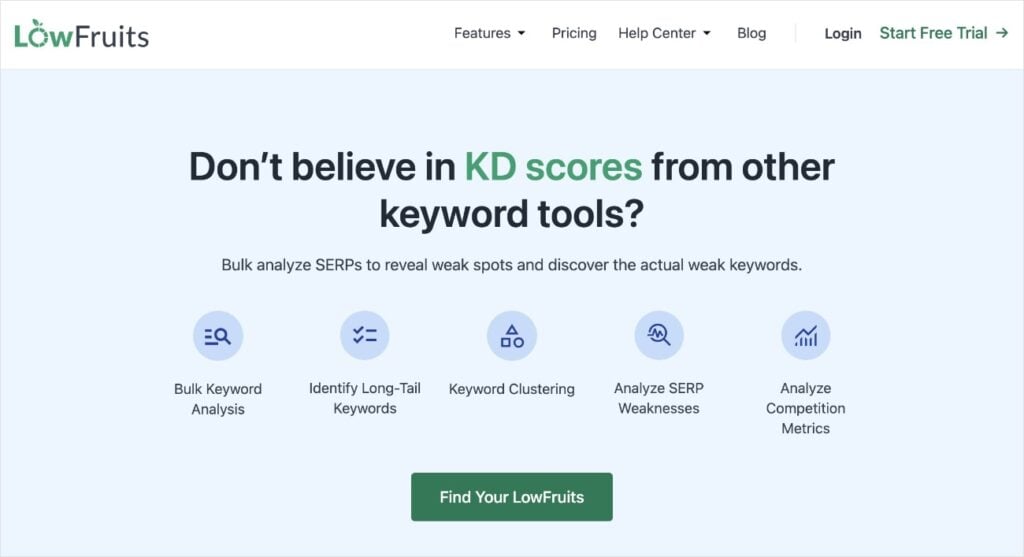
LowFruits is one of the best long-tail keyword research tools for finding queries you can actually rank for. These “low-hanging fruit” are often overlooked by competitors, making them ideal for new websites or small business owners.
LowFruits is designed for speed and efficiency, automatically identifying weaknesses in the search engine results pages (SERPs).
I consider it to be one of the most beginner-friendly tools for quickly finding easy keywords and analyzing SERPs.
Head-to-Head Comparison: LowFruits vs. Mangools KWFinder
Here’s my breakdown of how these two keyword research tools stack up against each other on the most important features.
Keyword Discovery
First up, we’ll compare how each tool addresses keyword research.
LowFruits
I use LowFruits when I’m specifically on the hunt for low-competition, long-tail keywords.
Its most powerful feature is its ability to automatically identify “Weak Spots” in search results. A “Weak Spot” is a low-authority page that ranks in the top 10—think forums, Q&A sites like Quora, or blogs with low domain authority.
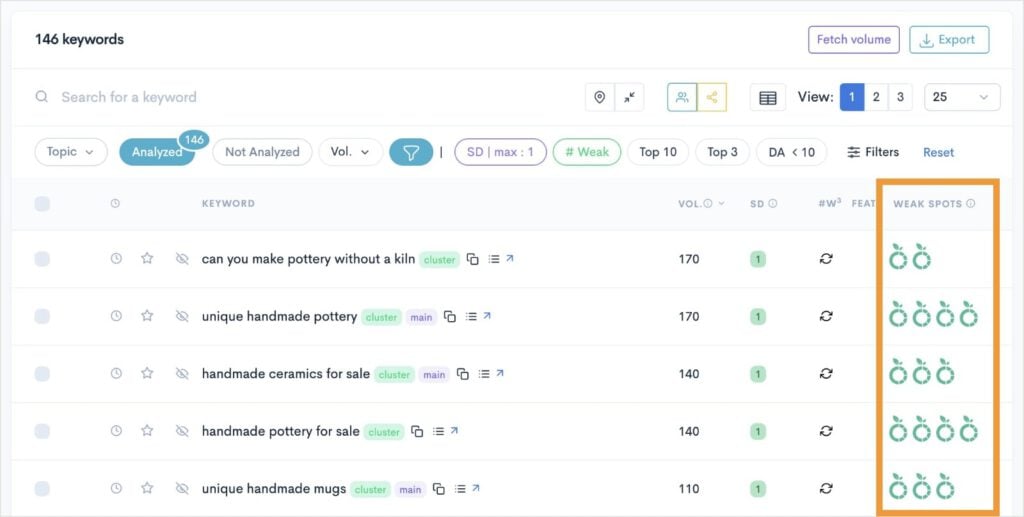
When I see these, I know the competition is soft, and I have a great chance to rank. This is a massive time-saver compared to manually checking SERPs.
The SERP Difficulty Score (SD) is another helpful metric that represent keyword difficulty. It’s on a simple 1–3 scale, with 1 being the easiest to rank for, and 3 being the hardest.
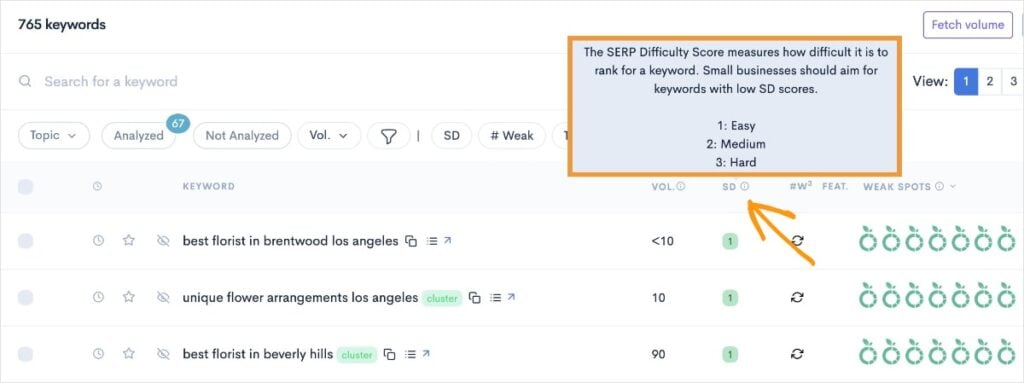
Pro Tip: Use filters to refine your list. I set the SD filter to 1 and a minimum Weak Spots count to 2. Then, you can sort by search volume to prioritize which keywords to target first.
Mangools
Mangools has a massive database of keywords and is excellent for getting a broad overview of a topic. Its keyword difficulty (KD) score is a classic metric that gives you a general idea of how hard it is to rank for a specific keyword.
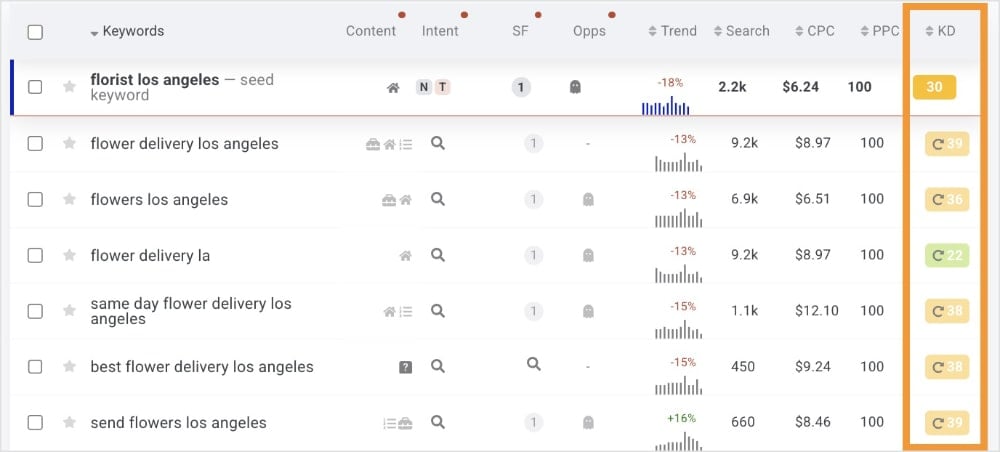
I often use Mangools Keyword Finder when I need to quickly brainstorm a large list of ideas and see their general volume and difficulty.
Now, even though getting this data is straightforward, beginners might be slightly put off by the initial view. There’s a lot of information.
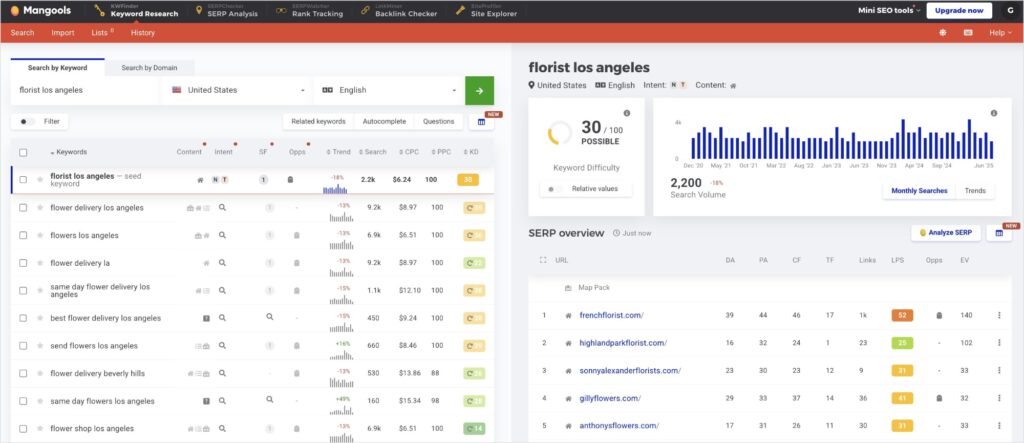
This is why it’s great for digging into a keyword and topic, but less impressive for narrowing in on long-tail, easy keywords.
It also doesn’t have the “Weak Spot” analysis that makes LowFruits so efficient at unearthing hidden ranking gems.
Verdict
For this round, LowFruits is the clear winner if your primary goal is to find low-competition keywords. Mangools is better for broad, high-volume keyword discovery and analysis.
SERP Analysis
Now, let’s explore how each tool runs a SERP analysis.
LowFruits
The SERP analysis function in LowFruits is highly automated and integrated directly into its keyword reports.
To use it, access any of your reports in the KWFinder. Then, you can either perform an analysis one-by-one or in bulk. Personally, I do a bulk selection because it’s faster.
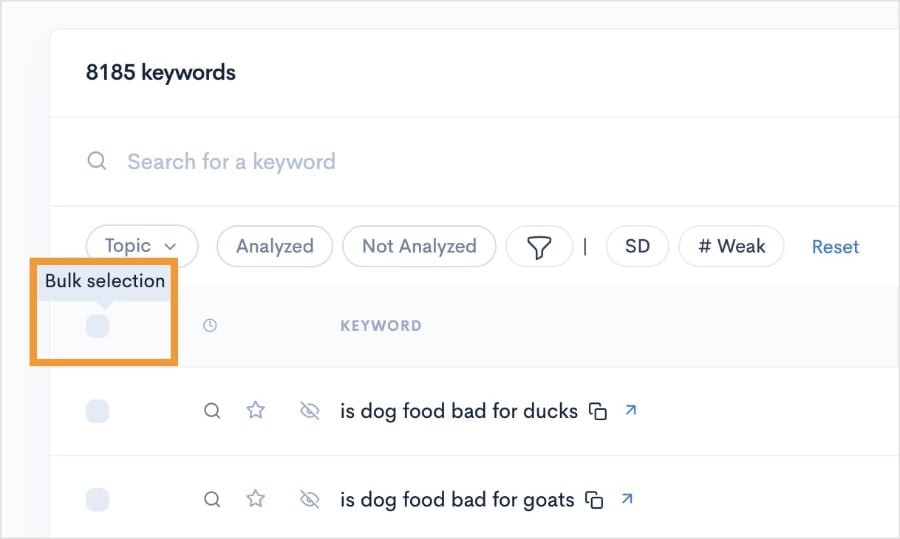
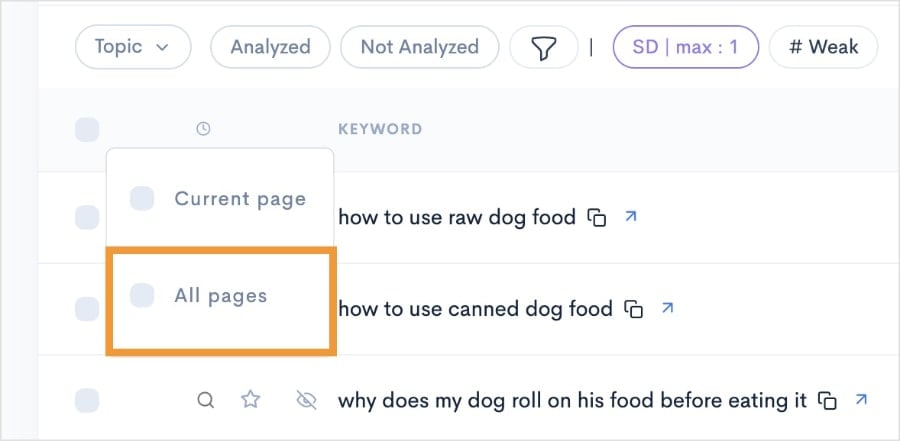
After checking the box, LowFruits will ask you to select the current page or all pages. For this step, you can do whichever you prefer.
Note: LowFruits uses a credit system for SERP analysis. 1 keyword analyzed = 1 credit. Because of this, you can make your selection based on preference or credit availability.
Once you’ve made your selection, a new menu bar will appear at the bottom of your report. You’re going to click SERP Extract.
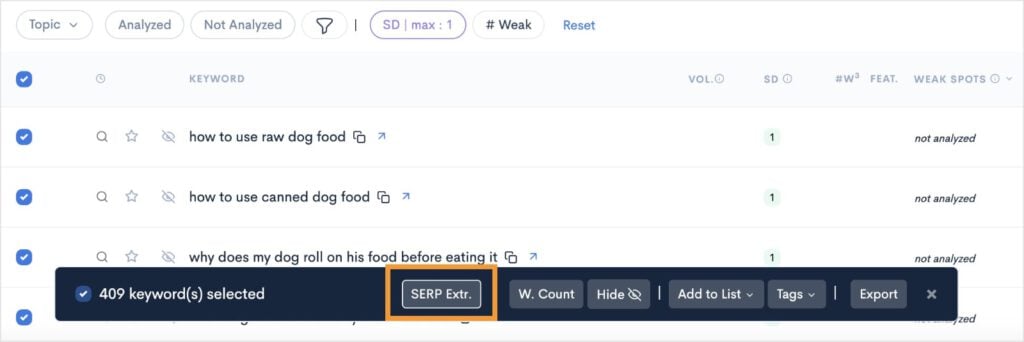
This is when you’ll get the Weak Spots data we discussed earlier.

Pretty easy, right?
You now have a deep understanding of competitors in SERPs and which keywords have the weakest ranking domains.
P.S. If you’re wanting to do a more traditional SERP analysis, you can also click the View the SERP button next to any keyword.
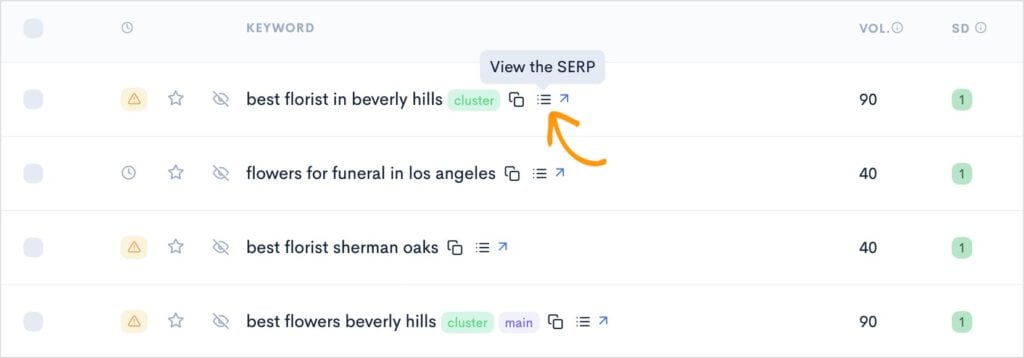
This will open a new window that shows the top 10 search results currently ranking in Google. You could analyze them manually from this data, but it would take more time than looking for Weak Spots icons.
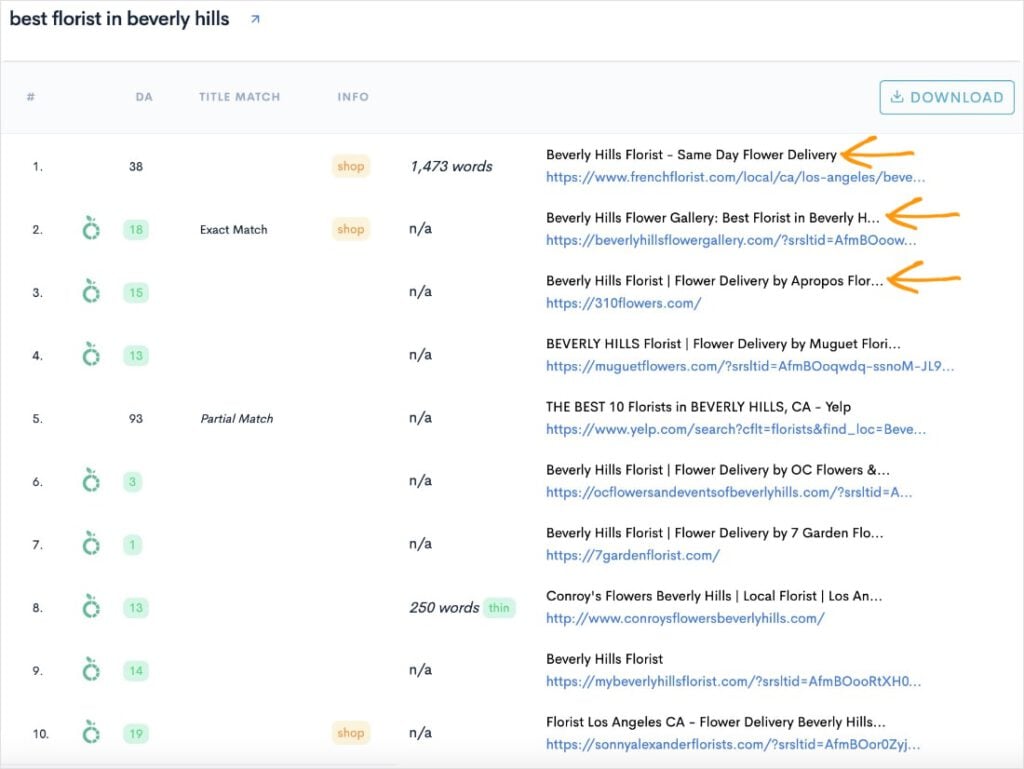
Nonetheless, it’s good to know this data is there.
Mangools
Mangools has a separate tool called SERPChecker for this purpose.
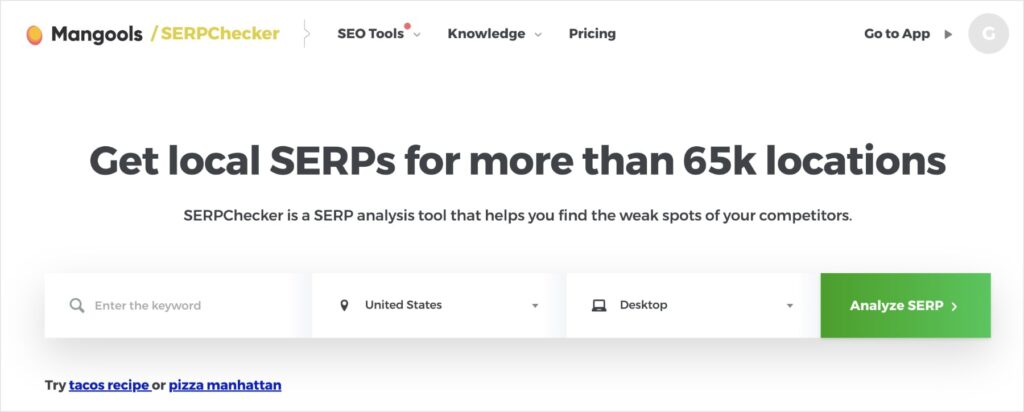
This means if you’ve already done keyword research in the KWFinder, you’ll need to reenter your seed keywords into this tool. This makes it less efficient than LowFruits, especially when you’re looking to analyze multiple keywords.
Once you’ve performed a search, you’ll get a report that looks like this:
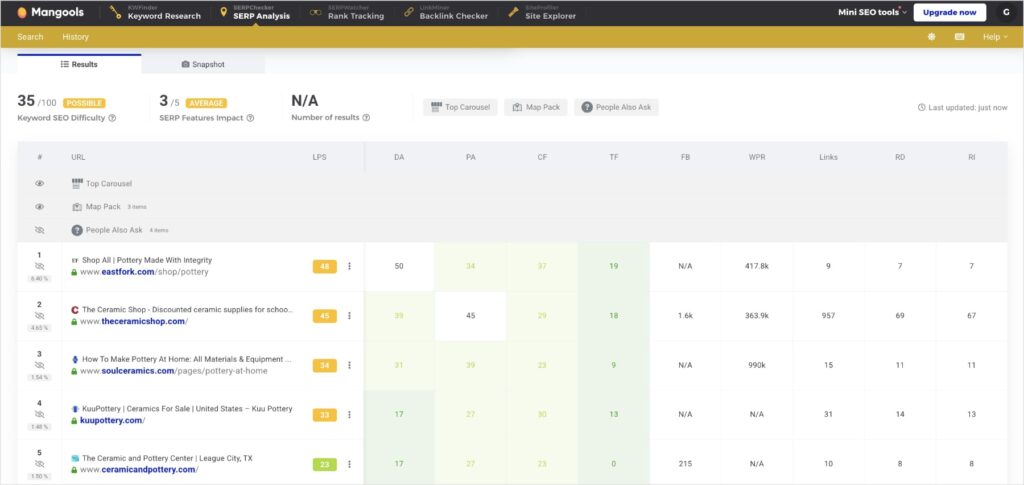
Mangools uses different metrics to communicate the authority of a ranking domain. You’ll see data on:
- Link Profile Strength (LPS)
- Domain Authority (DA)
- Page Authority (PA)
- Citation Flow (CF)
- Trust Flow (TF)
- And more
Since there are so many data points, it can be intimidating to beginners. And to be totally honest, I rarely pay attention to most metrics, like website popularity rank (WPR) and Facebook shares.
I typically just focus on the two authority metrics and some backlinking insights.
Overall, it’s a robust approach to SERP analysis. But it’s probably more than the average user needs.
Verdict
LowFruits is faster for analyzing a large volume of keywords at once. Mangools SERPChecker is better for a deep, single-keyword dive when you’re ready to start optimizing a specific page.
User Interface (UI) & Experience
You’ve already gotten a look into the UI of both LowFruits and Mangools, but let’s recap them here.
LowFruits
LowFruits is all about function over form. Its interface is clean, minimalist, and designed to get you to the insights you need as fast as possible.
There’s almost no learning curve. You enter a keyword, and the results are easy to understand. I love the speed and simplicity when I’m in a hurry.
Beginners will also appreciate how easy it is to get started using it.
Mangools
Mangools also has a clean interface, but it’s busier. There’s significantly more data to sift through, making it slightly more intimidating for new users.
The UX is also not as seamless as LowFruits. If you start your keyword research in the Mangools KWFinder and want to do a SERP analysis, you’ll have to go into another tool (SERPChecker).
This means you duplicate some of the work because you have to perform the same seed keyword searches twice.
LowFruits puts both processes in the same view, meaning you don’t have to navigate between tools.
Verdict
LowFruits wins for simplicity and speed. It’s extremely easy for new users to get set up quickly and start using features. Mangools is better suited for advanced users who are familiar with navigating more complex dashboards and broad data sets.
Pricing
We’ve reached the pricing differences in the LowFruits vs. Mangools debate.
Let’s see how accessible each tool is to budget-minded website owners and marketers.
LowFruits
LowFruits offers a flexible dual-pricing model. You can either use pay-as-you-go (PAYG) credits or opt for a subscription plan.
The PAYG model is fantastic for freelancers or project-based work, as you only buy credits when you need them. For example, you can get 2,000 credits for $25. This “pay for what you use” approach makes it a highly cost-effective Mangools alternative.

You can also buy subscription plans. These plans offer a set of number of monthly credits.
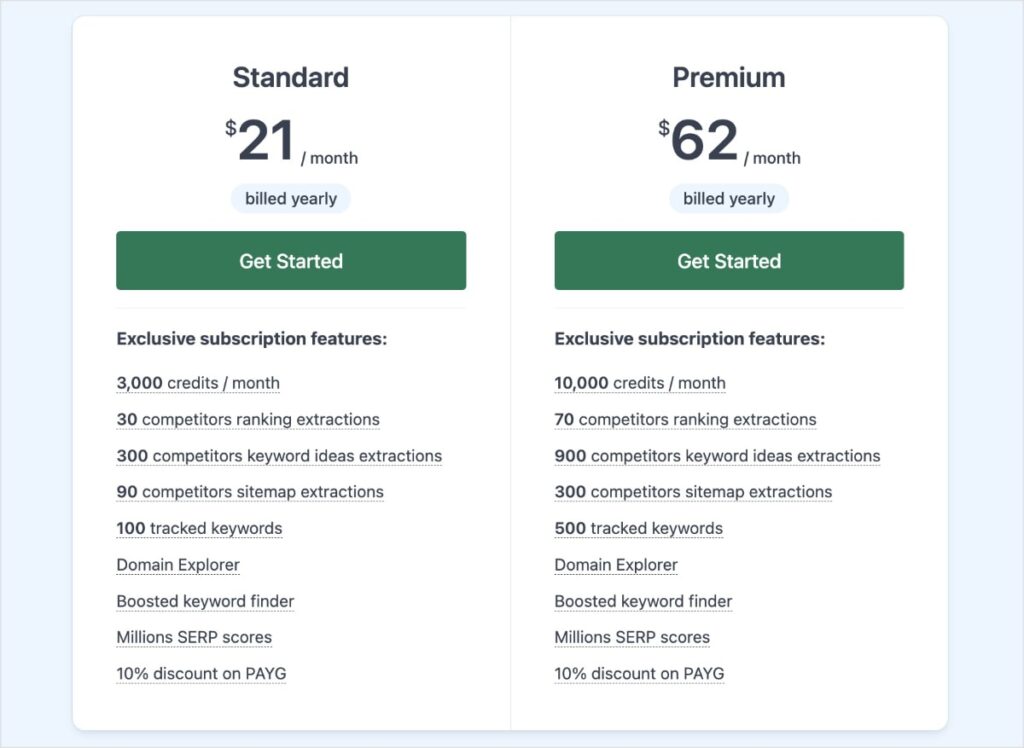
In addition to credits, subscription plans unlock exclusive features. Here are some of the most popular:
- Domain Explorer: Explore our database of over 100K low-authority websites. Identify weak competitors in your niche that you can easily outrank.
- Keyword Extractor: Uncover competitors’ keywords, ranking positions, and content gaps to improve your own SEO strategy.
- Sitemap Extractor: Extract competitors’ sitemaps to reveal their content strategies and find keyword opportunities for your website.
- Rank Tracker: Track your most important keywords in Google and their position changes over time with easy visuals and reliable data.
Finally, LowFruits offers a generous 14-day money back guarantee. This is more than enough time to figure out if you like the tool, providing peace of mind.
Need help deciding which model is best for you? Check out our LowFruits Pricing and Plan Guide.
Mangools
Mangools has a free version of both the KWFinder and SERPChecker. It also offers traditional subscription models where you pay a monthly or annual fee for access to the entire suite of tools.
This provides a good value if you plan to use all of these tools regularly, but can be slightly unnecessary if your main goal is just keyword research.
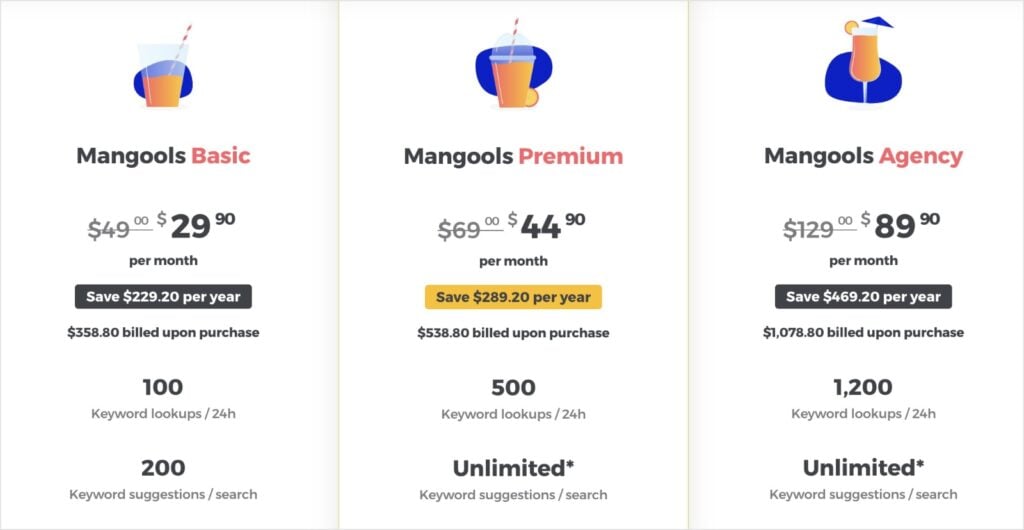
As for money back guarantees, Mangools is significantly shorter than LowFruits. Mangools offers a 48-hour window to get your money back versus LowFruits’ 14-day guarantee.
Verdict
LowFruits’ flexible pricing makes it an accessible and cost-effective choice for a wide range of users. It also offers two pricing models (PAYG credits and subscriptions), allowing users to select the plan most aligned with their needs. The Mangools KWFinder and SERPChecker are both free to use, making them a good starting point too.
Final Verdict: Which Tool Is Right for You?
After spending significant time with both platforms, here’s my final take on which tool you should choose.
Choose LowFruits if…
- Your primary goal is to find easy-to-rank, long-tail keywords.
- You want a fast, focused tool that gets straight to the point.
- You’re a beginner or a small business owner who wants a high return on investment for your content without battling massive competitors.
- You are looking for a powerful Mangools alternative that specializes in finding “low-hanging fruit.”
Choose Mangools if…
- You also want to also do backlink analysis, in addition to keyword research.
- You’re an agency or an SEO professional who needs a comprehensive suite for a wider range of ongoing SEO tasks.
- You’re an advanced user who wants access to more comprehensive data and metrics.
Ultimately, the best tool for you will always be the one that fits your workflow and helps you achieve your SEO goals.
For anyone who’s ever felt overwhelmed by competitive keywords, the focused power of LowFruits can be a breath of fresh air.
FAQs About LowFruits vs. Mangools
Mangools KWFinder is used for general keyword research, helping users find keywords with high search volume and good potential. It’s part of the Mangools SEO suite, which also includes tools for backlink analysis, SERP analysis, and rank tracking.
LowFruits is an excellent alternative to Mangools, particularly if your primary goal is to find low-competition, long-tail keywords. It is highly specialized in identifying “Weak Spots” in search results, making it more efficient for finding keywords with a higher chance of ranking.
Mangools uses a general keyword difficulty (KD) score based on a variety of factors. The LowFruits equivalent to this metric is the SERP Difficulty Score (SD). LowFruits also identifies the number of “Weak Spots” (low-authority domains) in the top 10 search results, which can be more useful for finding easy ranking opportunities.
The main difference is specialization versus breadth.
LowFruits is a focused keyword finder that excels at finding “low-hanging fruit” opportunities by analyzing SERP weaknesses. It also has a Domain Explorer for finding competitor keywords, a Rank Tracker for monitoring keyword positions, and additional SEO features.
Mangools is an all-in-one SEO suite that provides an even wider range of tools, particularly for backlinking analysis and site audits.